
Minutes from the Federal Reserve’s September meeting struck a hawkish tone, showing that all 19 senior officials supported a 25-basis-point increase in the federal funds target range to 3.75% to 4.00%. It was the Fed’s first rate hike since July 2023. The minutes also said most participants believed another increase before the end of the year “may be appropriate,” while stressing that policymakers would remain “open-minded” at each meeting.
After the minutes were released, Goldman Sachs said a December hike now appears more likely. At the same time, the bank said there is also a substantial chance that the Federal Open Market Committee, or FOMC, will ultimately decide that no further tightening is necessary.
Markets have pushed rate-hike expectations from October to December
The minutes, released Wednesday and covering the Sept. 15-16 FOMC meeting, said most participants still saw another increase in the target range before year-end as potentially appropriate. Even so, officials said future policy decisions would depend on incoming information.
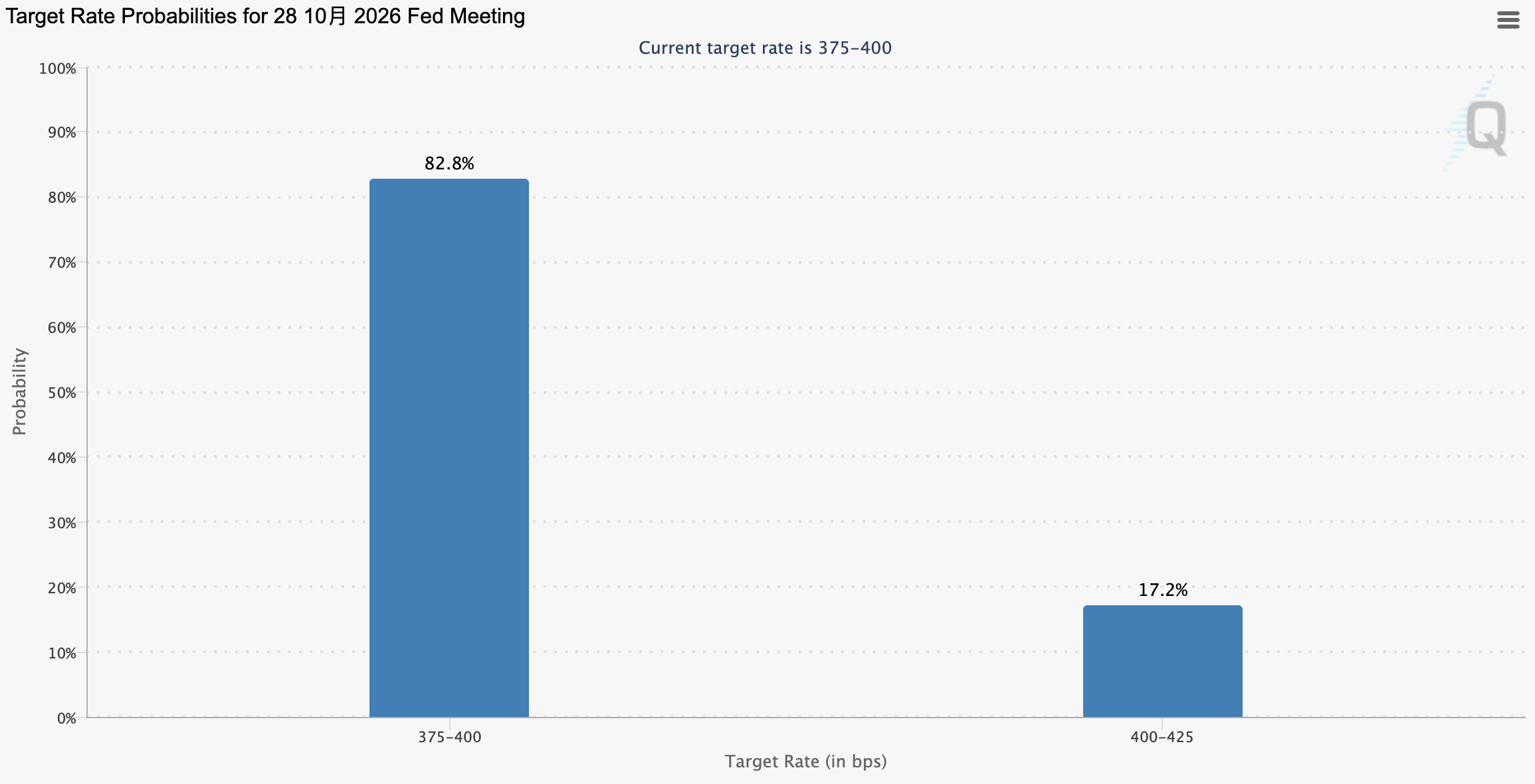
That stance landed as markets were already dialing back expectations for an October move. Weaker-than-expected September employment data, along with recent remarks from New York Fed President John Williams and Fed Vice Chair Philip Jefferson that signaled there was no need to rush, led investors to cut October hike bets sharply. According to CME FedWatch, the market is now pricing the probability of a 25-basis-point increase at the Oct. 27-28 meeting at below 20%, down from roughly 70% in the days after the September decision. The two-year Treasury yield has fallen by more than 12 basis points over the past week and is now near 4.78%.
Officials agreed on the hike, but not on the reasoning
While all 19 officials backed the September increase, the minutes showed clear differences in how they justified the move.
“Many participants” described the hike as a risk-management step meant to provide insurance against inflation staying above the 2% target, especially if demand proved stronger than expected or supply conditions were hit again. Others argued that a higher policy rate was necessary in its own right to keep recent shocks, including energy prices, from spreading into a broader range of goods and services. A smaller group said the increase was consistent with their view that the neutral rate had moved higher.
The minutes also said “several participants” believed the policy rate before the September increase was “not restrictive or only mildly restrictive.” That leaves room for a more mixed internal view than the unanimous vote alone would suggest. Support for the hike did not amount to a single shared judgment that the Fed had entered a new phase requiring sustained large-scale tightening.
Most still see one more hike this year, but October is not presented as urgent
On the policy path ahead, the minutes leaned hawkish without showing that an October increase had been locked in.
The key line was that “most participants judged that a further increase in the target range for the federal funds rate before the end of the year may be appropriate.” At the September meeting, that meant most officials still expected at least one more hike in 2026. But they also said each decision would be made meeting by meeting, based on new data.
Nick Timiraos, the journalist often referred to as the “Fed whisperer,” also highlighted that wording. Recent public comments from Jefferson and Williams quickly pushed markets to scale back October hike bets. Investors now appear more inclined to expect the Fed to pause in October and consider a second hike of the year in December instead. The U.S. consumer price index, or CPI, due on Oct. 14, may become an important variable for that view.
Goldman Sachs sees December as more likely, but not guaranteed
Goldman Sachs said after the minutes release that it expects the Fed to deliver a second rate increase of the year in December. That call reflects its reading of the August core PCE data, which already incorporates methodology adjustments from the Bureau of Economic Analysis, as well as recent public remarks from Jefferson and Williams.
The Wallstreetcn article said Jefferson had argued that future policy adjustments require careful study of data trends and that reaching a judgment may take more time. Williams delivered a similar message, and Vice Chair for Supervision Bowman echoed that tone. According to the article, those comments from three permanent voters pushed the implied probability of an October hike down from 70% to 25%, shifting market focus toward December.
Still, Goldman Sachs also pointed to another possible outcome: the FOMC may ultimately conclude that no further tightening is needed. The bank said that although the minutes showed “most” participants thought another hike by year-end “may be appropriate,” the committee would approach each upcoming meeting with an “open-minded” stance, leaving the final decision heavily dependent on the economic data available at that time.
Its report said inflation and employment data released before the December meeting will be critical. Those figures will shape not only whether the Fed hikes in December, but also whether this tightening cycle ends there.
Inflation risks still tilt upward, with energy and AI investment in focus
Although the Fed believes inflation is gradually cooling, officials still lack confidence in the speed of that decline. The minutes said almost all participants saw inflation risks as tilted to the upside, and some believed that upward tilt had strengthened in recent months.
Officials cited rising energy prices, geopolitical risks and tariffs as factors that could keep inflation elevated for longer than expected.
AI investment also emerged as a notable source of inflation risk in the discussion. Some officials said AI is driving investment and improving the outlook for productivity, but it may also lift inflation through stronger demand, higher input costs and greater financing needs. The minutes said AI buildout is pushing up business investment and that its scale and pace continue to “exceed expectations.” Some participants also said core goods prices are still rising at a relatively high pace, and that demand and cost pressures tied to AI construction could offset some of the inflation relief coming from a weaker tariff effect.
Economic activity remains resilient and financial conditions still support growth
The resilience of the economy formed an important backdrop to the Fed’s September decision. The minutes said several officials saw stronger underlying momentum in the U.S. economy, with consumer spending holding up, business investment supported by AI infrastructure construction, and overall activity expanding at a fairly solid pace. The labor market was described as close to full employment.
Financial conditions were also not seen as restrictive enough to materially slow growth. Even though longer-dated Treasury yields have risen noticeably in recent months, many officials said overall financial conditions still support economic expansion, pointing to a sharp rise in stock prices this year and relatively narrow corporate credit spreads.
The minutes said yields on Treasuries from two years to 10 years rose by about 35 basis points over the relevant period, and officials viewed changes in real rates as one of the main reasons behind the increase in longer-term yields. Market participants also pointed to geopolitical developments, uncertainty around the U.S. Treasury’s buyback plan, and heavy private debt issuance used to finance AI infrastructure as factors lifting term premiums and Treasury yields.
July yen intervention used Treasury funds, not Fed money
The minutes also said the U.S. action taken with Japan at the end of July to support the yen was carried out by the Treasury Department and did not use the Federal Reserve’s own funds.
According to the minutes, the New York Fed conducted the intervention “solely as fiscal agent for the U.S. Treasury.” The operation used Treasury funds, while the Fed’s System Open Market Account, or SOMA, portfolio was not involved.
The minutes did not disclose the exact timing or size of the intervention. U.S. Treasury Secretary Bessent said last month that the United States used only a “negligible” amount of money in the operation and said the move was in the U.S. interest.
The late-July action marked the first joint intervention by Tokyo and Washington in nearly 30 years to support the yen. Data from Japan’s Ministry of Finance showed that in the month through Aug. 26, Japan spent a record 15.4 trillion yen, or about $97.5 billion, on currency intervention. Japanese Finance Minister Katayama Satsuki and Bessent have both signaled that the two countries would be willing to intervene again if needed.