
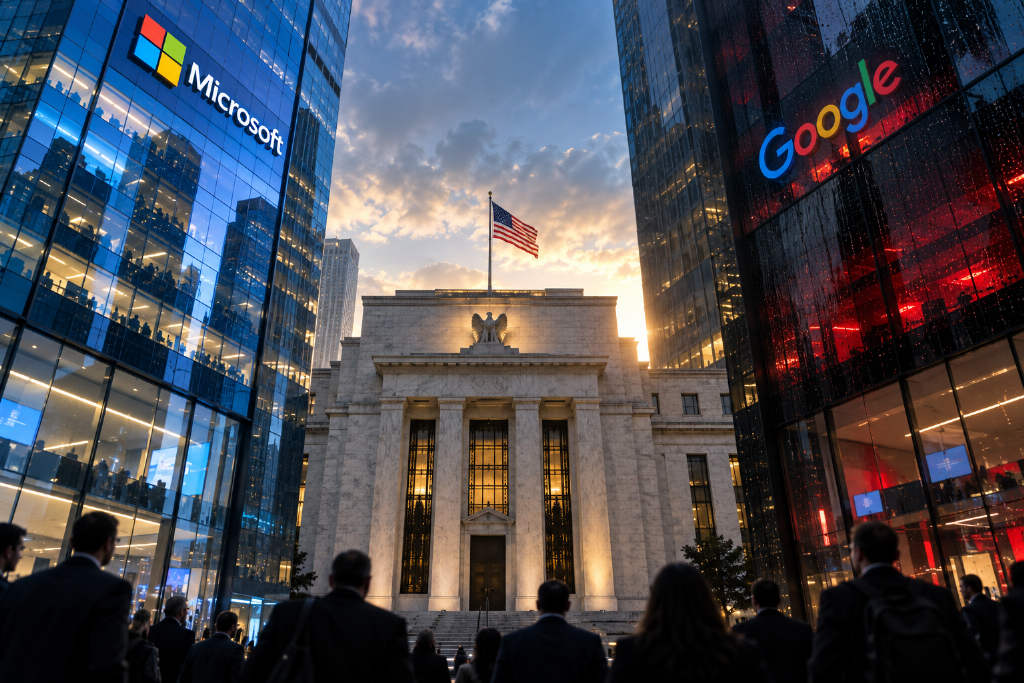
The Federal Reserve held rates steady, two policymakers backed a hike, and U.S. stocks still managed a third straight day of gains on Wednesday. After the close, earnings drove a sharp split in trading: Microsoft moved higher on faster Azure growth and lower-than-expected cash capital spending, while Alphabet fell after missing expectations on revenue, earnings per share, and cash flow.

Indexes edge higher for a third session
The S&P 500 rose 0.28% to 7,743.98, the Nasdaq gained 0.27% to 26,549.85, and the Dow added 0.19% to 52,475.10. The VIX fell 3.48% to 16.91.
Among the S&P sector ETFs, technology, financials, energy, industrials, health care, and materials advanced, while consumer discretionary, consumer staples, communication services, real estate, and utilities declined. Technology rose 0.80%, while utilities fell 0.84%.
Within the so-called Magnificent Seven during regular trading, Alphabet A gained 1.34% and Amazon rose 0.59%. Microsoft slipped 0.06%, Tesla fell 0.80%, Apple lost 0.94%, Nvidia dropped 1.17%, and Meta declined 1.24%.
The Philadelphia Semiconductor Index climbed 1.75% to 11,684.00. Micron rose 5.86%, Arm gained 4.10%, Marvell added 3.32%, AMD rose 3.24%, and Broadcom advanced 2.77%.
Memory names stood out again. SK Hynix’s U.S.-listed shares jumped 13.30%, Sandisk rose 7.66%, Silicon Motion gained 7.56%, and Seagate added 4.51%. Optical communications company Lumentum rose 5.52%, while Corning gained 3.88%.
Oracle rose more than 10% after issuing a new cash flow outlook. CoreWeave gained 7.32% and Nebius added 6.96%. Oracle said free cash flow should turn positive in the second half of fiscal 2028 and reach at least $30 billion in fiscal 2029, easing investor concern over expansion spending.
The Nasdaq Golden Dragon China Index fell 1.83% to 5,400.39. Baidu rose 1.57% and Alibaba gained 0.72%, while Trip.com fell 2.58%, NetEase lost 1.44%, and PDD dropped 1.19%.
Late in New York trading, the 10-year Treasury yield was about 5.02% and the 2-year yield was about 4.70%. Spot gold traded near $4,067 an ounce. At the time of editing this report in the morning, Bitcoin was around $81,000 and Ether was around $2,353.
Fed leaves target range unchanged in 10-2 vote
The Fed kept the federal funds target range at 3.75% to 4.00% by a 10-2 vote. Governor Cook and Cleveland Fed President Hammack dissented in favor of a 25-basis-point increase.
In its statement, the central bank upgraded its description of economic activity from solid expansion to strong expansion. It also said inflation remained elevated and that more information was needed to judge the appropriate policy stance. At his press conference, Warsh declined to signal what the Fed would do in December and did not rule out another hike.
The meeting schedule will also change. The Federal Open Market Committee will still meet eight times a year, but in 2027 one meeting will be dedicated to monetary policy strategy and will not include a rate vote. In 2028, the number of strategy meetings will increase to two, reducing rate-setting meetings to six.
Microsoft beats on cloud momentum
Microsoft reported results for the first quarter of fiscal 2027 after the close on Wednesday. Revenue came in at $92.279 billion, up 19% from a year earlier, while operating income reached $45.915 billion, up 21%. Excluding the impact of its OpenAI investment, earnings per share were $4.89, up 18%.
Azure remained the key driver. Revenue from the cloud platform rose 48% year over year, faster than the prior quarter’s 43%. Microsoft Cloud revenue reached $63.9 billion, up 30%.
Cash capital expenditures were $39.367 billion for the quarter. That figure was double from a year earlier but still below market expectations. Operating cash flow reached $58.0 billion, and free cash flow after cash capital spending was $18.633 billion, down about 27% year over year.
On the earnings call, Microsoft said Azure revenue should grow 49% to 50% in constant currency in the next quarter. Faster cloud growth and lower-than-expected cash capital spending helped lift the stock more than 6% in after-hours trading at one point.
Alphabet’s cloud unit shines, but ads and cash flow miss
Alphabet posted third-quarter revenue of $127.577 billion, up 25% year over year, and earnings per share of $2.12. Both figures came in below market expectations, and the stock fell more than 10% after hours at one stage.
Google Cloud was the main bright spot. Revenue rose 103% from a year earlier to about $30.7 billion, with TPU system sales also contributing. But search and related revenue grew 12%, and YouTube advertising revenue rose about 9%, both below analyst expectations.
Investment losses also weighed on profit. Alphabet reported a net loss of about $8.7 billion on equity investments in the quarter, reducing earnings per share by about $0.55 and accounting for part of the earnings shortfall.
Cash flow pressure intensified. Operating cash flow was $42.290 billion in the quarter, capital expenditures were $51.355 billion, and free cash flow was negative $9.065 billion. That marked a second consecutive quarter of negative free cash flow.
Oil rebounds as traders await GDP and PCE data
WTI crude for December delivery rose 2.88% to settle at $102.78 a barrel on Wednesday. Brent crude for December delivery gained 1.26% to $115.32 a barrel.
The report said Houthi forces attacked Saudi refining facilities, adding to supply concerns. The U.S. and Iran are still trying to restore contact, but no new ceasefire arrangement has been reached. Oil prices ended a two-day losing streak.
Markets are now watching the U.S. advance estimate of third-quarter GDP and the September personal income and spending report, due at 20:30 Beijing time. The latter includes the PCE price index. Traders will be looking at consumer spending, business investment, and whether core inflation is easing.
After the U.S. stock market closes in the early hours of Oct. 30 Beijing time, Amazon and Intel are scheduled to report earnings. For Amazon, the focus is on AWS growth, capital spending, and free cash flow. For Intel, investors are watching the data center business, margins, and forward guidance.



