
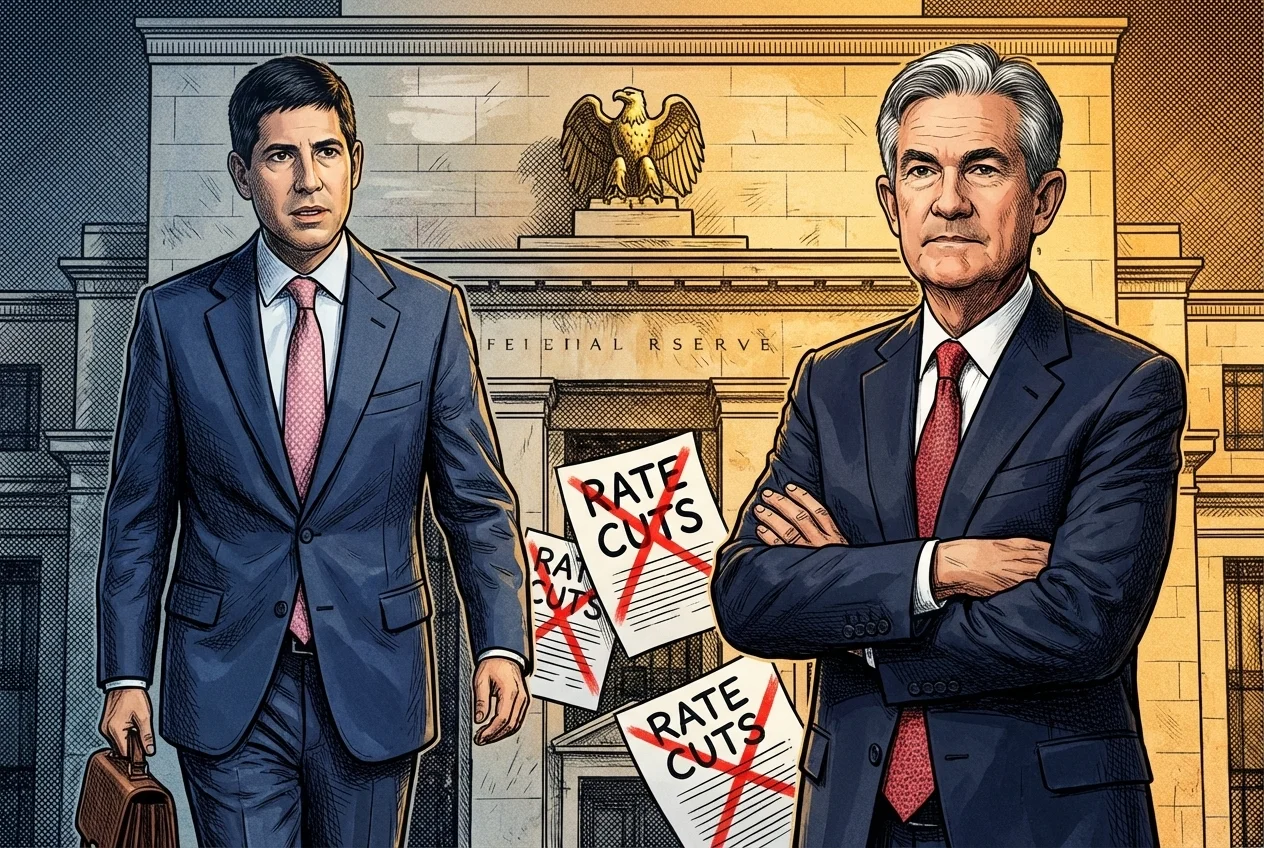
The Federal Reserve's leadership transition has entered its most awkward stalemate in decades. Incoming chair Kevin Warsh faces three simultaneous headwinds before even stepping into the building: the Iran war has pushed oil prices above $105 per barrel, inflation is reaccelerating, and his confirmation process is being blocked by a Republican senator. Meanwhile, current Chair Jerome Powell has made it clear he will not leave until the confirmation is complete and the Justice Department investigation into him is resolved.
A year ago, Warsh actively lobbied Trump for the nomination by publicly advocating for rate cuts and criticizing Powell as too conservative. Now, the Fed's preferred inflation gauge, the PCE, has been revised up to 2.7% — moving in the wrong direction. Markets now see a higher probability of a rate hike this year than a cut.
Powell Stays, FOMC Turns Hawkish
The confirmation logjam stems from Senator Thom Tillis (R-N.C.), who vows to block the vote until the Justice Department's criminal investigation into Powell concludes. The chief federal prosecutor has already signaled an appeal to overturn a subpoena, adding more uncertainty to the timeline. Powell himself told the press last week: if a successor isn't confirmed, he'll stay as chair; he won't leave the Board until the investigation ends with a 'transparent and conclusive' outcome. Trump responded by calling Powell 'incompetent' but has shown no interest in wrapping up the probe.
Within the FOMC, sentiment has shifted sharply hawkish. The November series of three consecutive rate cuts each faced growing internal dissent. In March, the committee voted 11-1 to hold rates steady, signaling that the majority now leans toward tightening rather than easing.
Irony of History: Warsh Once Favored Fighting Inflation
WSJ reporter Nick Timiraos unearthed a historical irony: In 2008, when Warsh was a Fed governor and oil surged to $140 per barrel amid galloping inflation, his stance was the opposite of what Trump expects today. Warsh reluctantly supported the last rate cut in April 2008 but then warned the FOMC against letting markets believe it had 'greater tolerance for inflation than is prudent.' By June, he explicitly argued that the next move would likely be a hike, because inflation pressures reflected 'forces deeper than a temporary oil shock.' The core dilemma today mirrors that moment: the Fed must judge whether inflation or a weakening labor market poses the bigger threat.
Optimistic Voices, but Skepticism Runs Deep
Not everyone is gloomy. BNP Paribas chief US economist James Egelhof told the WSJ that the labor market is near full employment, financial conditions are easy, and stability is solid — so the transition should be manageable. He added that Warsh is unlikely to immediately implement the drastic reforms he once touted, as stakeholders don't see the need. But former Boston Fed President Eric Rosengren warned that the core issue isn't just whether rate cuts happen, but whether motives are questioned: 'If rates are cut under these conditions, markets and the public will suspect political rather than economic motivations.' Tim Duy of SGH Macro Advisors said bluntly: 'The confirmation delay is actually a gift for Warsh. I don't envy anyone taking this job now.'
AI Productivity Argument Fails
Before Trump nominated Warsh, Warsh and Treasury Secretary Scott Bessent argued that an AI-driven productivity boom would allow the Fed to cut rates without reigniting inflation. But in recent weeks, multiple Fed officials have openly dismissed that view, essentially pushing back against the narrative. Warsh thus enters the job with part of his intellectual ammunition already neutralized — and the resistance comes from inside the Fed, not just from external markets.
Crypto Market Implications: Rate-Cut Hopes Fade
For crypto, the uncertainty around Warsh's rise directly impacts the rate-cut outlook. Markets have compressed the expected year-end cut to roughly one 25-basis-point move, a sharp drop from last year's projections. If the confirmation process drags on and oil stays high, the 'higher for longer' rate scenario will solidify — a headwind for bitcoin and other risk assets. Timiraos's closing observation carries weight: when Warsh finally walks into the Fed building, the job waiting for him will look very different from the one he applied for.