
Standard Chartered said in a Sept. 14 report that the Federal Reserve is likely to keep rates unchanged at the Sept. 15-16 Federal Open Market Committee meeting, arguing that a hike now would be the wrong policy choice.
The bank said the better course would be to wait until the effects of tariffs and recent data revisions fade, then reassess whether inflation is actually forming a sustained trend. The rate decision is due early Thursday in Beijing time.
Markets are leaning heavily toward a hike
That view runs against current market pricing. Fed funds futures are assigning an 88% probability to a 25-basis-point hike in September. Standard Chartered said that if the Fed stays on hold, rates markets could see a clear repricing and the U.S. dollar could weaken briefly. If the Fed does raise rates, hawkish expectations may strengthen even more.
In that scenario, the report said Warsh's credibility could help stabilize market expectations and support the dollar as well as the long end of the U.S. Treasury curve. For that reason, the bank said the main trading focus around the September meeting is not only the rate decision itself, but also how the Fed communicates the policy path that follows, especially whether Warsh can re-anchor expectations.
Standard Chartered says inflation pressure may be overstated
The report argued that core inflation may currently be overstated. Tariffs have pushed up core PCE, but the size and duration of that effect remain uncertain. Broad GDP revisions could also change how markets read the growth and inflation outlook. Until the data settle, the bank said, the Fed does not need to rush into a hike.
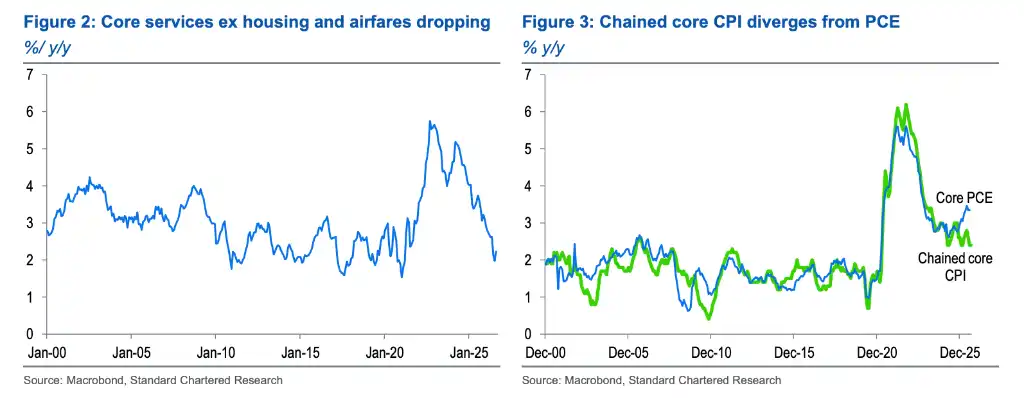
Standard Chartered's tracking of supercore CPI shows a notable pullback, with the measure returning to what the bank described as a normal range seen in the 2010s. It said current CPI pressure is being driven more by goods prices, with tariffs playing an important role, but that does not mean the economy has developed persistent underlying inflation pressure.
The report also pointed to a recent divergence between chained core CPI and core PCE, two series that had moved closely together for a long period. According to the bank, chained CPI better reflects actual consumer spending, making its recent path relevant for policymakers.
In addition, several internal Federal Reserve analyses cited in the report suggest tariffs may account for about 0.7 percentage point of PCE inflation. As tariff revenue peaks in the fourth quarter of 2025, the inflation effect could gradually weaken over the following months. Standard Chartered said that may mean the economy is entering a window in which the tariff-driven inflation shock begins to fade.
From a risk-management perspective, waiting for more confirmation would not remove the option to tighten later. The bank said that if future data show inflation rising again, the Fed could still deliver a 50-basis-point hike in one move. By contrast, hiking too early and then being forced to reverse course could damage policy credibility.
Warsh's Jackson Hole remarks helped drive expectations higher
Even though Standard Chartered does not expect a September hike, market pricing has become much more hawkish. Beyond the 88% implied probability of a 25-basis-point move this month, futures also point to about 74 basis points of cumulative hikes by next March. The bank said that shift was driven in large part by Warsh's speech at Jackson Hole.
Still, the report argued that markets may have focused only on the hawkish side of his comments. On one hand, Warsh stressed the importance of returning inflation to target. On the other, he also said policymakers need to judge whether underlying inflation is rising, falling or stalling, rather than react to a single data point.
The report added that Warsh warned of a policy error risk if markets rely on Fed guidance while the Fed, in turn, relies on market pricing. In that setup, policymakers could miss new changes in the economy.
Standard Chartered said that risk is now growing. The higher hike expectations rise, the stronger the feedback from market pricing becomes, making the Fed more vulnerable to existing expectations and creating a loop in which market expectations push policy and policy then reinforces market expectations.
If the Fed does stay on hold in September, the bank said the real issue will be how Warsh handles those elevated hike expectations: he will need to explain why a hike is not needed now and also show that the Fed is not being led by market pricing.
The vote count does not clearly support a September move
Standard Chartered also based its view on the likely voting structure. Three FOMC members had already backed a rate hike in July. For a September hike to go through, at least four members who had previously favored staying on hold would need to switch, bringing support to the seven-vote threshold.
The bank said Warsh is most likely to avoid ending up in the minority without actively pushing for a hike. If four more members turn, he may join the hiking camp. If only three members switch, he may still vote for a hike to avoid a 6-6 tie. If just two switch, he would still have room to support holding rates steady.
The key question, the report said, is whether data since the July meeting are strong enough to persuade at least three hold-leaning members to change their position. Standard Chartered's answer is no.
The press conference may be the real test
The bank expects no major changes in the FOMC statement. On the Summary of Economic Projections, the dot plot may not turn clearly more hawkish, but compared with June, the room for rate cuts could narrow and the weighted-average policy rate path could shift higher.
If the Fed holds rates steady, Warsh will face a tougher test at the press conference. He will need to explain why a hike is not warranted now and how the Fed views the already elevated market expectation for tighter policy.
Markets are especially likely to ask whether an October hike remains possible. Standard Chartered expects Warsh to stress that each meeting will be decided by the data, but it said doubts about his stance could persist if he does not offer clearer policy triggers.
In the bank's view, the impact of the September FOMC meeting will not be determined by the rate decision alone. It will also depend on whether Warsh can guide expectations effectively after the meeting. For the U.S. dollar and the long end of the Treasury market, the key variable will be how investors reprice the future interest-rate path.