

Market pricing for a September Federal Reserve rate hike has shifted sharply in the span of a week, with Bitcoin and crypto-linked equities already reacting to the change.
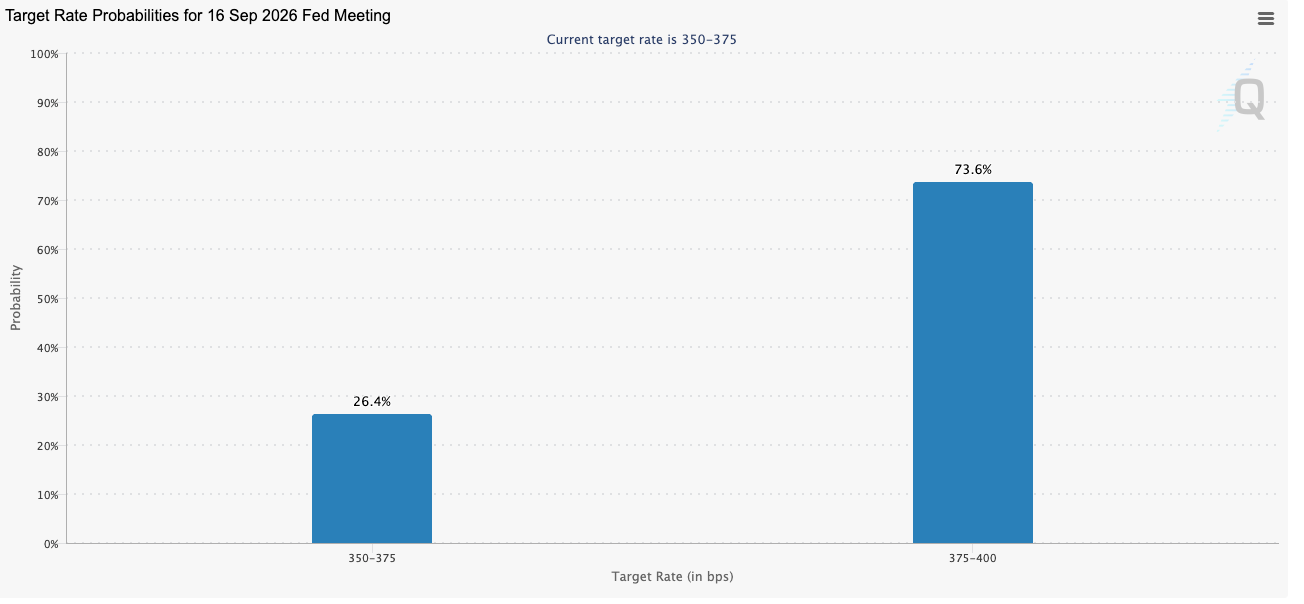
At its July 29 policy meeting, the Fed kept the federal funds target range unchanged at 3.50% to 3.75% in a 9-3 vote. It was the fifth straight hold. What stood out this time was the split. Cleveland Fed President Hammack, Minneapolis Fed President Kashkari, and Dallas Fed President Logan dissented and called for an immediate 25-basis-point increase, arguing that inflation has remained above the 2% target for more than five consecutive years.
Fed Chair Warsh described the post-meeting dynamic in unusually vivid terms, saying he had asked for “a proper family quarrel” and got one. That line added to the market view that hawkish support inside the committee has broadened.
Why September hike expectations moved so fast
According to the CME FedWatch tool, market-implied odds of a September hike were below 53% a week before the meeting. As oil prices climbed and inflation concerns picked up, that probability briefly jumped to 82% and was last at 73%. The 9-3 vote has been read as evidence that the hawkish camp inside the Federal Open Market Committee has expanded, lifting the odds of action in September.
That market repricing still sits well apart from the broader economist consensus. A FactSet survey cited in the report found that most economists still expect rate cuts to resume by 2027, with cumulative easing of about 50 basis points. In that sense, short-term rate futures appear to be reacting more to recent oil moves and inflation prints than to a settled long-range policy view.
On the macro side, the report points to geopolitical conflict near the Strait of Hormuz as the clearest transmission channel behind the latest revival in hike expectations. Since July, clashes involving Iran and other parties have escalated repeatedly, at one point threatening the roughly 30-mile-wide waterway that carries about one-fifth of global daily seaborne liquid petroleum flows. WTI crude futures rose about 20% during July. The article notes that this was not the first flare-up, but the second conflict between Iran and the United States after an agreement.
Energy is one of the most direct channels into the Fed’s preferred PCE inflation gauge. Higher oil prices can show up quickly in the next inflation reading, and the article says that is the immediate reason markets repriced September hike odds so aggressively over the past week.
The next data points that could change the picture
June CPI, released on July 14, showed a 3.5% year-over-year increase. The report describes it as the most encouraging reading since the Iran conflict began, helped mainly by a 5.7% month-over-month drop in energy prices during the ceasefire period. That relief now looks fragile. July’s rebound in oil prices could feed into the next inflation print.
The next major date is Aug. 12, when the July CPI report is due. If the data show that June’s cooling trend was real and sustainable, pricing for a September hike could move back toward economist expectations. If inflation re-accelerates on energy costs, especially with the ceasefire still incomplete and oil holding above $80, the odds of a September hike could climb again.
Signals from the Fed itself have also reinforced the shift. The June dot plot showed that 9 of 18 policymakers expected at least one more rate increase this year. That was a notable change from March, when the median outlook still pointed to rate cuts. The Fed also raised its core PCE inflation forecast to 3.3% for 2026.
Since taking office, Warsh has simplified policy statements and reduced the emphasis on forward guidance. He did not submit his own economic projections at the June meeting, an unusual step, but his comments at the press conference were taken by markets as hawkish and helped push up rate-hike bets at the time. The report also notes dissenting views inside the broader policy discussion. Milan, who served earlier this year, had publicly questioned the logic of hiking rates when core CPI on a month-over-month basis had briefly turned negative.
Over the next month, three signals stand out in the article: July CPI, the August nonfarm payrolls report, and remarks from Fed officials at the Jackson Hole symposium. Along with developments in the geopolitical backdrop, they are presented as the key windows for judging whether a September hike actually happens. Those same events could also amplify volatility in crypto assets and related U.S. stocks around release dates.
What this could mean for Bitcoin and crypto
For crypto, rising rate-hike expectations are usually negative. Bitcoin is currently trading in a $64,000 to $65,000 range, and its sensitivity to Fed signals remains high. The report says Bitcoin has repeatedly behaved like a high-beta risk asset over the past year, with a strengthening correlation to the U.S. dollar liquidity cycle.
Since the start of the year, a series of macro shocks including tariff policy and geopolitical risk pushed Bitcoin below $64,000 at one stage. Over the same period, traditional defensive assets such as gold and silver posted double-digit gains. The divergence, the article argues, suggests the market is not treating Bitcoin as a true safe haven, but as a liquidity-sensitive risk asset.
If the Fed does raise rates in September, the opportunity cost of holding non-yielding assets such as Bitcoin would move higher, while the appeal of money market funds and short-dated bonds would improve. That would put direct pressure on short-term sentiment in crypto markets.
The impact, however, is not necessarily linear. The article points to 2023, when Bitcoin rose 21% even though the Fed still delivered two more rate hikes. By the final two hikes in that cycle, the direct price effect had already become limited. The takeaway in the report is that once the tightening path is well understood and inflation shows signs of easing at the margin, a single hike may not keep prices under pressure for long. What matters more is the change in expectations about policy direction.
Using that history as a reference, the article says that even if a September hike happens, the downside for Bitcoin could be limited in depth and duration if the market interprets it as the end of the tightening cycle rather than the start of a fresh one. In that case, attention could shift quickly back to expectations for eventual rate cuts.
How U.S. equities, especially crypto-linked names, may respond
In U.S. equities, crypto-related stocks and instruments often move more sharply than spot Bitcoin itself. Shares of Coinbase (COIN), Circle (CRCL), and Strategy (MSTR) tend to react more violently to changes in rate expectations because a higher risk-free rate pushes up discount rates used in equity valuation models. That is especially difficult for growth and high-multiple technology stocks.
One of the major supports for U.S. equities in recent years has been multiple expansion driven by expectations for rate cuts. If that expectation is reversed, markets have to reprice around a higher cost of capital, making higher index volatility hard to avoid. The article adds that several heavyweight technology stocks in the S&P 500 and Nasdaq had already seen clear pullbacks. If September hike expectations continue to firm, pressure on those names could spread to the broader indexes.
The timing also coincides with an earnings season defined by heavy spending from large technology companies. From late July to early August, Google, Microsoft, Meta, Amazon, and Apple reported second-quarter results. Market reactions diverged sharply, with the key debate centered on whether capital expenditure can be converted into actual revenue.
- Google Cloud revenue rose 82% year over year, the fastest growth on record, but the company lifted its full-year capital spending guidance to a range of $195 billion to $205 billion. Its stock fell 7%.
- Meta reported 28% year-over-year revenue growth, slightly above expectations, but raised capital spending guidance to $130 billion to $145 billion. Its stock dropped nearly 9%.
- Apple shares fell sharply after fourth-quarter revenue guidance missed expectations and supply-chain constraints added to the concern.
- Microsoft was the exception. Full-year cloud revenue topped $100 billion for the first time, and the company cut fiscal 2027 capital spending guidance from $190 billion to $175 billion. Its stock surged more than 15% in a single day, its biggest jump in nearly 18 years.
The report says the four companies together are approaching $750 billion in capital spending, and the market’s test has changed. The question is no longer how much they are willing to spend on AI, but whether that spending can turn into visible revenue and cash flow.
That split leaves markets more sensitive going into September. These companies rely heavily on debt and equity financing to cover cash-flow gaps tied to large capital spending plans. If the Fed does hike, higher financing costs would directly compress the marginal return on those investments. The article argues that investors may become less tolerant of the idea that heavy AI spending alone justifies the growth story. Companies with negative cash flow and weaker evidence of sustainable growth could see even larger stock swings than they did in July.
For now, the more accurate framing is that a September rate hike has shifted from an outcome that was almost ruled out at the start of the year to one that is now priced as a mainstream possibility above 50%. For investors in crypto assets and related U.S. equities, oil prices, monthly CPI releases, and comments from Fed officials at venues such as Jackson Hole remain the key signals to watch over the next month.