
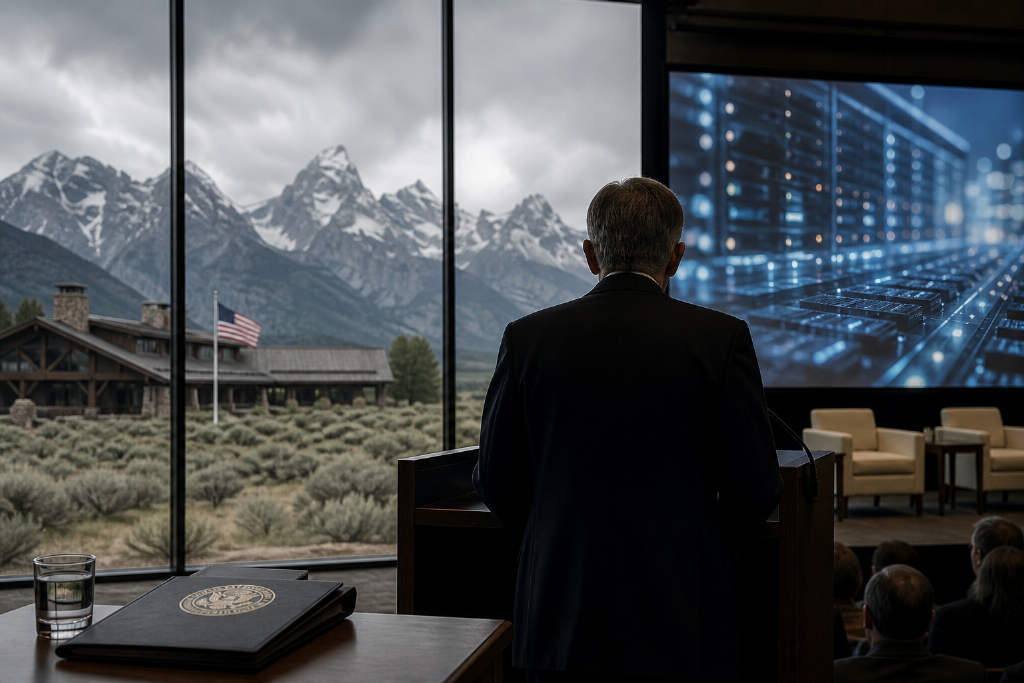
Federal Reserve Chair Kevin Warsh drew most of the immediate attention at Jackson Hole for what he did not say about interest rates. But one section of his first keynote as Fed chair stood out for another reason: it offered a detailed look at how the central bank is starting to read the economics of artificial intelligence.

Under the heading "Preparing for Future Policy Conjunctures," Warsh argued that the old post-2008 view of "secular stagnation" no longer describes the current moment. He said economists had spent the years after the financial crisis warning about a world where too much capital chased too few worthwhile investments because, in his words, "all the good stuff had been invented." That thesis, he said, no longer holds.
To support that point, Warsh cited business capital expenditures, which he called "the seed corn of future economic growth." He said capex is rising at its fastest pace since 2021, up roughly 9% over the past four quarters, with more than half of that growth tied to AI buildout. What he plans to watch next is not the spending level itself, but what he called "the second derivative"—whether the growth rate continues to accelerate or starts to slow.
AI progress is moving faster than expected
Warsh said, "Progress in artificial intelligence—the 80-year-old name for the newest technology—has been faster even than its evangelists predicted a couple of years ago. The potential for substantially higher growth is on the rise."
He pushed the point further: "Ever-expanding pools of capital are pouring into AI-related infrastructure of all sorts. A kind of hyper–Moore's law seems to be playing out."
Moore's law refers to the long-standing observation that computing power roughly doubles every two years. Warsh's description of a "hyper" version suggested that AI capability may be compounding at an even quicker pace. Coming from a central banker known for a hawkish bent rather than a Silicon Valley executive, the wording was striking. It was also the closest he came in the speech to saying that AI by itself may justify the scale of capital now flowing into the sector.
The AI economy now includes a $100 billion token market
Warsh framed token sales as a direct economic measure rather than a niche technology statistic. "Capital and labor have combined to create the large language models at the heart of AI," he said. "Users buy tokens to gain access to the models."
He then added a figure: "Reports put annualized token sales for the two leading labs alone at more than $100 billion—an increase of 500-plus percent from a year ago."
In this context, a token does not refer to a crypto asset. It is the basic unit AI companies use to sell access, roughly corresponding to a chunk of text a model reads or generates. By citing a dollar amount so directly, Warsh signaled that the Fed is now treating token revenue as something measurable within the broader economy.
The Fed is treating AI as a possible factor of production
Warsh said the central bank is closely tracking market dynamics across the AI ecosystem. "We recognize that AI is a new variable—potentially a new factor of production—that will have consequences for both the economy and the conduct of monetary policy."
That language is notable because the classic factors of production are labor, capital, and land. Putting AI into that category means the Fed is considering whether token consumption and AI investment could alter how much the economy can produce without overheating. That, in turn, matters for estimates of potential growth and the level at which interest rates may need to sit.
Warsh posed two questions without answering them. First, will AI drive "a significant, sustained rise in productivity across the economy?" If so, when? Second, will "token usage" prove complementary to labor or competitive with it?
He said a Fed task force on productivity and jobs is studying those issues, but he was explicit that its conclusions "have no bearing on decisions we make in the current policy conjuncture." That leaves a clear gap in the Fed's current stance: the institution has decided AI matters for macroeconomics, while also acknowledging that it does not yet have a settled framework to fold the shift into current policy decisions.
The Decrypt report also noted that Bill Gates has pushed the labor question further, arguing for a robot tax and for jobs from which humans cannot be fired.
Who captures the value remains unresolved
Warsh did not present the AI outlook as settled. He said it is difficult to predict whether AI will actually raise productivity in the global economy, or when such a change would begin. He also asked whether the business will produce global growth or growth concentrated in specific sectors, and how much of the surplus will flow to owners of scarce assets such as AI labs, chipmakers, energy producers, and cloud providers.
Again, he pointed to the Fed task force on "productivity and jobs," while repeating that its conclusions have no bearing on current policy decisions.
Decrypt tied that question to a real-world example that arrived two days before Warsh took the stage. Nvidia reported record quarterly revenue of $96.2 billion, disclosed $366 billion in future AI infrastructure commitments, and was separately moving to acquire open-source AI hub Hugging Face for roughly $12.9 billion. By contrast, the report also cited a study from a year ago saying that 95% of generative AI companies are failing.
The implication raised in the report is that AI value may be concentrating rather than spreading broadly. If one chipmaker can capture that much of the surplus from AI infrastructure buildout, while also sitting at the center of the compute customer base, then Warsh's open question about market structure may already have a leading practical answer.