
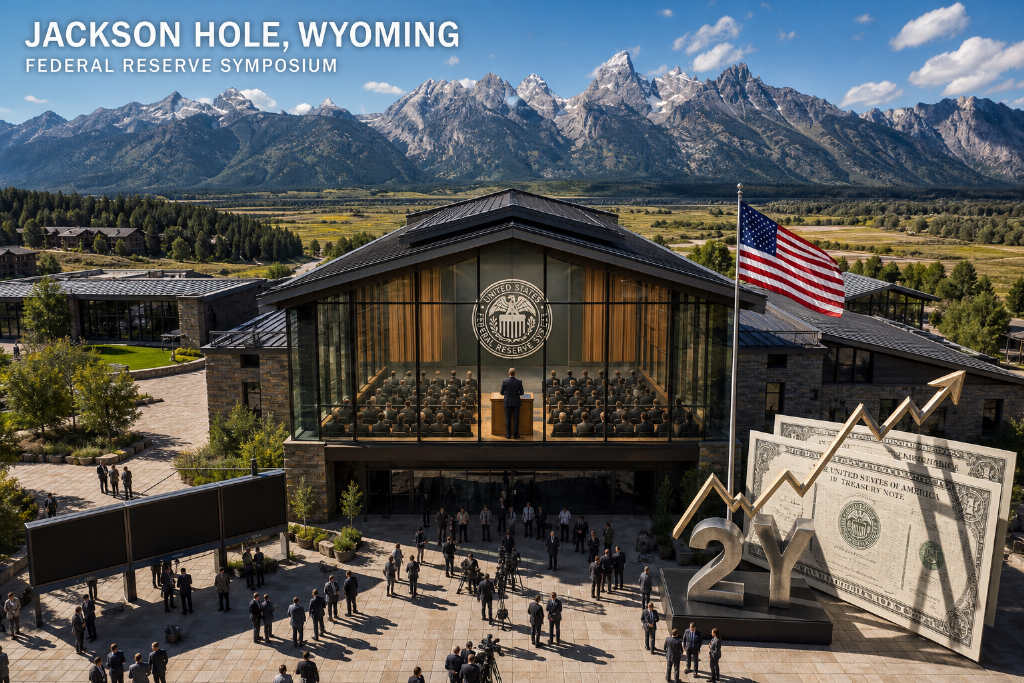
Federal Reserve Chair Kevin Warsh used his first appearance as chair at Jackson Hole to send a more hawkish signal than he did at the July FOMC press conference. He said inflation is “concerning,” that the Fed’s “primary focus should be on prices,” and that “we have more work to do” if the underlying inflation trend does not move back to target at a “sufficient pace.”
Markets reacted quickly. The 2-year U.S. Treasury yield jumped about 7 basis points after the speech, one of the largest Jackson Hole reactions in recent years. Pricing for a September rate hike also shifted, with the implied probability rising from about 30% before the remarks to more than 50% afterward.
Still, two major Wall Street banks did not follow that market repricing. JPMorgan kept its base-case forecast for a rate hike in December. Economist Michael Feroli said the “more important” information for the September meeting will be the August nonfarm payrolls report and CPI data that are due next. Goldman Sachs said it expects both August core CPI and core PCE to rise by about 0.2% month over month, a path under which the FOMC would likely stay on hold.
Inflation remained at the center of the speech
Warsh devoted a large share of the address to inflation. He acknowledged that this summer’s PCE and CPI readings had been “better than expected,” then added that “this does not tell me that the underlying trend has materially improved.”
To support that view, he pointed to one measure showing that over the past 12 months, 54% of items in the PCE basket posted price increases above 3%. That figure is below the post-pandemic peak of about 77%, but still far above the 32% level seen over the two decades before the pandemic.
Feroli said that compared with the trimmed-mean PCE measure Warsh had cited before, this indicator was “less opportunistic.” In his view, trimmed-mean PCE has already returned to a normal range, while the share of items rising more than 3% remains well above pre-financial-crisis levels. Goldman Sachs, for its part, said the calculation partly reflects tariff effects.
Warsh also acknowledged that wage growth is “moderate,” but said wages “have not been a reliable indicator of future inflation for a long time.” In other words, softer wage data alone do not amount to strong evidence that the inflation outlook has improved.
He walked back two contentious points from July
Warsh used the speech to clarify two statements from the July FOMC press conference that had unsettled markets.
The first was the 2% inflation target. After previously raising questions about its future, he said this time: “There should be no misunderstanding — the Federal Reserve’s 2% price-stability objective, measured by the PCE price index, is a fixed and unwavering target.”
The second was the policy toolkit. Warsh said “short-term interest rates are the primary tool for achieving the dual mandate.” JPMorgan said the two clarifications together sent a clear message: higher inflation would be met with a higher federal funds rate.
Warsh also laid out seven principles to guide policy, renewed his focus on monetary aggregates, questioned the role of forward guidance in normal times, and closed by calling for a “quieter and more purposeful in communication Federal Reserve.” JPMorgan described it as the longest Jackson Hole speech by a Fed chair since 2018.
Warsh described the economy as impressive and financial conditions as not restrictive
About a quarter of the speech dealt with the economy. JPMorgan said this section “sounded like a traditional technocratic Federal Reserve chair speech,” including discussion of indicators such as private domestic final purchases.
Warsh said the economy was “impressive” and appeared to have strengthened. Real consumer spending, in his telling, remained healthy “despite shocks,” while business capital spending was “rising rapidly.” He added that more than half of this year’s capital spending growth could be attributed to AI-related buildout.
He cited private domestic final purchases growth running near 3% so far this year. Goldman Sachs noted, though, that the measure is currently being pushed higher by imports of technology goods tied to AI investment.
On the labor market, Warsh said conditions were “fairly stable” and “consistent with full employment,” while the unemployment rate remained “low by historical standards.” He also offered a broader judgment, saying it was “hard to describe current broad financial conditions as restrictive.” That marked a noticeable change from his June press conference, when he had deferred the same issue to a working group.
Goldman Sachs and JPMorgan still do not see September as the base case
Warsh also revealed that at the July FOMC meeting, “most of my colleagues and I thought it was more prudent to wait for new information during the intermeeting period before deciding whether an adjustment in interest-rate policy was necessary.”
JPMorgan continues to forecast a December hike. Feroli said that with more Fed officials turning hawkish, an earlier move “would not be unreasonable,” but the key variables remain the August employment report and CPI data.
Goldman Sachs took a firmer line. It said a September hike would only become possible if August CPI and PPI data come in stronger than expected. Its baseline still calls for core inflation to rise about 0.2% month over month in August, leaving the FOMC likely to hold rates steady.