
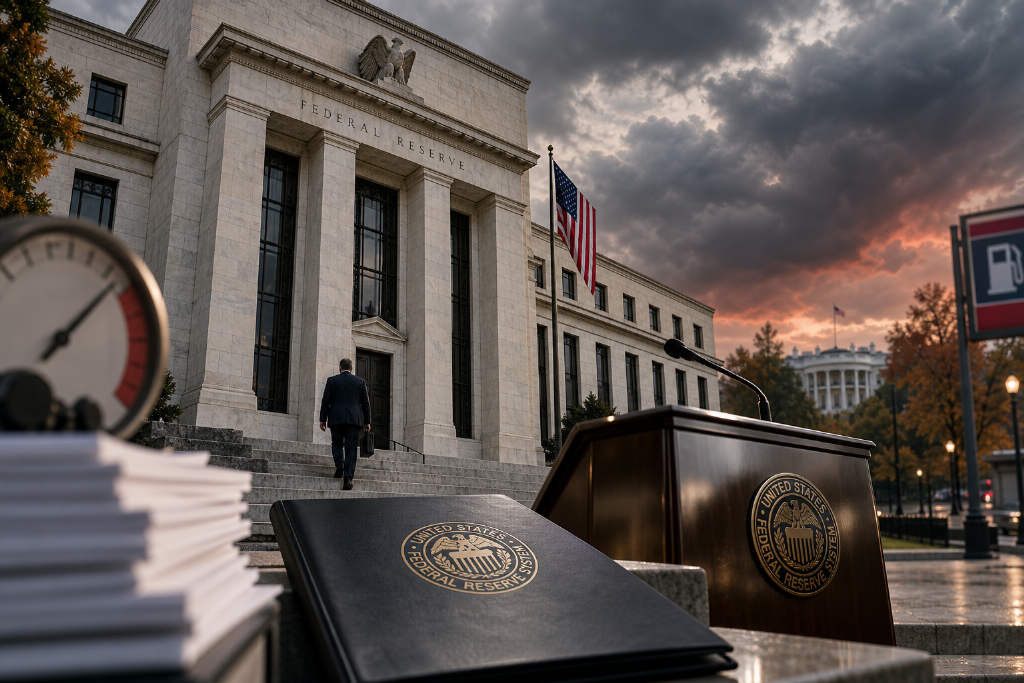
Federal Reserve Chair Kevin Warsh is nearing a decision that looks harder to avoid with each passing day: whether to raise interest rates at this week’s policy meeting as inflation remains stubborn and energy prices move higher.
In a Wall Street Journal article published on Sept. 14, Nick Timiraos wrote that Warsh’s own remarks over the past several months have left him with little room to stand still. After the August CPI report came in above expectations, that remaining space narrowed even more.
The White House has added another layer of tension. Publicly, officials say they “100% respect” the Fed’s independence. At the same time, they have signaled that President Donald Trump “wouldn’t be too happy” with a hike. With only seven weeks left before the U.S. midterm election, a move by Warsh would put Trump’s repeated statements of trust in him under direct pressure. If Warsh does not hike, his own credibility could face a different kind of test.
How Warsh backed himself into a corner
Warsh took over as Fed chair in May. At his first press conference in June, he delivered a firm anti-inflation message, and markets quickly began to expect more forceful action. But at the following policy meeting, he kept rates unchanged and did not offer a convincing explanation for why the policy stance had not moved with his rhetoric.
Timiraos wrote that longer-dated yields rose rather than fell while Warsh was speaking, a sign that investors were unsure whether his hawkish language would actually turn into policy.
In August, Warsh tried to correct that impression in a keynote speech. He said there was “little evidence” that borrowing conditions were restraining the economy, and that better inflation readings over the summer had not persuaded him that the underlying trend had improved. In Timiraos’s reading, those remarks were effectively laying the groundwork for a rate increase.
The September CPI release then changed the setup more sharply. Timiraos wrote that “key measures of consumer prices in August rose more than expected, interrupting the improvement seen over the prior two months,” even though that earlier improvement had been viewed as an early validation of the Fed’s own forecast. After the data, market odds of a rate increase this week climbed quickly to about 90%.
The timing mattered. The report landed during the Fed’s pre-meeting blackout period, leaving no official able to step out and cool expectations. As the Sept. 17 meeting approaches, Warsh’s room to maneuver has become tighter.
What is inside the White House’s “100% support”
Ahead of the meeting, White House National Economic Council Director Kevin Hassett said in a Sunday television appearance that inflation was improving and that the Fed had no need to raise rates. He also said Trump “100% respects Kevin Warsh’s independence” and would “100% support” any Fed decision.
But Hassett added a qualifier: Trump “wouldn’t be too happy” with a hike.
He also argued that changing rates so close to an election could “damage” the Fed’s reputation for staying out of politics. Timiraos turned that logic around in his article. If the White House publicly wants easier policy and the Fed still stays put when markets broadly expect a hike, outsiders could just as easily conclude that Warsh is accommodating the president who appointed him.
In other words, either choice invites questions about motive. That, in Timiraos’s framing, is the core dilemma now facing the Fed’s independence.
From open conflict to a temporary truce
The article recalled that Trump last year mounted what it described as the most sustained public pressure on the Fed in decades. He repeatedly attacked former Chair Jerome Powell and even threatened to pursue a fraud lawsuit against him.
Trump also installed economic adviser Stephen Miran on the Federal Reserve Board, and the article said Miran voted for easier policy in all six meetings he attended. Trump later tried to remove Fed Governor Lisa Cook, the first time a president had attempted to fire a Fed governor. The effort failed after Supreme Court involvement, but the case remains unresolved.
Warsh’s arrival temporarily cooled that fight. Trump has repeatedly said he trusts Warsh to do the right thing, a formulation that spared Warsh, at least for now, the kind of public attacks Powell had faced.
Timiraos argued that the truce has conditions attached. A rate hike seven weeks before the election would become a direct test of how long Trump’s trust can last.
Warsh himself had publicly criticized the Fed last year for cutting rates too slowly. When asked whether that position was influenced by the president who might nominate him, he told CNBC: “Birds molt when the timing is right. One has to move with the times. It has nothing to do with this president.”
Warsh’s answer: independence
As speculation around his motives has grown, Warsh has stuck to a public line centered on independence.
“They picked an independent person to do an independent job, and that’s exactly what I plan to do,” Warsh said at a congressional hearing this summer.
Timiraos added another detail from people who had spoken with Warsh. In their account, Warsh believes the Powell-era Fed made matters worse by making some “unnecessarily confrontational” statements, including public discussion of how tariffs lift prices or overt defenses of Fed independence. Warsh’s own method has been to say less and avoid provocation.
That lower-profile style helped preserve some peace with the White House. If he does raise rates this week, silence will no longer provide much cover.
Economists are split
Economists are not aligned on whether the Fed should move now.
Douglas Holtz-Eakin, a former Congressional Budget Office director and Republican economist, said that before July he did not think Warsh needed to risk a clash with the White House ahead of the midterms. Since July, however, Warsh’s public comments, combined with the economic backdrop shaped by an energy shock and an AI boom, have left him with nowhere to stand.
“His hand has been forced,” Holtz-Eakin said. “Kevin Warsh is an excellent politician, and he has to figure out how to handle this.”
Holtz-Eakin sketched out two possible paths from there. Trump and Warsh could fall into a tacit arrangement in which Trump criticizes him publicly and Warsh absorbs it quietly. Or Trump could simply shift the subject and act as though nothing happened. “Trump will change the subject instead of confronting it head on, because he can’t admit he made a mistake,” Holtz-Eakin said.
Michael Strain, a conservative economist at the American Enterprise Institute, took a different view. He said the Fed should have raised rates in July, but once it did not, moving again just weeks before the election would be poor timing.
“The unfortunate reality for the Federal Reserve is that it cannot ignore the fact that President Trump is deeply hostile to this important institution,” Strain said. In his view, investors would absorb another hold faster than the Fed would recover from a confrontation with Trump.
What comes after the truce
The article closed by noting that rate changes around election periods are not without precedent. The Fed made comparable moves before the 1988 political conventions, in 1994, 2004, 2018 and in 2022 during President Joe Biden’s term. Historically, the overlap between monetary policy decisions and election cycles is not unusual.
This time, however, the setting is more charged. Trump’s hostility toward the Fed is already well documented, and every move by Warsh is being read through that lens.
Among the views cited by Timiraos, Holtz-Eakin’s may be the simplest: whatever the outcome, Warsh needs to show that he is making decisions based on economic data rather than political pressure.