
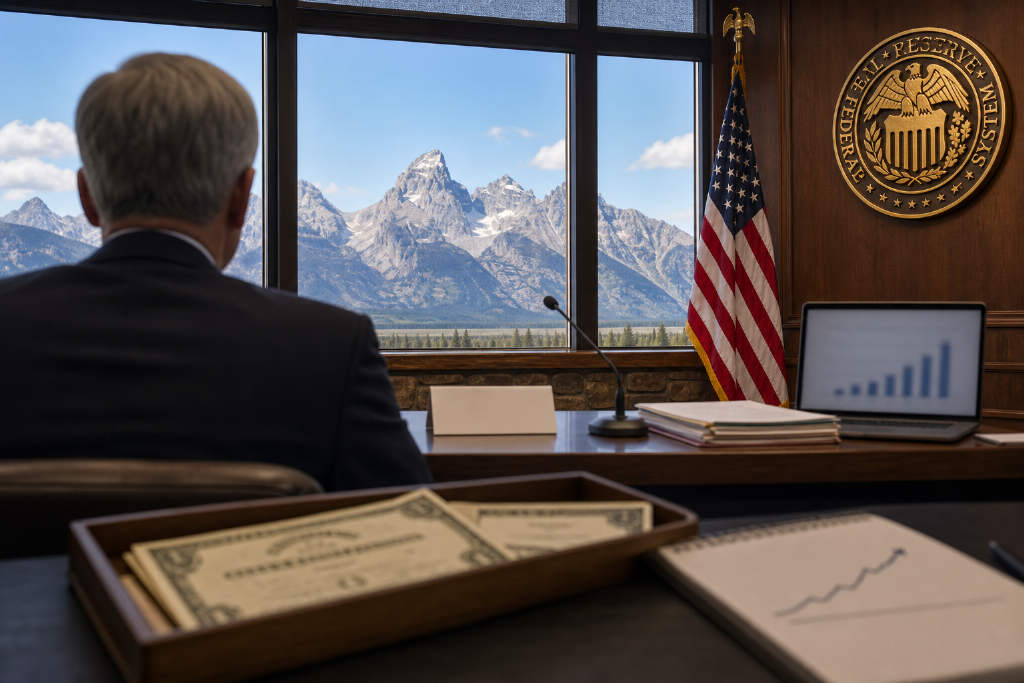
Expectations for a September Federal Reserve rate hike rose sharply after Fed Chair Kevin Warsh struck a hawkish tone at the Jackson Hole Symposium last Friday. Even so, CME FedWatch shows the probability of a hike at 59.9%, which still falls short of certainty.
Warsh said inflation data is "more concerning" than labor-market trends and argued that inflation is unlikely to return to target on its own. He also said the Personal Consumption Expenditures price index, the Fed’s preferred inflation gauge, currently stands at 3.7%, well above the central bank’s 2% target.
Jackson Hole remarks quickly fueled September hike bets
Warsh also noted that, over the past year, more than half of the goods and services tracked by the government posted price increases above 3%. Before the pandemic, that share was roughly one-third over a twenty-year period. Markets rapidly read those remarks as support for a rate increase, and social media soon filled with calls for a 25-basis-point hike in September.
The benchmark borrowing rate is currently in a 3.5% to 3.75% range. Still, actual market pricing has not moved as far as the loudest online commentary suggests.
Jim Bianco, founder of Bianco Research, wrote on X: "The next Fed meeting leans toward a hike, but it is not a done deal."
Analysts push back on the intensity of the rate-hike scare
Bianco is not alone. ABN AMRO Investment Solutions and Brandywine Global Investment Management have also expressed skepticism about the current panic around a possible hike.
Robin Brooks, senior fellow at the Brookings Institution and former chief economist at the Institute of International Finance, offered a more counterintuitive view in a blog post. If the Fed does raise rates in September, he argued, the goal may not be monetary tightening in the conventional sense. It may instead be an attempt to calm the U.S. Treasury market.
Brooks says a hike could be about stabilizing bonds
According to Brooks, a September hike could be meant to:
- anchor the 10-year Treasury yield
- avoid a repeat of the bond-market selloff seen after July 29
- signal that the Fed still has credibility in fighting inflation
- reduce the premium investors demand to hold long-dated bonds
He wrote: "If a September hike happens, its purpose would be to anchor the 10-year yield and prevent a repeat bond-market crash. Its purpose is the exact opposite of a traditional rate hike, which is why fiat debasement trades would still do well."
Brooks added that such a move would be performative in nature, with the main aim of keeping financial conditions loose.
Bitcoin and gold may still have room to rise
Under Brooks’ interpretation, a rate hike would not necessarily amount to a true tightening signal. If that view holds, the path higher for Bitcoin and gold may remain open. The article noted that the two assets rose 23% and 10% in August, respectively, and may still have room to extend gains after a short-term pullback.