
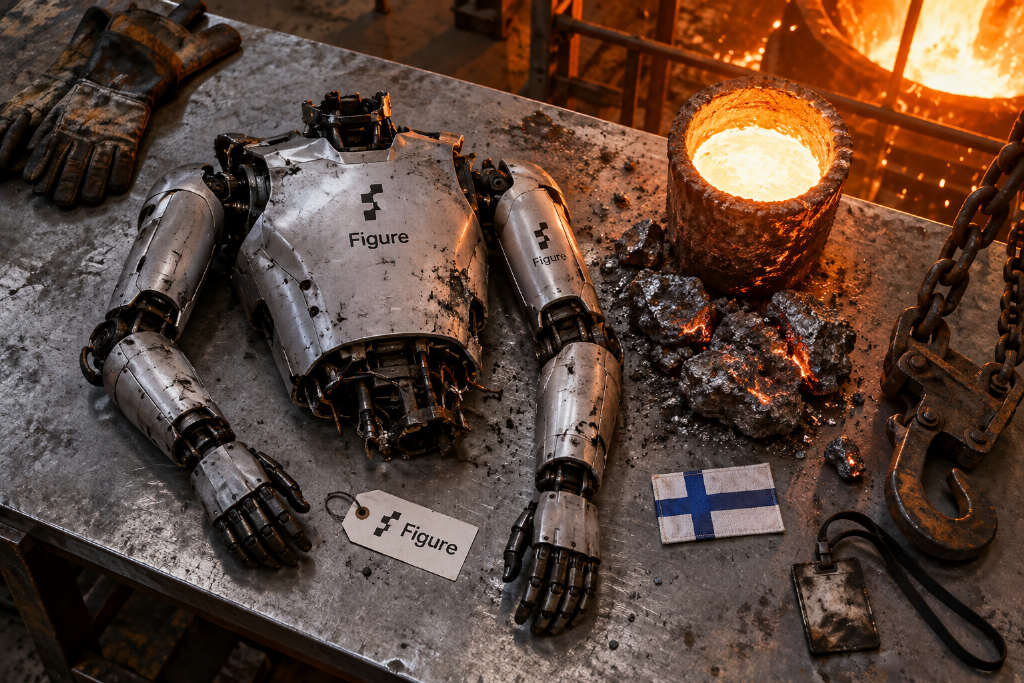
Figure said on Sept. 30 that it decommissioned its second-generation F.02 humanoid robots by sending them to a foundry in Imatra, Finland, where the machines jumped on their own into a 75-ton electric arc furnace.
Schwarzenegger’s reply became the trigger
The company said the idea was pushed forward by actor and former California governor Arnold Schwarzenegger. After Figure asked online how it should dispose of the retired robots, Schwarzenegger replied to CEO Brett Adcock on X on Aug. 19: 「You should melt them down.」 Figure said it then reached out to him directly, and the plan moved ahead after he agreed to participate.
In its explanation, Figure said F.02 delivered several firsts for the company: the first deployment at BMW, the birth of the Helix model, the first robot to do household chores, and the first logistics deployment.
Figure said dismantling the fleet would slow the next generation
As the F.03 fleet grows, Figure said it no longer makes sense to keep maintaining the F.02 fleet. The company added that the robots contain in-house actuators and other intellectual property, making it necessary to protect proprietary hardware during disposal. Having technicians dismantle the machines one by one would take time and delay the launch of F.04, it said.
For that reason, Figure chose to melt the batch rather than disassemble the robots individually.
U.S. and Mexico foundries declined the job
Figure said the foundries it contacted in the United States and Mexico were unwilling to let robots containing lithium batteries jump into expensive industrial equipment. The company even sought help from former MythBusters staff in its search for a site. In the end, it said, a foundry in Imatra, Finland, was the only facility in the world willing to take on the work.
Training started in San Jose
Figure said training began at its campus in San Jose. The team set up a large airbag and first taught the robots to jump from the second floor of a building. Using stunt performers’ movements as reference, the company trained a new AI model in simulation so the robots could accurately leap into a container of molten steel, even though the team had never visited the foundry in person before the operation.
The team had 24 hours and six melts
Figure said the foundry uses three large graphite electrodes to power a 75-ton electric arc furnace that melts scrap steel. The team had a 24-hour window and six melting opportunities. Between each run, there was only a 20-minute gap; beyond that, the molten steel would cool and form a crust.
The company also said cameras and other electronics malfunctioned in the high-temperature, high-electromagnetic-field environment, while the robots’ AI strategy executed successfully.
Recovered metal is being turned into commemorative items
Figure said the metal bars produced in the process were shipped back to the United States. The company is now turning that metal into limited-edition F.02 commemorative objects. Most of the F.02 fleet is now gone, it added, with only a few units left in storage at headquarters.
At the end of its explanation, Figure said that in an era of AI-generated video, it wanted to be explicit about what happened: it really did train the robots to jump autonomously, transport them to Finland, and send them into molten steel.