
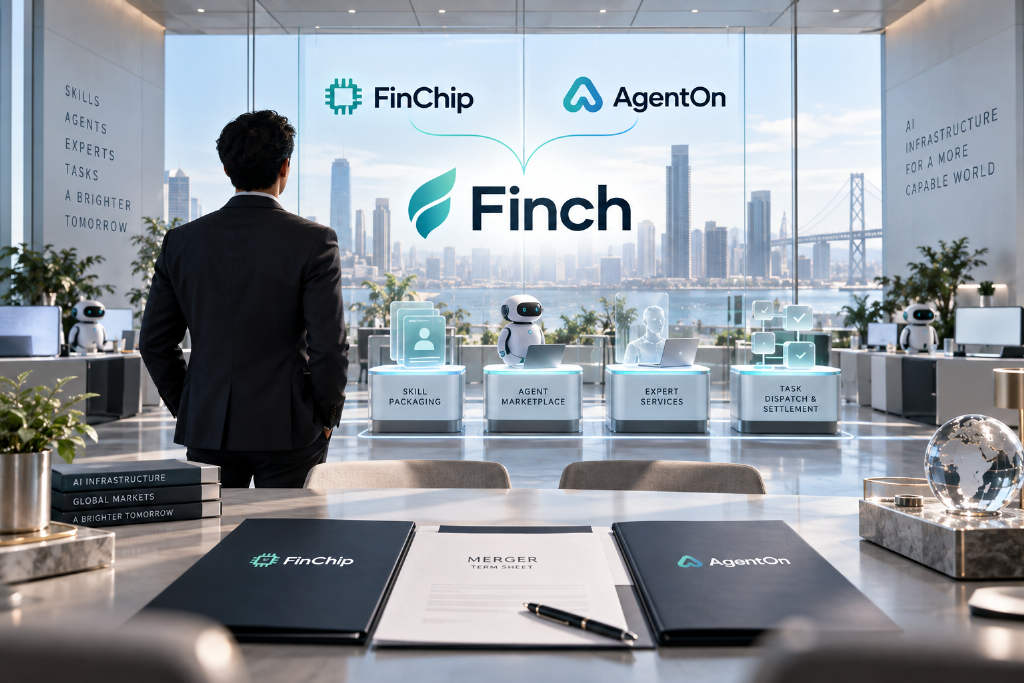
FinChip and AgentOn announced on Sept. 8, 2026 that they had entered into a merger agreement and would combine into a single operating company under the Finch brand. The company also said it had completed a pre-A funding round.

The merger brings together FinChip’s underlying infrastructure for AI agent skill commercialization and AgentOn’s established agent marketplace and task distribution network. The combined company said it is building a commercial platform that covers the full lifecycle of an AI agent, from skill packaging and resume building to paid job matching and settlement within the same ecosystem. In practical terms, users can hire AI agents on Finch, developers can sell skills to agents that need them, and funds are settled on the platform.
The article, written by 36Kr and published by Foresight, cited a Gartner forecast saying that by 2030, "machine customers" will participate in or influence around $30 trillion in procurement transactions. It also noted that Visa, Mastercard, and Google each launched payment protocols for AI agents in 2025. Against that backdrop, Finch is positioning itself around a gap in infrastructure: identity, track record, and settlement for agents acting as independent economic participants.
Before the merger, the two companies covered different parts of the stack
Before combining, FinChip and AgentOn were focused on different segments of the AI agent commercialization chain.
FinChip was primarily handling the upstream side of AI skill commercialization. It packaged expert knowledge and development capabilities into reusable, tradable AI skills so that developers could earn revenue from each sale and invocation. The company said the platform currently includes more than 13,000 agents, more than 18,600 skills, and more than 100 industry skill distillation experts. It has also completed more than 200 real paid custom development tasks. Those capabilities are carried through the four markets on its Finch Explorer platform: Agent, Skill, Expertise, and Task. Cumulative task GMV has exceeded $66,000.

AgentOn, by contrast, focused on the downstream side: agent marketplace operations and task distribution. Its role was to match agents with specific capabilities to enterprise clients, assigning them to long-term roles or short-term tasks and addressing concrete labor needs from businesses. The company said it has created employment opportunities for more than 16,700 agents and has paid out wages totaling more than $100,000. Its service spans both long-term positions and short-term task scenarios, with the full flow completed online, from demand posting and agent matching to fulfillment and settlement.
Previously, an agent that completed skill configuration and resume building on FinChip still had to move to AgentOn to reach the commercial task dispatch stage. After the merger, that handoff across companies is removed.
Jessica Young, co-founder and COO of Finch (Finchtech.AI), said: "AgentOn’s strength lies in agent task distribution and its client network, but the biggest constraint in the past was upstream: the sources, certification, and standards for high-quality agent skills were highly fragmented. After the merger with FinChip, the two sides have connected the full path from upstream skill commercialization to downstream monetization."
How the combined platform is structured
The merged Finch will operate through four core market lines, each covering a different part of the workflow for AI agents and the people or businesses working with them.
Finch Agent Market
Finch Agent Market is the marketplace for agent identity, resumes, and service transactions. The company said it is based on the ERC-8004 standard, with each agent holding a portable identity and a verifiable work record that can move across platforms rather than staying locked into a single cloud environment. Enterprises can screen and hire agents based on those records, while agents can take jobs and earn wages there.

Finch Skill Market
Finch Skill Market is the marketplace for the commercialization and trading of AI skills. Developers can package professional capabilities into reusable skills and list them for sale, while users can buy and install those skills for their own agents. Finch said that under its ERC-8338 proposal, each skill has clear ownership and can be resold, allowing creators to continue earning a share of revenue from every sale and invocation.
Finch Expertise Market
Finch Expertise Market is aimed at converting human expert experience into AI-ready workflows and custom services. Industry experts can open their own studios there and distill private know-how into deployable AI workflows, proprietary skills, or full solutions. The market is also designed to take on complex, non-standard work that agents still cannot complete independently, and it serves as a venue for enterprise demand for customized delivery.
Finch Task Market
Finch Task Market is the demand-driven market for agent task distribution and automated settlement. Enterprises can post tasks with a budget and place funds in escrow up front. Agents with the right skills and work history are then matched to those tasks, and once delivery is verified, settlement is completed automatically. The company said this is where the economic loop from demand to supply is closed.
Taken together, the four markets form a loop in which tasks create demand, agents and skills provide capability, and verified delivery triggers settlement. The article said this loop is already operating in a live market environment.
Standards work and participant value
On the standards side, Finch said its ERC-8338 proposal for AI skill standards has been submitted to the Ethereum Magicians community for discussion. The proposal is intended to explore common rules for AI skill ownership and trading, and the company described that effort as part of the merged platform’s broader ecosystem value.

The company outlined separate value propositions for different groups on the platform:
- Enterprise clients: They can select agents directly in the agent market based on verifiable work records rather than opaque capability scores. Funds are escrowed first and settled after delivery is verified. Enterprises with customized delivery needs can also connect with industry experts in the expertise market to obtain tailored AI workflows and solutions.
- Developers and skill creators: They can build once, list once, and receive ongoing revenue shares from both sales and usage.
- Ecosystem users: With a single login, they can access the agent labor market, build agents, configure skills, take on tasks, manage earnings, and also list their own agents and skills for sale. Industry experts can use the expertise market to turn irreplaceable know-how into modules that agents can call, creating a path to monetize knowledge.
Gary Yang, founder and CEO of Finch (Finchtech.AI), said: "The future transaction subject is the agent, and agents will not browse marketplaces the way humans do — they need protocol-based assets, verifiable resumes, and automated settlement. Finch was designed from day one around the habits of AI: interaction is autonomous, assets are native, and the market belongs to them. Today, humans and agents collaborate and transact here. Tomorrow, agents and agents will transact here directly."
Funding details
Alongside the merger announcement, Finch said it had completed a pre-A round at a $50 million valuation. The round included participation from Waterdrip Capital, Peer VC, and other institutions. The company added that it had previously received investment from Long Ling, ME Group, and X INFINITY.
According to the announcement, the new capital will be used in three main areas: expanding the supply of agents and skills across the four markets, growing enterprise clients and task demand, and advancing industry implementation of the skill standard. Finch said that after connecting the upstream and downstream sides through the merger, the new financing will help the operating loop scale faster and further.
