‹ BackFinChip

FinChip

Finch
2026-09-09 06:59:18

FinChip and AgentOn Merge Into Finch, Announce Pre-A Round at $50 Million Valuation

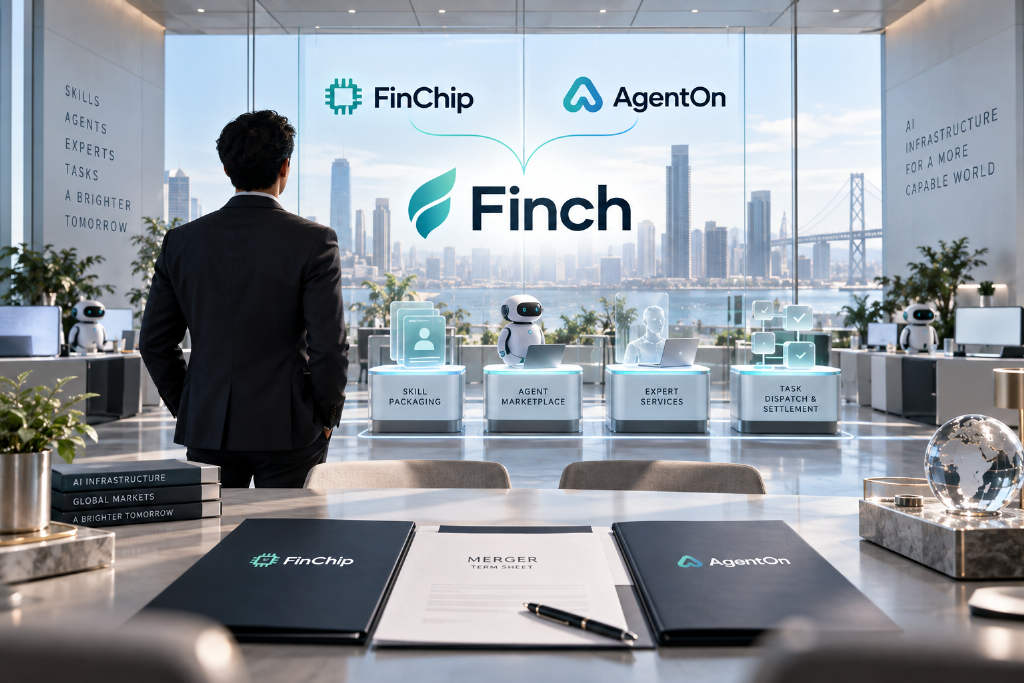
FinChip and AgentOn said they have signed a merger agreement and will operate as one company under the Finch brand, while also announcing the completion of a pre-A funding round at a $50 million valuation. The deal combines FinChip’s infrastructure for commercializing AI agent skills with AgentOn’s existing agent marketplace and task distribution network. The merged company says it is building a full-stack commercial platform for AI agents, covering skill packaging, resume building, job matching, and settlement inside one system. According to the company, the platform will run through four core markets: Agent Market, Skill Market, Expertise Market, and Task Market. FinChip disclosed that its platform has accumulated more than 13,000 agents, more than 18,600 skills, more than 100 industry skill distillation experts, over 200 paid custom development tasks, and task GMV above $66,000. AgentOn said it has created job opportunities for more than 16,700 agents and paid out wages totaling more than $100,000. Finch added that its ERC-8338 proposal for AI skill ownership and trading has been submitted to the Ethereum Magicians community for discussion, and said the new funding will be used to expand supply on its four markets, grow enterprise demand, and push industry adoption of the standard.

1490
FinChip and AgentOn Merge Into Finch, Announce Pre-A Round at $50 Million Valuation
CertiK
2026-07-30 08:40:00

CertiK flags Google EdgeTPU flaws as AI security shifts beyond the model layer

CertiK researchers said they found two security flaws in Google’s EdgeTPU, tracked as CVE-2026-0150 and CVE-2026-0153. Google acknowledged the findings and listed them in its June 2026 Security Bulletin, rating the bugs High and Critical. Beyond the disclosure itself, the research points to a broader shift in how companies need to think about AI security. The report argues that as AI systems move from generating content to carrying out tasks, the security focus can no longer stay limited to model behavior alone. Enterprises are now deploying AI across identity verification, facial recognition, edge inference and other business-critical functions, while AI agents are increasingly connecting to databases, APIs and third-party tools. In that setting, risk can emerge not only inside a model, but across the interfaces and trust relationships that link infrastructure, applications and external systems. CertiK also ties this change to a wider industry trend. It cites McKinsey’s “The state of AI in 2025,” which says 88% of companies have deployed AI in at least one business function and more than 60% have begun exploring AI agents. A separate Google Cloud survey found 83% of respondents believe major infrastructure upgrades are needed to support AI agents at scale. The company says the practical implication is clear: securing AI now means validating the full system, from development and deployment to runtime operations.

1840
CertiK flags Google EdgeTPU flaws as AI security shifts beyond the model layer