
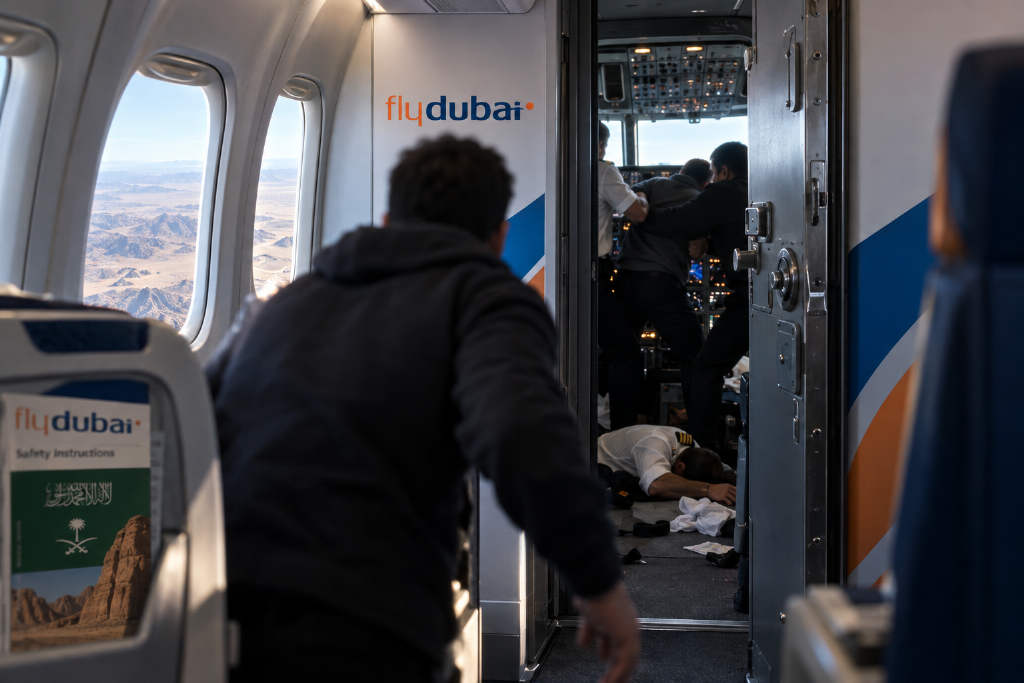
Flydubai flight FZ1073 turned into a cockpit emergency after the first officer allegedly attacked the captain and tried to take control of the aircraft, according to the account cited in the report. The captain, badly injured and losing blood on the cockpit floor, managed to trigger the cockpit door release from inside. That gave passengers a way in and changed the outcome for the 174 people on board.
The incident has also revived a long-running aviation safety debate. Reinforced cockpit doors became standard after 9/11 to keep attackers out. The same design can make outside intervention extremely difficult if the danger comes from inside the cockpit.
Attack unfolded near the Saudi-Jordanian border
The report said FZ1073 was flying from Dubai to Tel Aviv on Sept. 30, 2026. The aircraft was a Boeing 737 MAX 8 carrying 174 passengers.
About two hours after takeoff, as the flight approached the Saudi-Jordanian border, UAE Attorney General Hamad Saif al Shamsi said the first officer "began carrying out his plan during the flight, attacked the captain inside the cockpit with an emergency axe, and attempted to seize control of the aircraft."
The jet dropped from about 34,000 feet by roughly 17,000 feet in less than a minute before leveling at around 15,000 feet. Its transponder first switched to 7700, the general emergency code, and seven minutes later changed to 7500, which signals unlawful interference. Israel then scrambled fighter jets.
The captain later described the moment to Indian Prime Minister Narendra Modi, saying, "I was on the floor injured, but I told myself I had to try one last time and open the door from inside."
Once the door opened, passengers rushed into the cockpit and saw the first officer smashing the instrument panel, the report said. Israeli plumber Yaniv Hayun said he first dragged the attacker out and then went back to the controls. "I jumped back in, grabbed the control column, and started pulling back," he said.
Two off-duty pilots who were traveling on the flight then took over. The aircraft landed safely in Tabuk, Saudi Arabia. No one was killed.
Post-9/11 cockpit doors were built to resist forced entry
The report traced the issue back to the security changes that followed the Sept. 11 attacks.
The U.S. Federal Aviation Administration required U.S. airliners in January 2002 to complete reinforced cockpit door upgrades by April 9, 2003. The International Civil Aviation Organization later made the measure a standard for large aircraft on international routes, effective from November 2003.
Under 14 CFR 25.795, cockpit doors must be able to withstand forced intrusion, small-arms fire, and penetration by explosive fragments.
The operating logic is straightforward. The cockpit door remains locked throughout the flight. Crew outside can enter an emergency code on the keypad, but pilots inside can deny access with a single action. Using the Airbus A320 as the example cited in the report, if the code is entered and there is no response from inside, the door unlocks automatically after about 30 seconds. If the cockpit switch is set to lock, the keypad outside is disabled for five minutes and that period can be extended again.
In practice, the final decision stays with the person inside the cockpit.
Past cases show the same door can block help
France 24 said after the incident that there have been at least 10 cases of deliberate crew-caused crashes or hijackings since 1982, with half of them occurring before 9/11. In publicly documented cases after 9/11, three involved one crew member locking another out of the cockpit.
- LAM Mozambique Airlines Flight 470: On Nov. 29, 2013, an Embraer 190 captain locked the first officer out while he was in the lavatory and deliberately crashed the aircraft in a national park in Namibia, killing all 33 people on board.
- Ethiopian Airlines Flight 702: On Feb. 17, 2014, a Boeing 767 first officer, Hailemedhin Abera Tegegn, locked the captain out while he was in the lavatory and diverted the aircraft to Geneva to seek political asylum. All 202 people survived.
- Germanwings Flight 9525: On March 24, 2015, Airbus A320 first officer Andreas Lubitz locked the captain out after he left the cockpit and set the aircraft on a descent into the French Alps. The captain could not force the door open. All 150 people on board were killed. The report said Lubitz had a history of depression.
No single global rule followed the Germanwings crash
After Germanwings 9525, the European Union Aviation Safety Agency in 2015 temporarily recommended that at least two people remain in the cockpit at all times. In 2016, it shifted to a risk-based approach that left the decision to airlines, and Germany's airline association later dropped the rule.
The FAA, by contrast, kept the practice requiring two qualified people to be present when a pilot leaves the cockpit. The report said there is no mandatory ICAO rule applied worldwide on this point.
Questions raised over pilot screening
The report argued that reinforced cockpit doors were designed on the assumption that the threat would be outside the cockpit. Cases such as FZ1073 and Germanwings 9525 show the same lock can help save 174 people in one case and contribute to the deaths of 150 in another.
It also said Oman had previously barred the first officer from flying because of his extremist ideology, but Flydubai still hired him. Israeli Prime Minister Benjamin Netanyahu described him as having been "indoctrinated with Islamic extremist ideology," while UAE officials classified the incident as an act of terrorism.
The case has now put pilot vetting and background review back under scrutiny.