
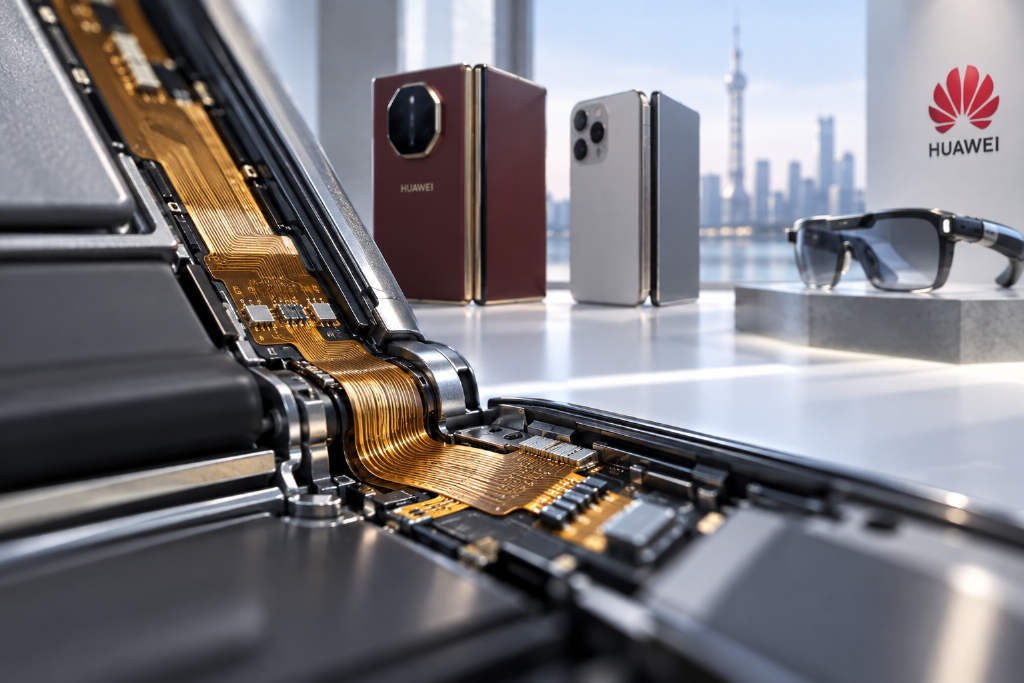
Huawei and Apple have both rolled out new foldable phones since September. That has shoved top brands into a tight launch window and, at the same time, changed both how many flexible printed circuits, or FPCs, go into premium smartphones and what standards those boards have to hit.
FPCs are the bendable links connecting screens, batteries, and motherboards inside smartphones. They are used all over display, touch, camera, and communication modules. A traditional flagship slab phone usually carries 10 to 15 FPCs. But the report, citing a forecast, said Apple’s iPhone Duo could use more than 50 FPCs because of its hinge and dual-screen design. Tri-fold models may need even more. One more screen. One more hinge set.
Foldables are driving both volume and value growth for FPCs
After speaking with several parties, CLS reporters said Avary Holding Co. (002938.SZ) and Hongxin Electronics (300657.SZ) have already supplied FPC products for mainstream foldable devices. In the first half, gross margins in the related businesses at both firms increased from a year earlier. At the same time, performance drift under extreme conditions and mass-production yield for ultra-thin flexible boards are raising new entry barriers. That is speeding up the shift of high-end orders toward leading manufacturers. And the process experience built around these products is starting to spill into newer hardware categories such as AI glasses.
Counterpoint said in a report released in September that global foldable smartphone shipments are expected to grow 24% year over year in 2026. By the end of this year, cumulative global foldable smartphone shipments are projected to top 100 million units. Counterpoint said that would be the first 100 million units accumulated in the eight years since foldables were commercialized. The second 100 million, in its view, may take only three years.
As shipments rise, FPCs are becoming harder to ignore inside foldables. Xin Guangyi (301687.SZ), replying to IPO inquiries last year, said FPCs are light and thin, two things that matter in foldable phone design. The company also said two displays require FPCs to create flexible connections across the hinge, while a higher number of cameras lifts FPC usage and raises the required number of bend cycles.
An employee in Avary Holding’s securities department told CLS reporters by phone, with the reporter posing as an investor, that all phones use FPCs, but foldables have two screens and a folding structure in the middle, so usage is higher than in standard phones. The person added: “We supply across the full product systems of major customers, including Apple.”
Foldable smartphones have now been on the market for seven years, and hardware upgrades have kept pushing up both the number and the density of internal routing paths. Apple’s first foldable phone, the iPhone Duo, was cited as one example. The device has an unfolded thickness of 5.2 mm, a folded thickness of 11.3 mm, and a starting price of RMB 15,999. Inside that 5.2 mm unfolded body, Apple removed a standalone periscope telephoto lens and replaced Face ID with side-mounted Touch ID. The result: denser internal component stacking and denser routing across the hinge.
For FPC makers, the clearest effect of those hardware changes is straightforward: more usage per device. Wu Peidong, managing director at Wanchuang Investment Banking, told reporters that differences in FPC consumption in foldable phones mainly come from three hardware shifts: the connection method between the display and the hinge, the amount of routing created by dual batteries and dual motherboards, and the selected FPC specifications.
So the main upgrade directions in foldables right now — thinner bodies, larger battery setups, and tri-fold designs — all increase FPC demand. Device-level value has already gone up too. Wu said total FPC cost in a foldable phone is roughly in the several-hundred-yuan range and can rise to a little above RMB 1,000, at least double the level of a flagship slab phone. Hongxin Electronics had previously said during investor research that the value of flexible boards inside foldables is about 3x to 6x that of slab smartphones.
Wu said Apple’s move into foldables may push the industry to care more about value growth. In his view, the average selling price of domestic foldables has dropped sharply in recent years, which kept the supply chain focused on cutting costs. But with Apple entering the category, hardware requirements are moving toward denser, thinner, and more reliable flexible boards. That makes value per device, not shipment volume, the main growth driver for the industry at this stage.
Leading suppliers are already showing earnings effects
Operating data from major suppliers is already starting to show that change. Prismark says Avary Holding has ranked first globally among PCB manufacturers by revenue for several consecutive years. In the first half, revenue from its communication board business reached RMB 10.048 billion, while gross margin was 19.94%, up 3.96 percentage points from a year earlier.
A staff member in Hongxin Electronics’ securities department told CLS reporters that the company makes multilayer flexible circuits and rigid-flex boards with 4 to 12 layers, and that customer orders have stayed stable. The person said foldable smartphones have brought some growth momentum to FPCs, current shipments mainly go to domestic manufacturers, and capacity utilization has improved this year. In the first half, gross margin in its FPC business was 12.60%, up 4.79 percentage points year over year.
Dongshan Precision (002384.SZ) said in its interim report that it is the world’s second-largest FPC supplier. Its construction-in-progress balance reached RMB 4.514 billion in the first half, up 92.41% from the end of last year, with spending aimed at high-end production lines. Jingwang Electronics (603228.SH) recently said key manufacturing technologies for foldable-screen FPCs used in smart terminals passed a scientific and technological achievement evaluation and were recognized as reaching an internationally advanced level.
The challenge has shifted to long-term performance drift
At the manufacturing level, the report said the core issue in foldable FPC products is no longer just whether a board can bend. The harder question is whether performance stays stable after repeated bending over time.
“Being able to bend and not drifting after bending are two different issues,” Wu told CLS. He said the industry has already completed certification tests at 200,000 and even 500,000 bending cycles. But once the bend radius narrows to 1.5 mm to 3 mm, and the product faces below-zero temperatures or hot and humid environments, failure risk still exists. Those risks involve fatigue behavior in ultra-thin rolled copper foil below the 6-micron class, as well as creep and interface delamination between PI, or polyimide, substrates and adhesive layers. Here, drift means the gradual departure of a flexible board’s bending performance from its factory condition as time passes and conditions shift.
Wu also said the foldable FPC market still has no unified industry standard. Getting one batch through hundreds of thousands of test cycles is not especially hard. The ugly part comes later. Making every batch pass, and keeping drift controlled for every unit throughout its full lifecycle, is much tougher. In his view, the real barrier is consistency in mass production.
To cut handset thickness, high-end foldables are using more ultra-thin multilayer stacked FPCs, squeezing more circuit layers into a thinner total structure. These products use polyimide substrates as thin as 15 microns or less, together with rolled copper foil around 12 microns or thinner. Some production steps have moved to mSAP, or modified semi-additive processing, which forms circuits directly on the substrate in a more additive manner and fits ultra-fine lines better than traditional etching.
Wu said thinner materials make dimensional stability far harder to control during processing because of thermal expansion and contraction. That pushes up the difficulty of layer-to-layer alignment, microvia processing, lamination, and glue filling. And across the industry, he said, it is common for prototypes to pass while mass production runs into problems, stretching yield ramp cycles and driving costs higher.
Upstream material supply remains constrained
The bottleneck is not just in fabrication. FCCL, or flexible copper clad laminate, is the main raw material for FPCs and acts as the board’s substrate. It makes up about 40% to 50% of FPC material costs. Once coverlay films and specialty adhesive films are included, direct materials account for 40% to 60% of total production cost. So cost control and supply security for FPC makers depend heavily on upstream substrate suppliers.
Flexible boards for foldable phones generally use two-layer adhesive-free FCCL. That structure removes the intermediate adhesive layer and gives thinner profiles and better bending resistance. Core capacity for these products, along with ultra-thin rolled copper foil, is still mainly provided by manufacturers in Japan and the United States.
Progress among domestic material companies has been uneven. A staff member in the securities department of Shengyi Technology (600183.SH) told CLS reporters by phone, again with the reporter posing as an investor, that the company’s adhesive-free FCCL is mainly supplied to downstream FPC factories. Shipment volume for flexible-board materials has increased from a few years ago, and capacity utilization “should be full,” though the business still contributes a relatively small share of total company revenue because rigid boards remain the company’s main business.
Fangbang Co. (688020.SH) said in its interim report that sales of its FCCL products using externally purchased copper foil reached RMB 19.9955 million in the first half. Its higher-margin in-house copper foil plus PI solution is still in the customer testing and certification stage.
AI glasses are emerging as the next likely volume market
Higher-end FPC capabilities developed for foldable phones are now being used in other hardware categories. Wu said about 70% of the equipment and process platforms built for foldable flexible boards — including work on ultra-thin substrates, fine lines, component mounting, and bend-test systems — can be reused directly for new hardware. For FPC manufacturers, that means production lines built for foldables do not have to be scrapped and rebuilt, and new orders can keep absorbing earlier investment.
An industry source also told CLS that, compared with traditional smartphones, emerging categories such as AI glasses require higher line precision and greater circuit complexity. That means FPC manufacturing processes need to be upgraded in step.
Commercial rollout is moving at different speeds depending on the hardware category. In Wu’s view, AI glasses are the clearest emerging direction over the next 12 months, with global shipments expected to exceed 15 million units in 2026. Based on his understanding, Avary Holding has already entered the supply chain for AI-glasses flexible boards for leading customers, and related FPC products for major domestic brands have already entered mass production.
A staff member at Hongxin Electronics also told reporters that the company has started research in emerging fields including AI PCs, AI glasses, and embodied intelligence, covering both FPC processes and how those processes fit target customer products.
Humanoid robots, by contrast, are viewed as a medium- to long-term source of incremental demand. CLS reporters said industry expectations for global humanoid robot shipments in 2026 range from 50,000 to 85,000 units. After component mounting is completed, the value of flexible boards per robot can reach about $500, or several thousand yuan, roughly five times that of a foldable smartphone.
Even so, annual robot shipments are still only in the tens of thousands, far below the hundreds of millions of smartphones shipped every year. The view cited in the report is blunt: robots are unlikely to give the FPC industry a meaningful scaled boost before 2027.
The original article was published through the WeChat account of CLS and credited to Wang Biwei and Lu Tingting.