
Fomo has turned a social trading product into a new on-chain entry point during a bear market, raising a total of $94 million in a little over a year while posting rapid gains in volume, users, and fee revenue. The company has also started to collide more directly with Pump.fun in the Solana ecosystem as it expands beyond a simple trading tool.
Trading activity accelerated within weeks
According to Dune data cited in the report, Fomo had recorded about 28.644 million cumulative trades, more than $4.69 billion in cumulative trading volume, and over $31.79 million in cumulative fees as of Aug. 12.
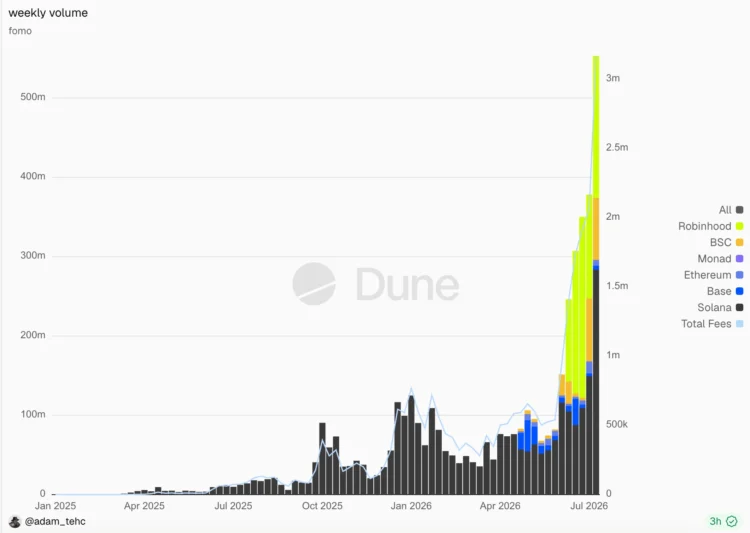
The report said the company’s inflection point came near the end of the second quarter of 2026, with the breakout happening in a matter of weeks. Before that, weekly volume had mostly stayed in the range of several million to several tens of millions of dollars. After July began, trading activity expanded sharply and quickly moved into the hundreds of millions. In the latest trading week, weekly volume climbed above $550 million, setting a fresh high.
This expansion did not come from a single network alone. Before May 2026, Solana accounted for almost all of Fomo’s trading volume. After that, activity spread to Base, BNB Chain, and Ethereum, though the report said those networks made a relatively limited contribution to the overall increase.
Robinhood Chain drove the breakout phase
The main driver behind Fomo’s explosive growth was the launch of Robinhood Chain’s mainnet, which brought a large amount of new trading flow onto the platform. Se Yong Park, Fomo’s co-founder, said: 「On Robinhood Chain, one out of every two active wallets comes from Fomo.」
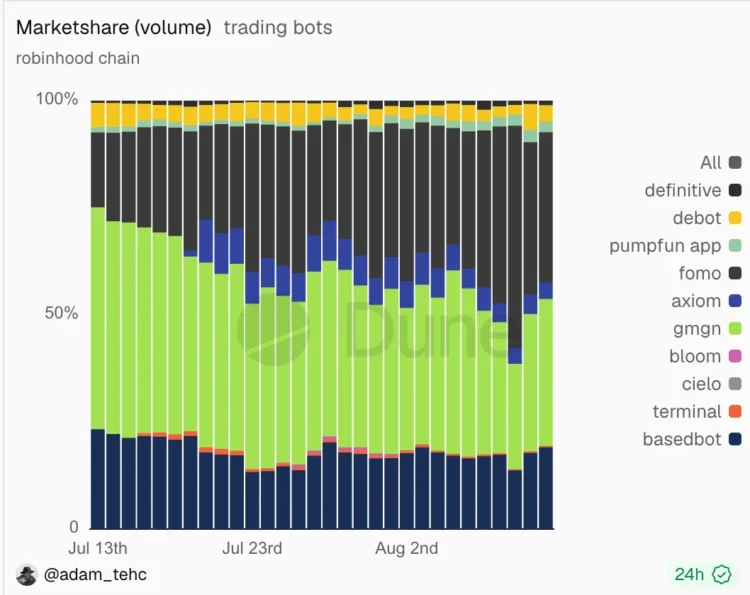
In the latest week, Robinhood Chain contributed about 32.4% of total trading volume, and that share had at one point reached 64.8%. Within the Robinhood Chain ecosystem, Fomo’s traffic lead was even more visible. Dune data cited in the report showed that, as of Aug. 11, Fomo accounted for 35% of trading volume across trading bots on Robinhood Chain. It was also the platform with the highest number of daily active wallets, with more than 92.9% of the chain’s overall daily active wallets.
In the framing of the report, Robinhood Chain supplied Fomo with a new stream of incremental users, while Fomo quickly became a core trading gateway on the newly launched network.
Solana retook the lead and competition with Pump.fun intensified
Even with Robinhood Chain bringing in new users, Solana recently regained its position as Fomo’s largest traffic source, contributing about 51.2% of trading value in the latest reading.
Within Solana, Fomo has also grown into the biggest rival to meme launchpad Pump.fun, according to the report. It said the two sides have begun to clash more directly, with Pump.fun reportedly trying to win over Fomo users through high-priced offers, seeking to lock in traffic through exclusive agreements, and rolling out social trading features similar to Fomo’s. That shift suggests Fomo is no longer just a utility layer for execution. It is competing for control of the on-chain trading entry point.
User growth and fee revenue climbed together
Volume was not the only metric moving higher. The report said the number of weekly traders on Fomo increased 10-fold over the past several months. Dune data showed that before July this year, daily active traders had remained in the thousands for a long period and growth was relatively slow. After Robinhood Chain’s mainnet launch, user activity entered a breakout stage, with daily active traders rising into the tens of thousands and peaking at nearly 48,000 in a single day.
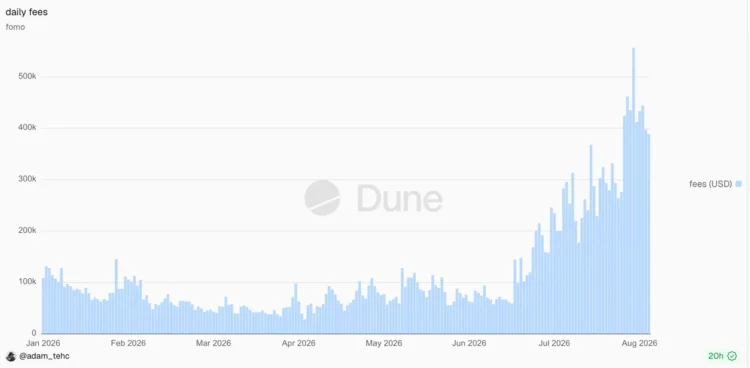
As on-chain activity rose, fees followed. Before the second quarter of 2026, Fomo’s weekly fees were mostly in the tens of thousands to the hundreds of thousands of dollars. After trading volume expanded in July, fee revenue jumped into the millions, reaching about $3.17 million in the latest trading week. The report said Fomo recently made it into the top 10 protocols by revenue across crypto for a period, with revenue exceeding that of Hyperliquid, Axiom Pro, and Pump.fun.
The article’s conclusion was that Fomo’s breakout came from two forces at once: the cold-start traffic generated by Robinhood Chain’s mainnet launch and the continued high-frequency demand coming from Solana’s mature meme ecosystem.
$94 million raised in just over a year
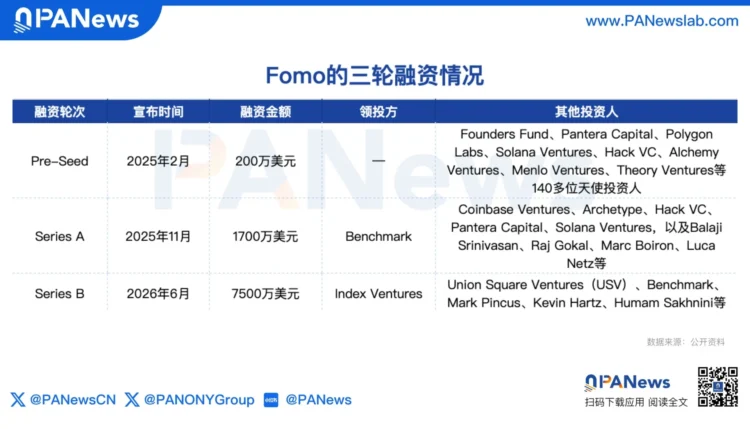
Fomo’s capital raise has been as notable as its product growth. The report said the company completed a $75 million Series B in June led by Index Ventures. Union Square Ventures, or USV, Benchmark, Zynga co-founder Mark Pincus, Discord CEO Humam Sakhnini, and Eventbrite co-founder Kevin Hartz also participated. The round valued the company at $550 million.
For a crypto consumer startup founded only a little over a year ago, that size of financing already stands out. The report argued that the more important question is why Fomo managed to keep expanding while the broader market remained weak.
A 17-person team with dYdX roots
Fomo’s three co-founders — Paul Erlanger, Se Yong Park, and Prashan Dharmasena — all came from dYdX. The report said their previous work in on-chain trading gave the team complementary strengths across product, growth, and engineering.
The company currently has about 17 people. During the first eight months after launch, core members took almost no salary, and non-founder engineers were offered 2% to 3% equity stakes, terms the report said are usually reserved for founding teams. Before product validation was complete, Fomo did not rely on heavy spending to buy growth. Instead, it pushed forward with a small team, low costs, and an incentive structure built around value alignment. The article described that level of capital efficiency as a key advantage during a bear market.
Hiding crypto complexity in the background
The founders’ experience at dYdX also shaped their view that on-chain assets and trading opportunities were expanding, while the user experience still looked like a crypto-native product from an earlier phase. Users entering on-chain trading often had to manage wallets, private keys, and seed phrases, while also dealing with bridges, gas fees, and fragmented liquidity across chains. For mainstream consumers, those steps are barriers in themselves.
Fomo’s answer was not to turn the product into a tool that asks users to learn more about blockchains. It tried to move the complexity into the background and make trading feel closer to a standard consumer app.
Users can sign up with Google or Apple ID, without a seed phrase and without paying gas. The platform also supports funding through Apple Pay, debit cards, or crypto. In an interview cited in the article, Se Yong said Fomo chose not to denominate account balances in SOL, ETH, or other crypto assets. Instead, it shows balances directly in U.S. dollars. He said: 「If an ordinary person sees $100 turn into $98.52 because of underlying token price volatility, they may think the platform stole their money.」 In his view, once trust in fund safety is damaged, it is hard to rebuild.
That de-cryptoized product design appears to have helped pull in users from outside the existing crypto crowd. Data disclosed in June 2026 showed that more than 68,000 users had completed their first crypto purchase through Apple Pay. Julia Andre, a partner at Index Ventures, also said the firm did not invest in Fomo because it was a crypto company, but because 「on-chain trading is too hard.」
Turning trading into social content
Lowering the barrier solves the problem of how users get in. Retention and sharing are a separate challenge. Fomo’s answer was to make trading itself into social content.
The team believes trading is fundamentally social behavior, while existing communities and signal sources remain fragmented and uneven in quality. In a recent interview cited in the report, Se Yong said Fomo’s core vision is to become a social graph for finance, which means the product needs to be seamless, social, and fun.
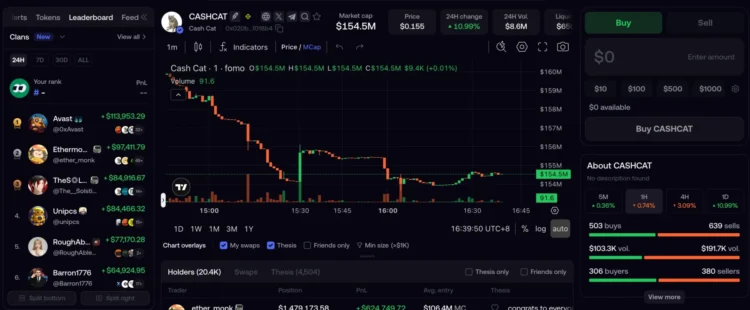
Inside the app, Fomo turns trading into content that users can scroll through, follow, and discuss. Its features include a real-time feed showing other users’ buys, sells, and profit and loss; periodic leaderboards for top traders; follow functions and live notifications; profile pages that display positions and trading history; and charts layered with buy and sell points that let others inspect trading logic. The report argued that once trading becomes content with built-in sharing effects, user acquisition can happen at lower cost, especially among newer participants.
Community fundraising as a cold-start tool
One of the hardest problems for a consumer product is cold start. Fomo concluded that relying only on ads or conventional distribution channels would be expensive before network effects had formed, so it built community fundraising into its cold-start strategy. Paul Erlanger said the team wanted to use fundraising to 「solve the cold-start problem and create distribution channels.」
In its first fundraising round, Fomo assembled a list of about 200 dream investors. Drawing on relationships built at dYdX, it eventually brought in more than 140 angel investors and raised $2 million. These backers were not just capital providers. They included founders and executives at top protocols, well-known venture investors, professional traders, market makers, and industry operators. For Fomo, that group also represented a potential user base and a distribution network.
When the company raised its $17 million Series A, it kept the same structure. Benchmark was the only institutional investor in that round, while the rest came from existing and new angel investors. The report said that for a consumer product trying to build network effects quickly, an investor who understands, uses, and actively shares the product can matter more than simply adding another check.
Meme trading remained active in a weak market
The article also pointed to a practical reason Fomo found room to grow during a bear market. While most crypto assets cooled and trading appetite weakened, meme coins kept a relatively high level of activity and shareability. Those assets depend heavily on attention, social consensus, and immediate sentiment, which fit naturally with Fomo’s social discovery model.
Fomo’s plans go beyond meme trading. The product has already expanded into perpetuals, or perps, and the company plans to cover stocks, derivatives, prediction markets, and additional asset classes.
The growth curve was not immediate
The report noted that Fomo’s rise did not happen overnight. After its first fundraising round, the company went through a quiet period lasting several months, and its user base struggled to move past 140 people. Se Yong said the turning point came from a group of early users who used the product almost every day and kept sending feedback that helped the team iterate. That experience pushed the team toward a different priority: rather than chase headline user counts too early, it focused on serving a small set of early users well and listening closely to what they actually needed.
Whether this high-speed growth can continue, and whether Fomo can turn short-term traffic into long-term users and stable revenue, remains to be tested over time, the report said.