On Robinhood Chain, a token can move from obscurity to the center of market attention in minutes. By the time most traders see it, the harder questions usually begin: who bought first, who copied the trade, whether that wallet has a real record of profits, how concentrated the supply is, and whether the pool has enough liquidity to support an exit.
In a review published by Foresight News, reporter KarenZ mapped out a growing stack of tools built around fomo trading. The common thread is simple: they pull together live trades, trader identities, historical performance, holder structure and off-chain public signals so users can check what they are seeing before they place orders.
GMGN: a single terminal for discovery, analysis and execution
Across Robinhood Chain, BSC and other networks, GMGN offers Trenches, Trending, new token discovery, wallet tracking, holder concentration checks and contract risk review, while also supporting direct trading and position management.
A user can start from a simple question — which tokens are heating up — then move into liquidity, the share held by the top 10 addresses, developer holdings, contract permissions and wallet fund flows before deciding whether to buy.
GMGN also lets users import custom watch addresses and keep tracking those wallets in real time, including buys, sells and position changes.
Beyond on-chain data, the platform includes X and Telegram monitoring. Users can track posts, follows and unfollows from selected X accounts, along with updates from related Telegram channels. Foresight gave one example: traders can add Robinhood founders, core team members and founders of ecosystem projects to a watchlist and monitor new activity from their public accounts and community channels.
The tool also supports AI-generated narrative summaries or token background pages.
rhtrenches: live buy-and-sell tracking for top traders
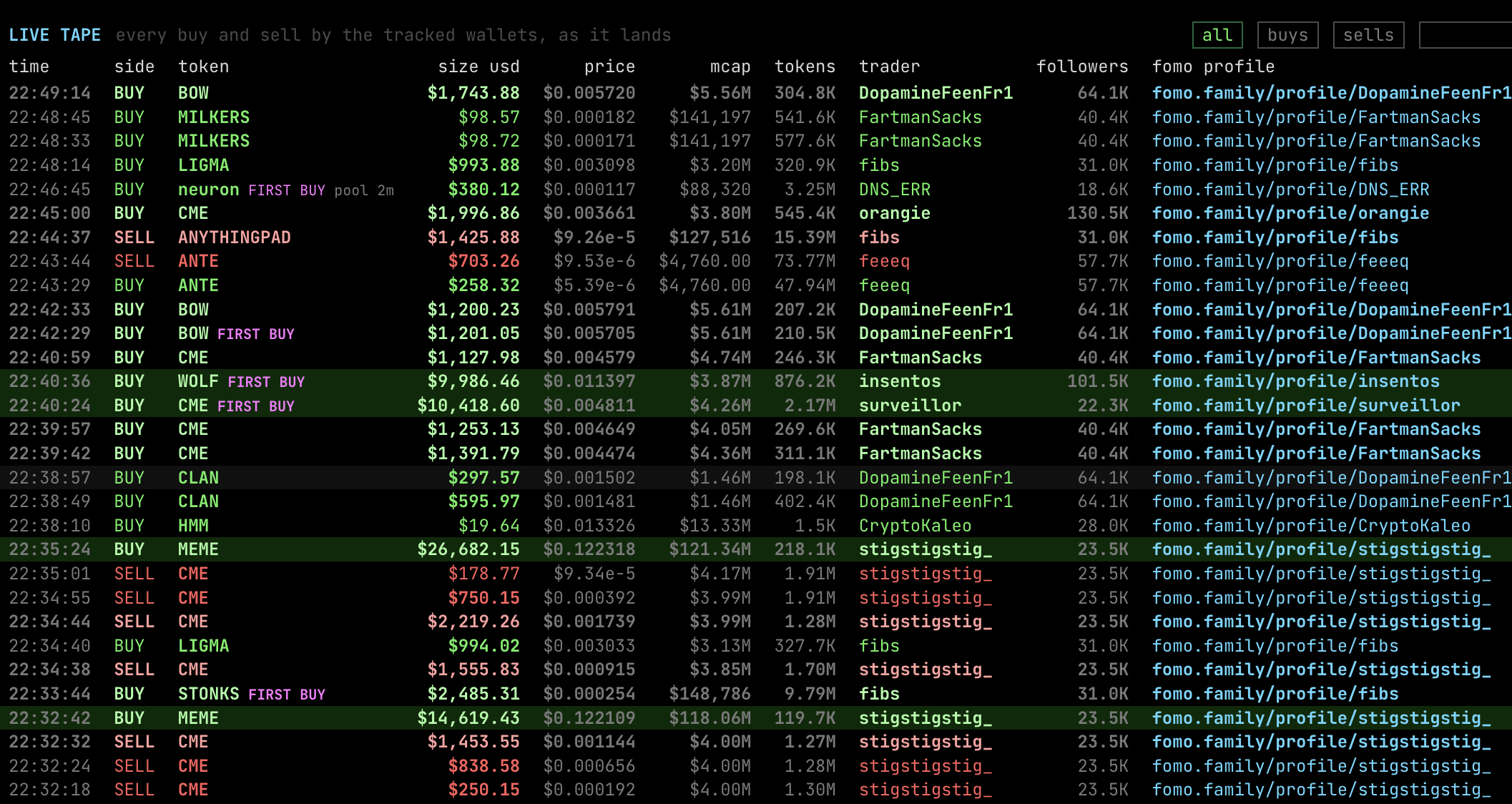
rhtrenches, built by @Degenerate_DeFi, is presented in a format that closely resembles a traditional trading tape. It continuously displays buys and sells from 147 tracked top fomo wallets, including the token, trade size, price, market cap, trader, contract address and on-chain transaction link.
The site also compiles closed positions and provides trader-level metrics such as volume, realized PnL, unrealized PnL on open positions, win-loss count ratio, and each trader’s best and worst trade.
At the bottom of the page, the tool offers three extra views:
- Tokens Being Bought: a consolidated look at tokens currently being bought by tracked traders, including how many wallets joined the buys, how many still hold the token, and which wallet bought first.
- Who Followed Who: a reconstruction of follow-on buying paths between Fomo users, showing who entered first and how many seconds later others followed.
- Fresh Pools: a feed of newly appeared trading pools designed to help users spot assets that have only just entered the market.
DeBot: using AI to add capital signals and token narratives
DeBot supports token scanning, price checks, wallet monitoring and trade execution.
Foresight highlighted two features in particular: AI Signal and AI Narrative. The first is used to screen for tokens being bought in concentration by multiple smart money wallets. The second combines smart money flows, on-chain data and off-chain social information to generate a token narrative, while also organizing related X accounts, public discussion around the contract address and market views to show why the asset is drawing attention.
985monitor: a practical ranking board for quick checks
The 985monitor fomo live ranking board from @Unipioneer is framed as a faster way to check standings. It provides leaderboards for the past 24 hours, 7 days, 30 days and total returns, along with shared-follow rankings, alliance rankings, individual profile lookup and CSV export.
For users trying to find recently strong-performing accounts, match a fomo handle to EVM and Solana wallets, or export data in bulk, the article says this page is more direct than searching through social feeds one account at a time.
FOMO Alpha Radar: traders, capital consensus and narrative in one place
FOMO Alpha Radar, from @Cryptoxiaodd, is described as more than a trade list. Its aim is to answer a narrower question: whether a specific trade is worth deeper study. The page combines consensus signals, trader profit rankings and a narrative radar.
Its signal model weighs trader quality, net inflows, multi-trader consensus, narrative support and time decay. The trader page shows rankings over 24 hours, 7 days, 30 days and full-cycle periods, and allows exports of SOL or EVM addresses for import into GMGN wallet watchlists.
FomoScan: linking a fomo username to on-chain wallets
FomoScan, built by @fomoscansh, allows users to search a fomo handle and find the corresponding Solana and EVM wallets, while also viewing follow relationships between users.
Bubblemaps: holder structure instead of just price action
As the article puts it, price charts tell users how a token moved. Bubblemaps is more concerned with who holds it.
The Robinhood Chain page in Bubblemaps V2 supports views of token distribution, whale addresses, and transfer or funding links between wallets.
Foresight added an explicit caution here: transfers between two wallets, shared initial funding from the same address, or appearance in the same cluster do not by themselves prove that the wallets are controlled by one person. Wallet relationship maps are useful for raising questions, not for assigning an "insider" label without other evidence.
Tingfeng: watching X, Telegram and trade flows together
Tingfeng, from @JokkiBTC, aggregates sources including X, Telegram, fomo and pump.fun. Users can filter by account, event, trade size, token and chain, and can also set separate buy and sell ranges, chain filters, sound alerts and voice broadcasts.
Its "real-time stream" displays consensus signals formed by multi-trader activity, such as how many traders bought the same token within a defined period and the cumulative amount bought. A separate "trend direction" function looks at how capital and token attention are clustering so users can see which assets are drawing market focus.
Fomo Lens: an information card for fomo, GMGN and XXYY
Fomo Lens, from @0xHogen, is an open-source Chrome extension. When users browse tokens on FOMO or GMGN, a floating card can display DeBot narratives, community narratives and the share of holdings attributed to fomo users.
FomoAPI: a data layer aimed at bots and developers
While the earlier tools are mainly trader-facing, FomoAPI is positioned more like a developer data service.
Through REST and WebSocket, it provides traders’ SOL and EVM wallet addresses, plus period-based PnL, holdings, trade records, follow relationships, rankings and thesis data. It also supports real-time trade updates and alerts. Developers can use the feed to build monitoring bots, Telegram push services, trader research dashboards or custom analytics tools.
Risk warnings highlighted in the article
Foresight closed with a broad caution. These tools are mainly designed to aggregate, organize and display public information. They are not investment advice, and they do not guarantee complete, real-time or accurate data. Rankings, smart money tags, multi-trader consensus signals and historical PnL should be treated as research leads rather than a basis for inferring future returns.
A trader who made money in the past may not profit on the next trade. Multiple wallets buying at the same time may reflect copy-trading, linked wallets or short-term emotion rather than independent judgment.
The article also noted that different tools may use different methodologies for returns, holdings, trade counts and the definition of smart money. AI-generated token narratives and background summaries may omit information or make faulty associations. When questions involve project origins, celebrity relationships or contract addresses, users should verify against original posts, official project accounts and block explorers.
For trading terminals, browser extensions and wallet-linked tools, the article urged users to review the domain, installation source, extension permissions, signing content and contract approvals carefully. When testing a new tool, it suggested using a fresh wallet with a smaller amount of funds.
It also warned that new tokens can face thin liquidity, sharp price swings, contract permission risks, malicious token design, honeypot setups and liquidity withdrawals by project teams. Even if a risk-check page shows no obvious issue, that does not mean funds are absolutely safe. DYOR.