
Foresight News used this week’s roundup to map out the stories that drew the most attention across crypto, splitting the list into three buckets: industry debate, black swan events and project-level developments. The lineup ranged from Harry Yeh’s death in Paraguay and a running count of failed Web3 projects to fresh tension over Bitcoin scaling, a string of security incidents, Ethereum roadmap changes, Bitwise’s product reshuffle and Trump Media’s widening business mix.
Industry debate
Harry Yeh death in Paraguay remains under investigation
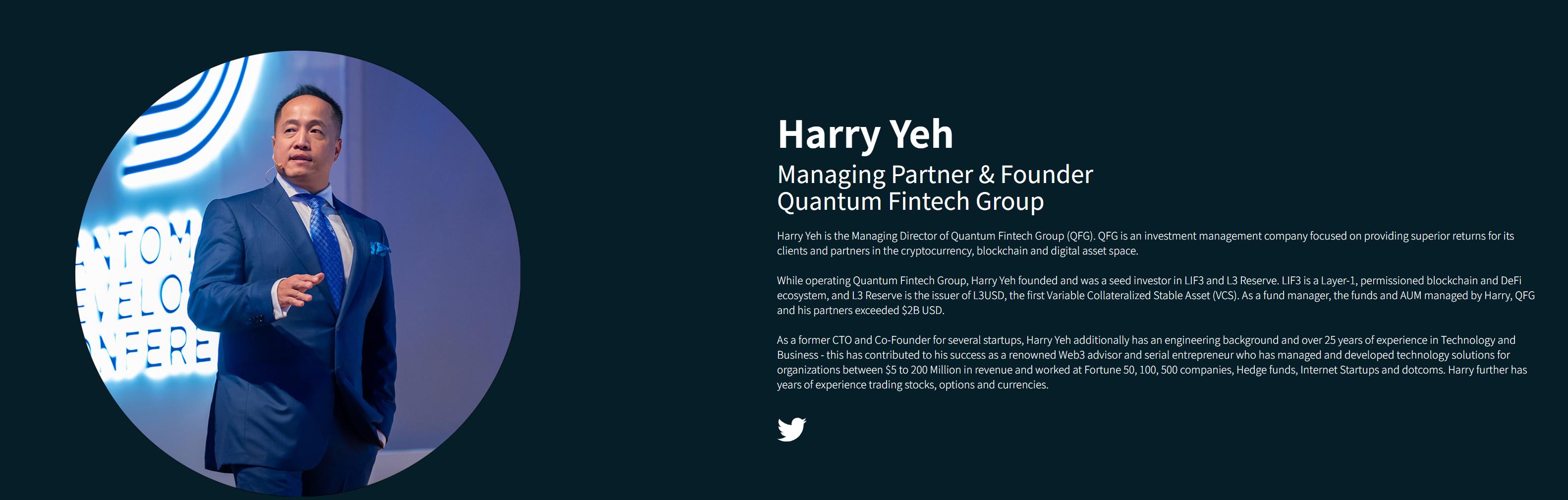
Foresight highlighted 「The full story behind Harry Yeh’s fatal fall from a 30-story building in Paraguay」 as one of the week’s standout reads. The report said the death of Harry Yeh, a Chinese crypto industry figure based in Paraguay, sent shockwaves through the community. Questions at the scene have fueled speculation, but police have not reached a final conclusion.
According to the article, Paraguayan outlet La Tribuna reported on Aug. 7, 2026 that a Chinese man had been found dead outside Jade Park, a luxury apartment tower in the Trinidad district of Asuncion. He was preliminarily identified as Harry Chun Tak Yeh, also known online as @harryyeh, the founder and managing partner of Quantum Fintech Group.
Police said the fall was initially estimated to have happened early Tuesday local time the previous week, from the building’s 30th floor. Jade Park is described as one of the tallest buildings in the area. The report said his body was found naked and covered with a black plastic bag. Investigators later inspected a 30th-floor apartment tied to him and found the door open and the interior badly disturbed. A separate apartment linked to him on the 27th floor in the same tower was also processed by forensic staff.
The article added that Yeh’s 29-year-old Brazilian girlfriend lived on a lower floor and told authorities she knew nothing about the incident. Paraguay’s homicide unit and criminal technicians collected evidence and passed it to prosecutors. Prosecutors are examining accident, possible suicide and homicide in parallel, and the body has been sent to the judicial morgue for autopsy. No official final conclusion has been issued.
More than 300 Web3 projects have faded over roughly 588 days
Another featured piece, 「588 days, 300+ Web3 projects sink into the deep」, focused on the pace of industry washout. Foresight framed the trend as a sign that capital is no longer paying for empty narratives and that self-sustaining business models have become the baseline for survival.
Based on the publication’s review of public information, at least 78 Web3 projects with total financing above $1.5 million have announced shutdowns since 2025. Among 69 projects with verifiable fundraising figures, combined funding exceeded $900 million. If smaller projects that never raised institutional money and quietly disappeared are included, the total rises well past 300.
That works out to roughly one Web3 project dying every two days over close to 600 days. The article described the process as a brutal but familiar industry cleanse, one that leaves room only for builders serving real demand with durable commercial models.
Li Lin returns to the conversation through UMX
Foresight also pointed readers to 「From Avenir to UMX: Li Lin’s return and a new set of questions」. The piece argued that Li Lin’s re-entry into the spotlight through Avenir Group-backed UMX says less about another exchange launch and more about the intersection of crypto and traditional finance.
The article looked back to 2013, when Li founded Huobi with a simple goal: build a better Bitcoin trading site. Thirteen years later, after moving from frontline entrepreneur to investor and allocator, the problem in front of him has changed. Earlier trading venues were built around one question, how digital assets could be traded more efficiently. Today, professional investors often hold BTC, stablecoins, U.S. equities, ETFs, options and yield products at the same time. The new question is how those assets can sit inside one funding and risk framework.
UMX is presented as an attempt to connect crypto assets with U.S. stocks and ETFs through a unified account structure. Whether the model works still depends on real users and market cycles, the article said, adding that it is too early to make a firm judgment.
BIP-110 revives Bitcoin scaling conflict
In 「Bitcoin community erupts: understanding the new scaling fight triggered by BIP-110」, Foresight described the latest dispute as a fight over what block space should be used for and how consensus rules can be changed.
On Aug. 10, Luke Dashjr, a long-time Bitcoin Improvement Proposal editor and the co-founder and CTO of Ocean pool, was removed from the editor group and lost his editorial access. The article said colleagues cited his decision to push BIP-110 outside the normal discussion process, assign a proposal number ahead of consensus and his limited recent contribution to editorial work.
The immediate backdrop was a chain split a few days earlier. On Aug. 8, the Bitcoin network split at block height 961,632. A set of nodes refused to follow the main chain and continued enforcing BIP-110, a soft fork proposal that Luke helped draft and that would ban the insertion of non-payment data into transactions. The minority chain managed to add only one extra block before stalling, while the main chain continued and quickly pulled ahead by dozens of blocks.
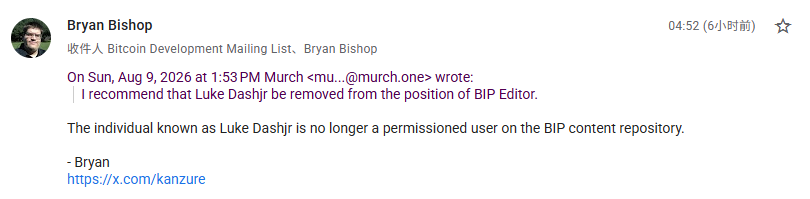
Foresight’s conclusion was straightforward: paper proposals do not decide Bitcoin’s direction on their own. Hash power, miners and user consensus still make the final call.
Black swan events
DeFi whale drained again, with losses estimated at $25 million to $26 million
「Phished three years ago, drained again now: DeFi whale loses another $25 million」 followed a veteran DeFi holder who was hit for a second time. Foresight said the victim had already suffered an eight-figure phishing attack three years earlier and, despite recovering most of the funds then, did not close the security gaps that mattered.
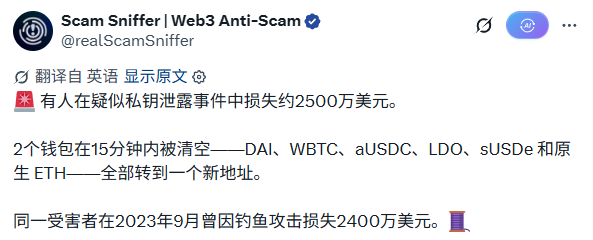
Scam Sniffer posted on X early on Aug. 13 that two wallets belonging to one user had been emptied within 15 minutes. DAI, WBTC, aUSDC, LDO, sUSDe and native ETH were all transferred out, with total losses estimated at roughly $25 million to $26 million. The victim address had previously lost $24.23 million in a phishing incident in September 2023.
On-chain analyst EmberCN said three wallets were involved. One of them, 0x8f3...914, had never shown any token approval history and had been treated as a clean wallet. Its depletion suggests the incident was not a simple approval-phishing case and that the attacker likely had direct control of the private key.
Trezor order labels and customer data exposure raise privacy concerns
「11,742 delivery addresses leaked together with Trezor orders」 examined the gap between private-key security and identity security. The point of the story was that a hardware wallet can protect keys while still exposing the owner in the real world.
On Aug. 11, a Trezor customer posted about receiving a Trezor Safe 3. What stood out was not the device inside the package but the shipping label outside it. Instead of using a generic description such as electronics, the label plainly said 「Trezor Safe 3 Bitcoin Only」. The user, Angelus Borgia, said the package was shipped within the United States and did not involve international customs forms, prompting him to ask why the full product name had to be printed on the exterior.
Two days later, on Aug. 13, Trezor disclosed a more serious issue: its logistics partner ShipMonk had suffered a data breach. Nearly 14,000 customers had information exposed, including names, email addresses, phone numbers and shipping addresses. Foresight said the leak sharply increased the risk of social-engineering attacks and showed that self-custody security begins long before a wallet is turned on.
Harmony exploit expands ONE supply and crushes price
Foresight’s piece 「Hackers mint trillions of ONE: Harmony suffers another major blow」 focused on a fresh vulnerability at Harmony. The report said attackers abused a flaw in cross-shard receipt validation to mint a large amount of ONE and trigger a violent market reaction.
On Aug. 12, X user Juiceberg wrote that on-chain data showed Harmony had been exploited. The attacker minted about 4 billion ONE through empty blocks, worth a little over $3 million and equal to 26% of total supply. Roughly 2.8 billion of those tokens were quickly sent to exchanges during the price collapse. At the same time, Harmony’s total-supply endpoint failed to reflect the new issuance, leaving a mismatch between actual on-chain supply and publicly displayed figures.
The attacker was left with about 115 million ONE on-chain, or roughly 2.9% of the minted amount. Most of the rest had already moved into exchange accounts, where the tokens may have been sold or parked in deposit wallets. After the exploit became public, ONE fell from $0.00118 to a low of $0.00056, then recovered to $0.00078. The 24-hour loss was close to 38%.
Impersonation scam tied to at least $5 million in losses
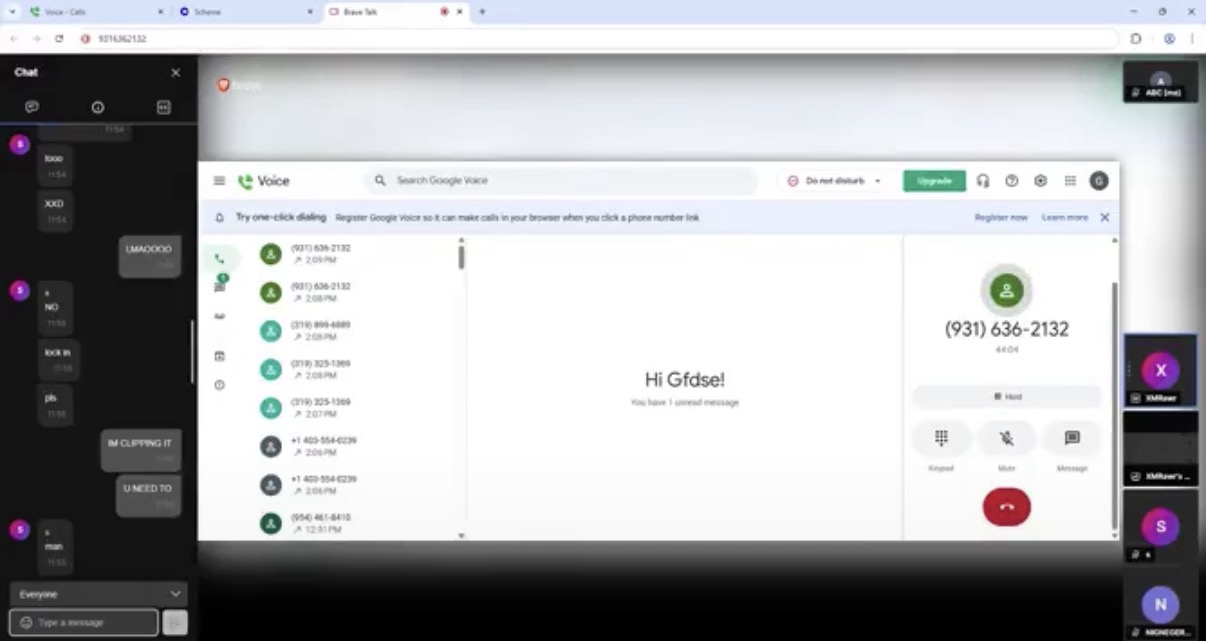
In 「Even U.S. crypto users are not spared: she stole $5 million by posing as exchange support」, Foresight looked at a social-engineering fraud case involving fake support calls. The article said a U.S.-based minor impersonated exchange and hardware-wallet staff, pushed victims to disclose sensitive information and stole at least $5 million in crypto.
On the evening of Aug. 10, on-chain investigator ZachXBT published a detailed thread about the case. He said the scammer, using the alias Tiffany Milanovich, mocked victims during calls and later flaunted the stolen money on social media. ZachXBT identified the person as a minor, and some media reports cited by the article said the individual was about 17 years old.
The report stressed a basic point: crypto transfers are irreversible, so unsolicited calls claiming to be from security teams should be treated with suspicion, and seed phrases should never be disclosed.
Bybit recovery effort reaches about $78.9 million after Lazarus-linked theft
Foresight also revisited Bybit’s legal and recovery campaign in 「Bybit sues North Korean hacking group in U.S. court, and more than 90% of funds may already be out of reach」. The piece said that after the 2025 theft of about $1.46 billion in crypto attributed to Lazarus Group, Bybit turned to U.S. litigation and sought asset freezes. Most of the money, though, moved quickly through laundering channels.
So far, Bybit and its partners, including blockchain analytics firms, exchanges and international law enforcement agencies, have recovered about $48.4 million in stolen assets and frozen another $30.5 million across more than 28 exchanges and custodians. Combined, that is about $78.9 million, or roughly 5% of the total loss.
The U.S. Federal Bureau of Investigation identified Lazarus Group as the actor behind the attack, according to the article. Follow-up actions included the dismantling of the crypto exchange eXch by German authorities and the joint shutdown of mixer platform Cryptomixer.io by German and Swiss authorities. Even with those actions, most of the stolen funds have already moved beyond effective tracing through cross-chain bridges, mixers and over-the-counter channels. Court orders in the case only apply to identifiable on-chain assets. Once the money is mixed, bridged and handed to entities or individuals outside the reach of freeze cooperation, recovery becomes far harder.
The article added one more complication: ETH was around $2,730 when the theft happened and is now about $1,920, a drop of roughly 30%. Even if some assets are found later, their dollar value has already fallen sharply.
Project insights
Vitalik’s updated Strawmap puts privacy and post-quantum security higher on the list
「Privacy, quantum security, native rollups: what was added to Ethereum’s roadmap?」 centered on Vitalik Buterin’s latest Strawmap update. Foresight said the comparison with his 2023 roadmap shows a clear shift in what Ethereum now treats as core work.
On Aug. 10, Buterin published an overlay comparing the 2023 roadmap with the current Strawmap. He said the overlap was still high overall, but some items had moved up in priority, including quantum security. Others had moved down, such as VDFs and several EVM improvements. Some previous approaches were replaced by alternatives judged to be better, with Verkle trees first replaced by a unified binary tree and then by PBT, while state expiry gave way to new state types.
The current roadmap also introduces several directions not present at all in 2023. Strong privacy is now listed as a first-tier concern. Aggressive scaling appears in a post-quantum context. The protocol specification is being simplified to support formal verification, and Buterin said AI makes full formal verification of the protocol possible. The roadmap also adds the concepts of block and gas futures, native rollups and more design room for the future of the EVM, with the possibility that the protocol could eventually expose a non-EVM instruction set architecture to users.

Ethereum shifts away from Poseidon at L1
Another featured story, 「After eight years of research, why is Ethereum suddenly dropping Poseidon?」, covered a notable cryptographic change. Foresight said the Ethereum Foundation has decided not to use Poseidon as an L1 hash function and is turning instead to more established options such as SHA2 or BLAKE2.
On Aug. 13, Ethereum researcher Justin Drake wrote on X that Ethereum had decided to abandon the SNARK-friendly Poseidon hash at layer 1 in favor of SHA2 or BLAKE2. The article described the move as the product of eight years of research, tens of millions of dollars in spending and a significant correction to Ethereum’s post-quantum cryptography path.
With progress in binary-field SNARK technology, the efficiency of zero-knowledge proofs for traditional hash functions has improved sharply, the piece said. Faced with a growing quantum threat, Ethereum is leaning toward mature cryptographic primitives that have been tested over a much longer period.
Bitwise shuts eight ETFs, cuts staff by 14%, and still launches products
Foresight’s report 「Why is Bitwise still launching products after shutting eight ETFs and cutting staff by 14%?」 traced a restructuring that combines contraction with expansion. It said that after client assets shrank by more than $4 billion, Bitwise moved to cut heavier Web3 and options-related products while directing resources toward staking and tokenization.
The timeline in the article is specific. In April, Bitwise launched an Avalanche ETP in Europe with internal staking arrangements. In May, the Hyperliquid ETF went live. In June, the firm took over Superstate’s Crypto Carry Fund, which had more than $267 million in assets, entering tokenized fund management.
Bitwise said in a June 30 announcement that it had 70 investment products, served more than 5,500 private wealth teams, registered investment advisers and family offices, and worked with more than 20 banks and broker-dealers. A product set that large means a steady burden across compliance, custody, trading support, disclosures and customer service.
Headcount dropped from 180 to 155, leaving a team about one-seventh smaller. Seen alongside the eight ETF closures, the newer products show where resources are still going. Web3 thematic funds and options-income strategies built around single assets are being wound down, while spot-oriented crypto exposures, staking-yield products and tokenized fund structures remain in focus. Bitwise has not said which roles were tied to the product changes and has not disclosed any one-time layoff costs.
Trump Media keeps stretching beyond social media
The final featured piece, 「What kind of company is Trump Media becoming?」, examined Trump Media & Technology Group’s widening business profile. Foresight said the company is no longer just a social-platform operator. Social media, crypto exposure, low-latency market data products and frontier technology bets are now sitting inside the same public company.
The article said Trump Media posted second-quarter revenue of $1.67 million and a net loss of $238 million. It recently scrapped a public-listing plan for a CRO treasury company, then converted about $160 million in Bitcoin-related equity securities into spot BTC. Its newest business line is a low-latency API selling public posts from top accounts, including Donald Trump’s, to Wall Street trading firms.
On the surface, second-quarter revenue rose 89% year over year. But the report said Truth Social’s core advertising revenue was actually falling, and the large loss mostly reflected swings in crypto asset prices. The company’s highlighted $1.9 billion in financial assets is also not the same thing as unrestricted cash. Only about $425 million of that total is cash and short-term investments.
Management has also told investors that the company’s most important future value driver is a fusion company, referring to the major combination it is pursuing with TAE. For Foresight, the real takeaway from the quarter is that Trump Media is still redefining what it is and how it plans to make money.
The week in one frame
Put together, the roundup points to three parallel tracks. High-profile people and legacy names are still shaping the narrative, from Harry Yeh and Li Lin to Trump Media. Security failures remain constant, and the weak points now extend well beyond wallets to shipping labels, customer databases and fake support operations. At the same time, infrastructure and asset-management strategy are both being redrawn, with Ethereum and Bitwise each shifting resources toward what they see as the next durable layer of the market.
Disclaimer: Markets carry risk, and investors should act with caution. The article does not constitute investment advice. Readers should assess whether any views or conclusions discussed are suitable for their own circumstances and bear their own responsibility for investment decisions.