
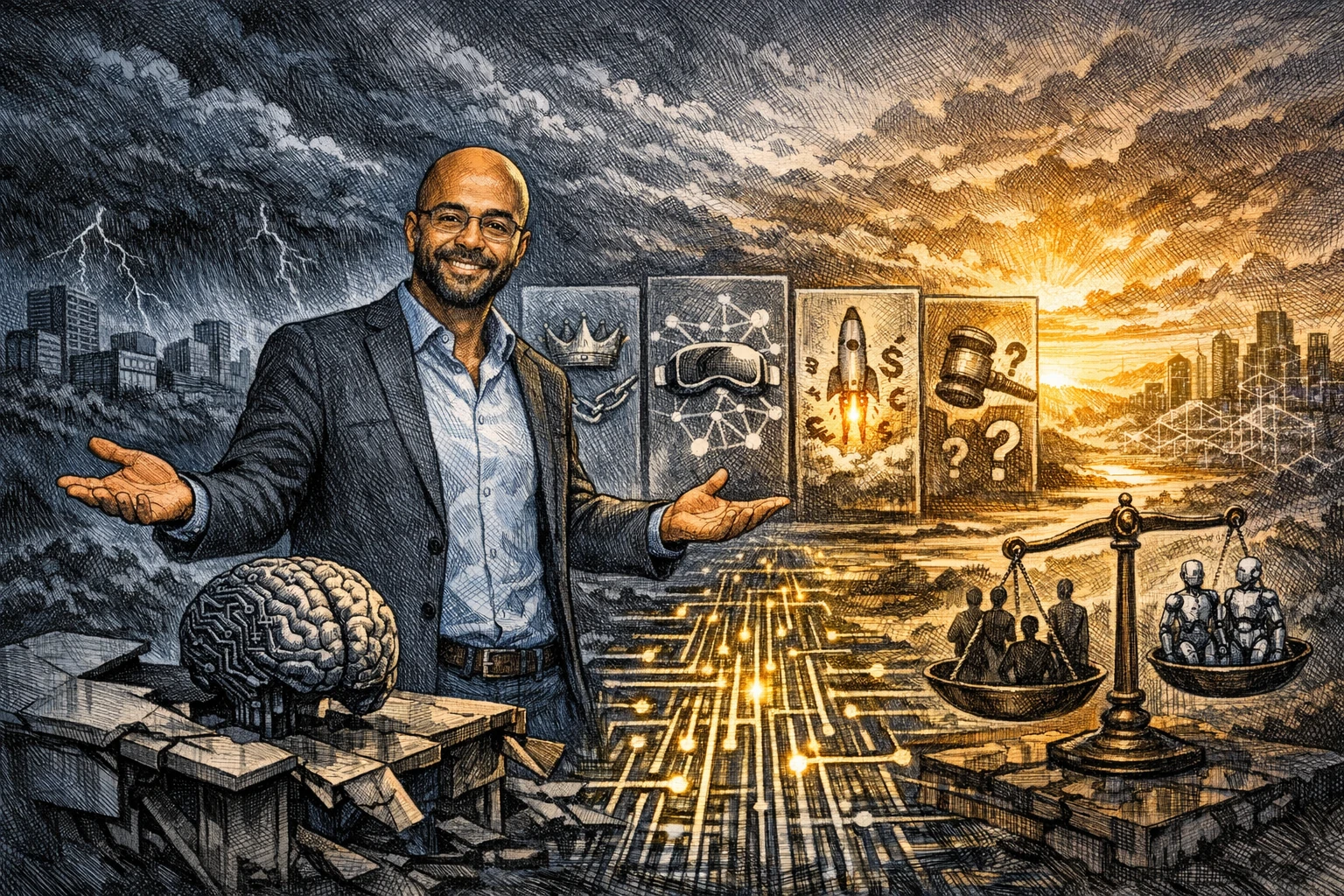
Mo Gawdat, former chief business officer at Google X, said in a recent interview that the labor shock tied to AI is already underway and could peak around 2027. He argued that entry-level white-collar roles are the first to be squeezed, while graduate hiring has already fallen by 23% to 30%. In his view, the world may face 12 to 15 years of instability before any broader reset takes shape.
FACE RIPS as his framework for the next wave
Gawdat used a seven-part framework he calls “FACE RIPS” to describe the shift, grouping the pressure points around power, freedom, reality, connection, innovation, economics, and accountability. His most striking claim was that AI may be humanity’s “last innovation.” He said AI is no longer limited to assisting with tasks and is now being used to build better AI, while also contributing to new discoveries in math, biology, and materials science. Once machines outperform humans at a given intellectual task, he said, that work will eventually move to machines.
He tied that view to a larger economic problem. If production capacity expands through AI while labor demand shrinks, the current model of income, work, and consumption comes under strain. Gawdat said some industries could see unemployment reach 10%, 20%, or even 30% in the next few years. He also raised the prospect of universal basic income, but framed it as a political fight over who pays and who controls the system when fewer people are needed in the workforce.
Entry-level office jobs face the earliest pressure
On the jobs most exposed, he pointed to customer support agents, clerical workers, researchers, and accountants. His argument was blunt: if AI can handle the work, companies will use it. He added that AI has not fully displaced some management roles yet, not because the models cannot process complexity, but because they still need to manage difficult human interfaces. He does not expect that gap to remain for long. Over the next 2 to 3 years, he expects the labor market to shift sharply.
He spent particular time on new graduates. If mid-level staff lose their roles, they do not disappear from the market; they move downward and compete for more junior jobs, making entry harder for recent graduates. Gawdat’s advice was not to resist AI but to get ahead of it. He used his own writing process as an example, saying his latest book was created with an AI collaborator named “Trixie,” which he said even had editorial authority in the project.
Startup building speed is changing fast
Gawdat said entrepreneurship is also being rewritten. He described the old model as chess, where founders tried to see far ahead. Now, he said, it looks more like squash, where constant reaction matters more than long static planning. He used his own startup, Emma, as an example. According to Gawdat, the company was built in just 6 weeks by him, a co-founder, two or three engineers, and 8 AI systems. He said the same effort in 2022 would have required 4 years and 350 engineers.
He also cited comments from another interview segment suggesting that if AGI covers all forms of labor, even CEOs would not be protected. For him, the issue is not only which profession gets automated first. It is what happens to demand when large groups of people lose income. He noted that 70% of the US economy last year was driven by consumption. If consumers cannot afford goods, businesses cannot keep selling at the same pace.
His education warning is just as aggressive
On education, Gawdat made one of his boldest predictions: the traditional university model may not survive the next 10 years. He said credentials and exams will lose weight as AI changes how problem-solving works. The real divide, in his telling, is between people who outsource thinking to AI and people who use AI to process information while keeping judgment and synthesis for themselves. In the first case, human capability weakens. In the second, it expands.
He offered four principles for children and younger workers. First, learn to lead AI rather than fear it. Second, stay adaptable and spend time each week following new AI developments. Third, hold the line on ethics, especially against surveillance and autonomous weapons. Fourth, do not accept information at face value. He said tools such as Gemini, DeepSeek, and ChatGPT can be compared against one another to surface contradictions and get closer to what is true.
For the longer run, Gawdat said AGI could arrive as early as this year, though embedding it into business management would take more time. He argued that an AI arms race will keep pushing deployment forward, whether societies are ready or not. His bottom line was narrow and harsh: master AI early, and demand ethical limits while the shock phase unfolds. He believes that difficult period could last 12 to 15 years.