
Twenty-five days after leaving the White House, David Sacks — the former White House AI and Crypto Czar — made his first public industry commentary on the All-In Podcast, delivering a mixed verdict on Anthropic: high praise for its enterprise business model, paired with blistering criticism of its policy tactics.
Anthropic's $30B ARR: Coding Hits the Enterprise Bullseye
Sacks argued that Anthropic's bet on code generation targets a core enterprise pain point: convincing CFOs to pay for AI by tying it directly to engineer productivity and cost savings. Claude's coding strength is driving rapid enterprise adoption. Numbers back this: Anthropic's annualized recurring revenue (ARR) has surpassed $30 billion, overtaking OpenAI's roughly $25 billion ARR. In February alone, it added $6 billion in monthly ARR. Enterprise customers with contracts over $1 million per year doubled from 500 to over 1,000. Sacks called it a clear strategic win, not an accident.
He also noted Anthropic is aggressively expanding agentic capabilities, moving Claude from a Q&A tool to an autonomous task executor — aligning with the next wave of enterprise demand.
OpenAI's Consumer Hangover
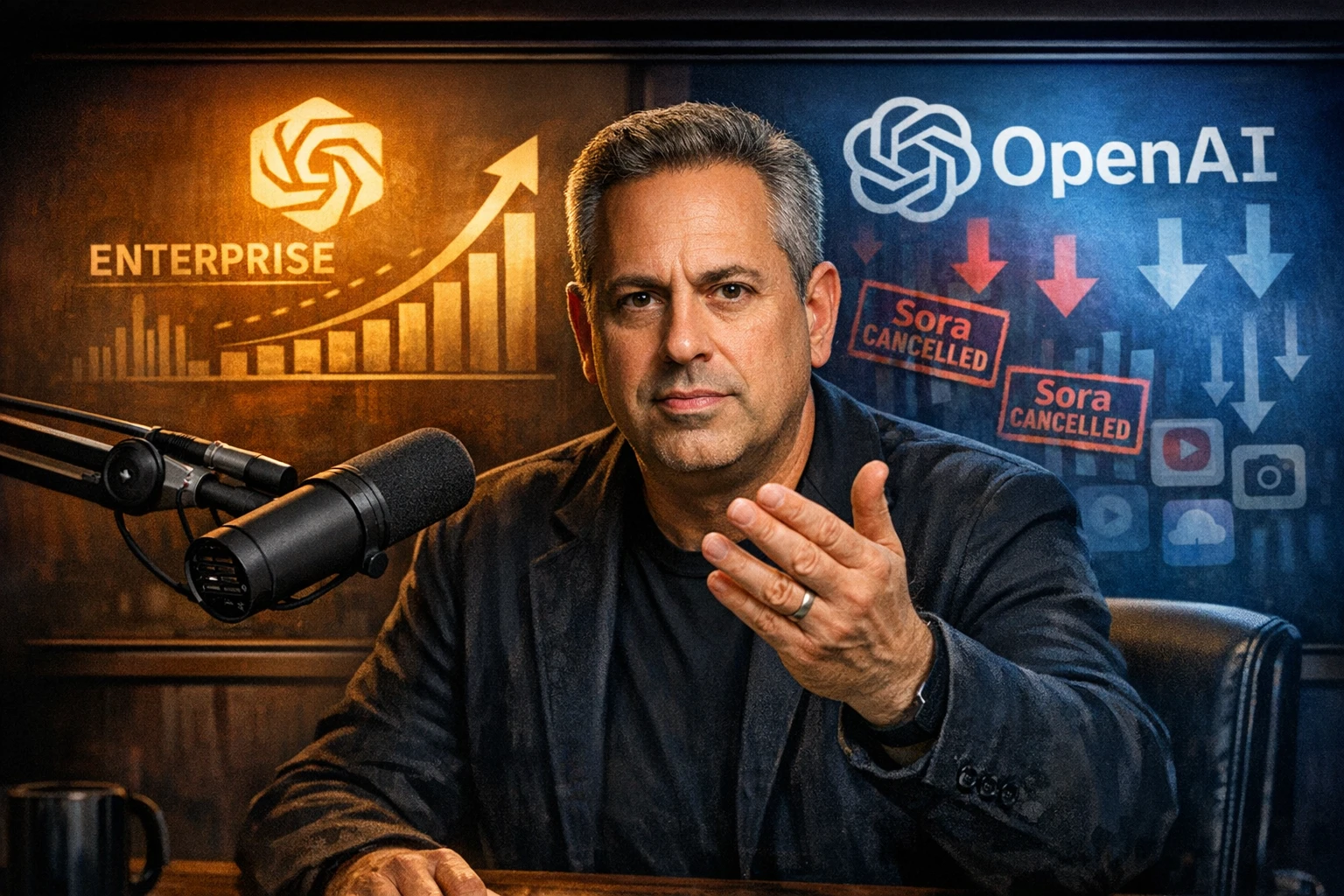
Sacks contrasted Anthropic's path with OpenAI's consumer-heavy bet — GPT apps, Sora video generation, ChatGPT subscriptions — which burned cash with slow monetization. OpenAI is now forced to pivot back to enterprise and has promised investors a 17.5% guaranteed return to shore up confidence. Anthropic, he said, avoided that detour and leapfrogged ahead.
Mandatory Licensing: A 'Sophisticated Regulatory Capture' Play
But Sacks did not stop at praise. He accused Anthropic of running a "sophisticated regulatory capture strategy based on fear-mongering." The company's push for a mandatory permissioning regime — requiring government approval before deploying AI models — would, Sacks argued, create high barriers for startups while leaving deep-pocketed incumbents like Anthropic largely unscathed. Effectively, Anthropic is packaging its own competitive advantage as a public safety measure.
Mythos Research: Real Threat or Chicken Little Routine?
In a separate All-In episode, Sacks questioned Anthropic's Mythos model research, which claimed it could find critical vulnerabilities in major systems within hours. He called it a possible "tactic" or even a "Chicken Little routine" — sky-is-falling fear-mongering. He didn't dismiss the risk entirely but insisted such narratives, if used to drive regulation, must face independent scrutiny, not self-serving benchmarks.
AI Doomerism as Self-Inflicted Injury
Finally, Sacks zoomed out to geopolitics. He warned that America's indulgence in AI doomerism — endless debate over existential risks — is a "self-inflicted injury" that slows the US down in the AI race with China. The stance mirrors his tenure as White House AI Czar, but delivered now without political armor, it lands with sharper edge.