
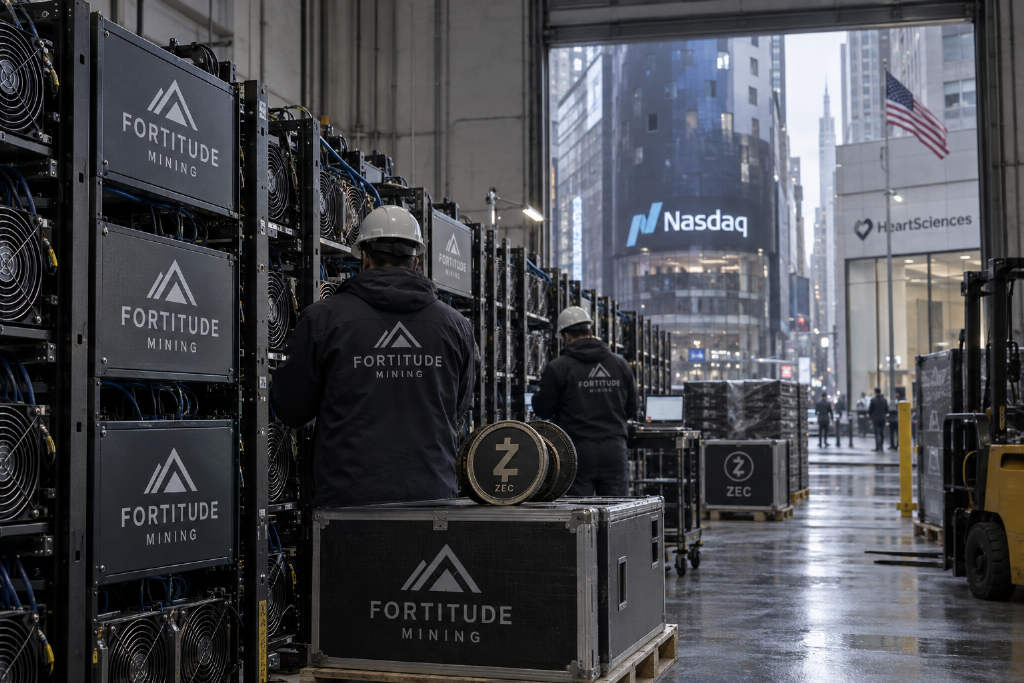
Fortitude Mining, the mining company spun out of Digital Currency Group’s Foundry unit, is pushing ahead on two tracks at once: expanding its ZEC mining business and pursuing a U.S. public listing. The company said it mined 72,696 ZEC in the first half of 2026, or about 28% of total network output over the same period, while also moving to go public through a merger with Nasdaq-listed HeartSciences.
DCG carved out Foundry’s self-mining business
According to a PANews report by Suanli Zhi Xin, DCG separated Foundry’s proprietary mining business in January 2025 and formed a wholly owned subsidiary, Fortitude Mining. Rather than competing directly with Bitcoin miners for power, the company centered its strategy on Zcash (ZEC), a long-running proof-of-work token known for its privacy features.
By the first half of 2026, Fortitude’s mined ZEC accounted for about 28% of network issuance during the same period. Against that backdrop, the company began planning a reverse-merger transaction that links crypto mining with a listed medical AI company.
Jaime Leverton to take over as CEO on Sept. 21
Fortitude announced on Sept. 17, 2026 that Jaime Leverton would become chief executive officer effective Sept. 21. Former CEO Andrea Childs moved into the COO role, taking charge of mining-site operations, the mining fleet, and infrastructure.
The report said Leverton previously led Hut 8 and played a central role in the cross-border merger between Hut 8 and US Bitcoin Corp. She was removed as Hut 8 CEO in February 2024, with US Bitcoin Corp. president Asher Genoot taking over, but she remains one of the few executives in the sector with direct experience in public-market mining company transactions.
All-stock merger with HeartSciences
Instead of taking the traditional IPO route, Fortitude chose a reverse-merger structure to reach the market faster. On June 23, 2026, the company announced an all-stock merger agreement with HeartSciences, a Nasdaq-listed company.
The two businesses come from very different sectors. HeartSciences develops electrocardiogram artificial intelligence algorithms, while Fortitude is a token mining company. Under the proposed structure, HeartSciences’ existing medical team would continue its healthcare work after closing, while the combined company would be renamed Fortitude Mining Group and apply to trade on Nasdaq under the ticker TUDE.
On a fully diluted basis, parent company DCG is expected to hold about 95% of the merged entity.
72,696 ZEC mined in the first half
Fortitude’s main pitch to investors is its operating scale and cash-flow profile. In the first half of 2026, the company mined 72,696 ZEC, equal to about 28% of total ZEC network output during the same period.
To support that production, the company operates seven mining sites across South Dakota, Nebraska, Texas, and New York, with a combined power mix of more than 60 megawatts.
Fortitude also signed an agreement with Bitmain in May 2026 to buy 9,000 Antminer Z15 Pro machines. The company disclosed the terms in late July: a unit price of $3,499, a total value of about $31.5 million, and deliveries scheduled in two batches in October and November.
Q2 revenue reached $20.9 million
For the second quarter of 2026, Fortitude reported revenue of $20.9 million and a net loss of $9.5 million. The report said that figure included $10.3 million in miner impairment charges and another $5.6 million in depreciation and amortization.
Excluding those non-cash items, adjusted EBITDA came in positive at $8.5 million.
KuPool points to rising ZEC hash-rate pressure
The report also cited comments from the KuPool technical team, which it described as having developed and operated the world’s largest Zcash mining pool. In an interview, the team said the influx of North American capital and the resulting rise in ZEC hash rate are already established facts and will remain a core industry trend.
KuPool said Zcash’s Nu7 upgrade proposal is scheduled to go live on Nov. 5. At that point, block time would be cut from 75 seconds to 25 seconds. That change would sharply increase the number of blocks produced each day, speed up on-chain transaction packaging, and improve transfer performance for end users.
The team also said the faster block cycle will place much tougher demands on mining-pool infrastructure. According to the report, KuPool has already added support for the new Zcash client and invested in lower-layer network optimization to reduce hash-rate delay and block-loss risk under Zcash’s network conditions, with the goal of keeping miner returns stable during high-concurrency periods.
The model still depends on ZEC prices
The report noted that placing heavy mining assets into an existing listed shell company is not a new script in U.S. equity markets. From early Bitcoin miners to more specialized vertical mining companies, capital has kept looking for new public-market vehicles.
Even so, Fortitude’s business model remains tied to the secondary-market price of Zcash. Cash flow may be running and machines may keep operating, but valuation still comes back to the cycle between miner depreciation and token-price swings.