
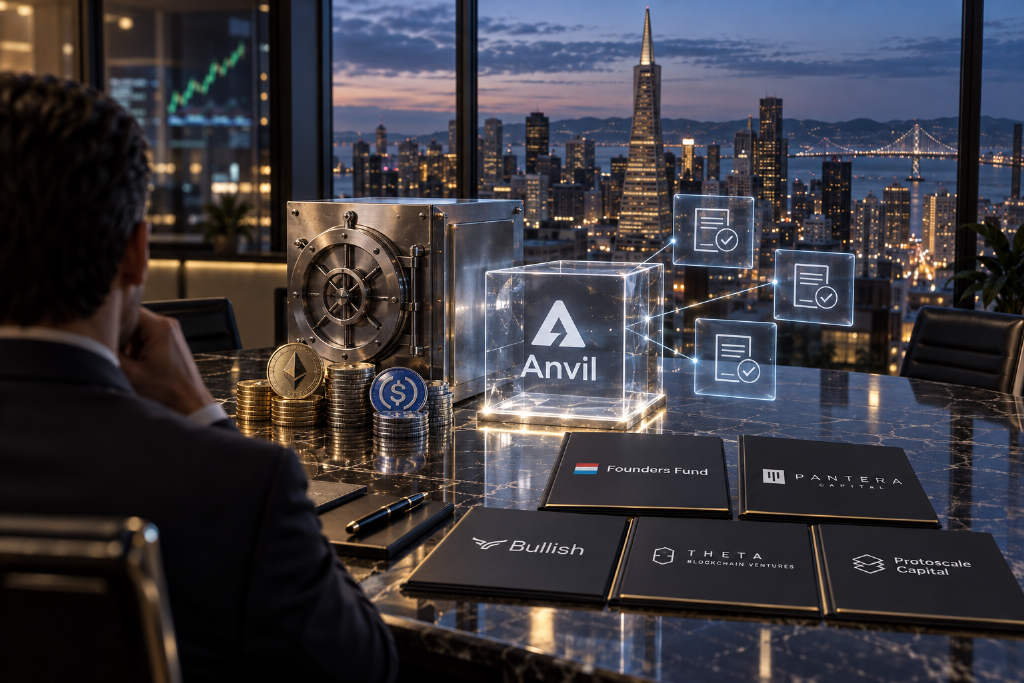
Founders Fund, the venture firm associated with Peter Thiel, led a $5 million token purchase in DeFi protocol Anvil on Oct. 6. Other participants included Pantera Capital, Theta Blockchain Ventures, Bullish (NYSE: BLSH) and Protoscale Capital. Individual investors included Compound founder Robert Leshner, now CEO of Superstate, and Celo co-founder Rene Reinsberg.
After the announcement, ANVL rose more than 83% and its market capitalization briefly reached about $109 million.
The structure of the transaction matters. Founders Fund bought ANVL tokens rather than equity in the company behind Anvil, and the tokens came from Anvil’s existing treasury. No new tokens were issued.
Anvil is not a lending protocol
The clearest way to understand Anvil is to start with what it does not do. It is not a lending protocol in the mold of Aave or Compound, where users deposit collateral, borrow another asset, pay interest and face liquidation if collateral values fall.
Anvil uses a different structure. Users lock ETH or USDC in an Anvil vault and receive an on-chain letter of credit, or LOC. The LOC acts as verifiable economic backing that shows the holder has enough assets locked up to honor a financial commitment.
Letters of credit are one of the oldest tools in commerce. In traditional finance, a bank issues a payment commitment to a seller and pays once the seller delivers the agreed documentation, such as shipping records. Trillions of dollars in global trade rely on that mechanism.
Anvil moves that logic on-chain and removes the bank from the middle. Users lock their own assets, smart contracts verify whether collateral remains sufficient, and the status of the letter of credit can be checked in real time by any counterparty.
Joey Krug, a partner at Founders Fund and co-founder of Augur, said in the announcement: 「Businesses need to know that the promises behind payments and credit will be kept. Anvil lets them back those promises with verifiable digital asset collateral.」
Where the protocol is being used
The term letter of credit can sound abstract until it is tied to actual use cases. According to the disclosed information, Anvil is already live or being integrated in several areas.
Payment guarantees
Flexa, a crypto payments network previously co-founded by Tyler Spalding, integrated its Capacity v3 system with Anvil in March 2025. When a merchant accepts a crypto payment through Flexa, Anvil’s letter of credit is designed to guarantee final settlement. That means the merchant can receive confirmation that payment is backed even if the underlying blockchain still needs time to confirm the transfer.
Instant exchange deposits
Bullish, the parent company of CoinDesk and a New York Stock Exchange-listed firm, is exploring Anvil for instant margin deposits. Under the standard flow, traders moving assets from an external wallet need to wait for on-chain confirmations before funds are credited. With Anvil’s letter of credit, the exchange could extend trading capacity as soon as the assets are locked in the vault.
Business credit guarantees
Anvil also offers an SDK that allows enterprises to integrate the protocol without writing blockchain code themselves. Consensus and Bitcoin.com were also listed as partners.
The common thread across these cases is simple: nothing needs to be borrowed. The protocol is being used to prove that funds exist, that they have been locked, and that they cannot be moved elsewhere.
Zero protocol fees and a governance-driven model
Anvil does not charge transaction fees at the protocol layer. That sets it apart from much of DeFi.
No fees means the protocol does not generate direct revenue. Under its current design, the ANVL token derives its role from governance. Token holders vote on which collateral types the protocol supports, how letter-of-credit parameters are set and which external contracts can connect to the system.
ANVL has a total supply of 100 billion tokens, with about 80 billion currently in circulation. The token is not tied to fee-sharing because there are no fees to distribute. Its value case rests on governance rights: if Anvil becomes core infrastructure for commercial credit guarantees, control over that infrastructure could matter.
That also makes it a long-duration bet. If usage scales enough, governance rights may become scarce and valuable. If adoption stays limited, those rights may not amount to much.
TVL and token price remain far below prior highs
The on-chain data is still modest.
At publication, DefiLlama showed Anvil with about $14 million in total value locked. That figure is small in absolute terms, although it ranked first in the collateral management category and accounted for more than 90% of category TVL. The category itself is still tiny, with only two tracked protocols.
The historical trend is more revealing. In July 2025, Anvil’s TVL peaked at about 36,000 ETH, or roughly $109 million. It then fell to the current $14 million level, a decline of about 87%.
ANVL was trading around $0.00098, down about 89% from its all-time high of $0.0093 on Jan. 3, 2025. Even after the more than 83% one-day jump tied to the funding news, the token was still trading near historical lows.
What Founders Fund is betting on
The purchase was not a bet on another DeFi lending token. It was a bet on whether on-chain letters of credit can become a category large enough to stand alongside on-chain lending.
By the standards of Founders Fund, $5 million is not a large position. The firm completed a $6 billion fundraise in May 2026, its largest ever, according to the disclosed information. That makes this deal look more like an exploratory position than a major capital deployment.
Still, Joey Krug’s public support and Robert Leshner’s personal participation gave the deal a signal value that appears larger than the dollar amount alone.
Three things to watch next
- Enterprise integrations. Once the SDK is out, the key question is how many businesses actually integrate Anvil. Among the names listed so far — Flexa, Bullish, Consensus and Bitcoin.com — only Flexa was explicitly described as having completed deep integration. The difference between exploring and deploying is substantial.
- Whether a zero-fee model can last. For now, development can be supported by treasury tokens. Over a longer period, the protocol may need some form of fee model, or ANVL may need to appreciate enough to keep funding the team.
- Whether there is enough on-chain demand for letters of credit. Traditional letters of credit support a market worth trillions of dollars, but how much of that demand shifts on-chain depends on the pace of enterprise crypto adoption.
That is the core question around Anvil. The protocol is not trying to prove there is demand for borrowing. It is trying to prove that businesses are willing to move payment commitments and credit guarantees into an on-chain collateral system that anyone can verify.