
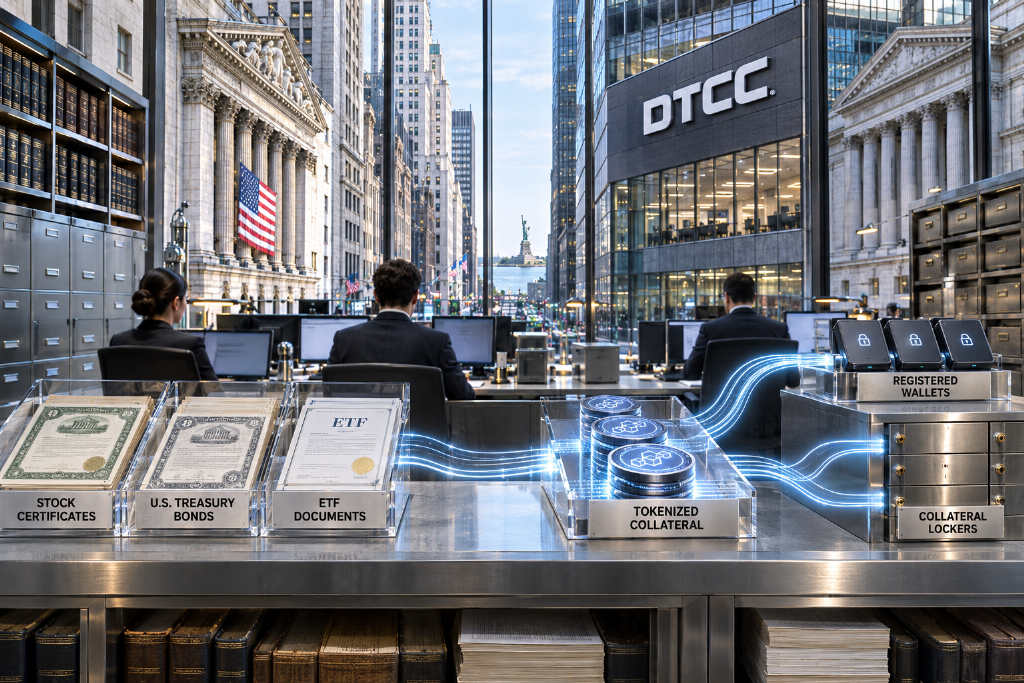
DTCC has formally launched its tokenized securities service, but Four Pillars says the market may be overstating what the product changes today. In the report, the firm argues that the clearest near-term benefit of DTCC Tokenized Securities, or DTS, is more efficient collateral movement rather than a full remake of how securities trading works.

That said, the launch still matters. DTCC sits at the center of custody and settlement for nearly all U.S. stocks and bonds, so its decision to put a tokenization service into production carries more institutional weight than most crypto-native token launches.
DTS is now live under a tightly defined SEC framework
According to the report, DTCC officially launched DTS on Oct. 28. Before that, the market had mostly been hearing about plans to bring securities onchain. The service is now operating in practice.
Four Pillars says the rollout was made possible in large part by a no-action letter the U.S. Securities and Exchange Commission sent to The Depository Trust Company, or DTC, in December last year. In simple terms, SEC staff said they would not recommend enforcement action if DTC operated a limited tokenized securities service while complying with a specific set of conditions.
Those conditions are narrow:
- Eligible securities are limited to Russell 1000 index constituents, U.S. Treasuries, and ETFs that track major indexes.
- Tokenized securities may be used as collateral in external transactions, but DTC does not recognize them as having collateral value or settlement value within its existing risk management framework.
- Transfers are limited to wallets that have been registered with DTC.
- DTC retains the authority to force the recovery or transfer of tokens in cases such as loss, theft, erroneous transfers, and other specified situations.
- The no-action relief remains effective for three years from the date the first service begins operating.
The report describes DTCC’s move as a major milestone for blockchain adoption in securities markets. At the same time, it says the details of the SEC letter give investors reason to ask how much additional value this form of tokenization delivers compared with the existing financial system.
What DTS actually changes
Four Pillars lays out the operating flow in several steps. A participating institution first registers its digital wallet with DTS. It then submits a request to tokenize securities already held in its DTC account. DTC performs the required verification and compliance checks. The corresponding security entitlements are moved from the participant’s account into DTC’s Digital Omnibus Account. Tokens representing those entitlements are then minted and sent to the participant’s registered wallet.
In practical terms, institutions can now convert existing security entitlements into tokens that can be held and transferred onchain.
The report says DTS was not designed primarily to create an active market for tokenized stocks in equity trading. Its focus is institutional use cases such as collateral mobility. On that front, Four Pillars points to several potential improvements.

24/7 transferability after tokenization
Requests for tokenization and conversion can be submitted only on business days between 2 a.m. and 6 p.m. Eastern Time. Once the securities have been tokenized, however, the tokens can move on a 24/7 basis and may also trade through supported venues. The report calls this a real improvement over traditional DTC processes, where securities transfers and collateral operations are usually constrained by business hours and processing cutoffs.
Near real-time collateral transfers
Collateral movements involving tokenized securities can be completed onchain in near real time, without waiting for traditional DTC settlement windows.
Smart contract functionality
Tokenized securities may also use smart contracts to automate selected functions, including compliance controls and processes tied to distributions.
What does not change
A great deal remains the same, the report says.
- Securities tokenized through DTS keep the same ownership rights, economic rights, and investor protections as traditional securities.
- DTC continues to hold and safeguard the underlying securities.
- The underlying securities remain registered in the name of DTC’s nominee, Cede & Co.
- DTC remains responsible for official recordkeeping, using its existing books and LedgerScan to track tokenized entitlements.
- Tokenized securities keep the same CUSIP identifiers as their traditional counterparts.
- The existing relationships among DTC, broker-dealers, issuers, custodians, and beneficial owners do not change.
- Dividend and interest payments continue to move through traditional financial infrastructure in fiat rather than through onchain stablecoins.
- Existing KYC, anti-money laundering, and other compliance requirements still apply.
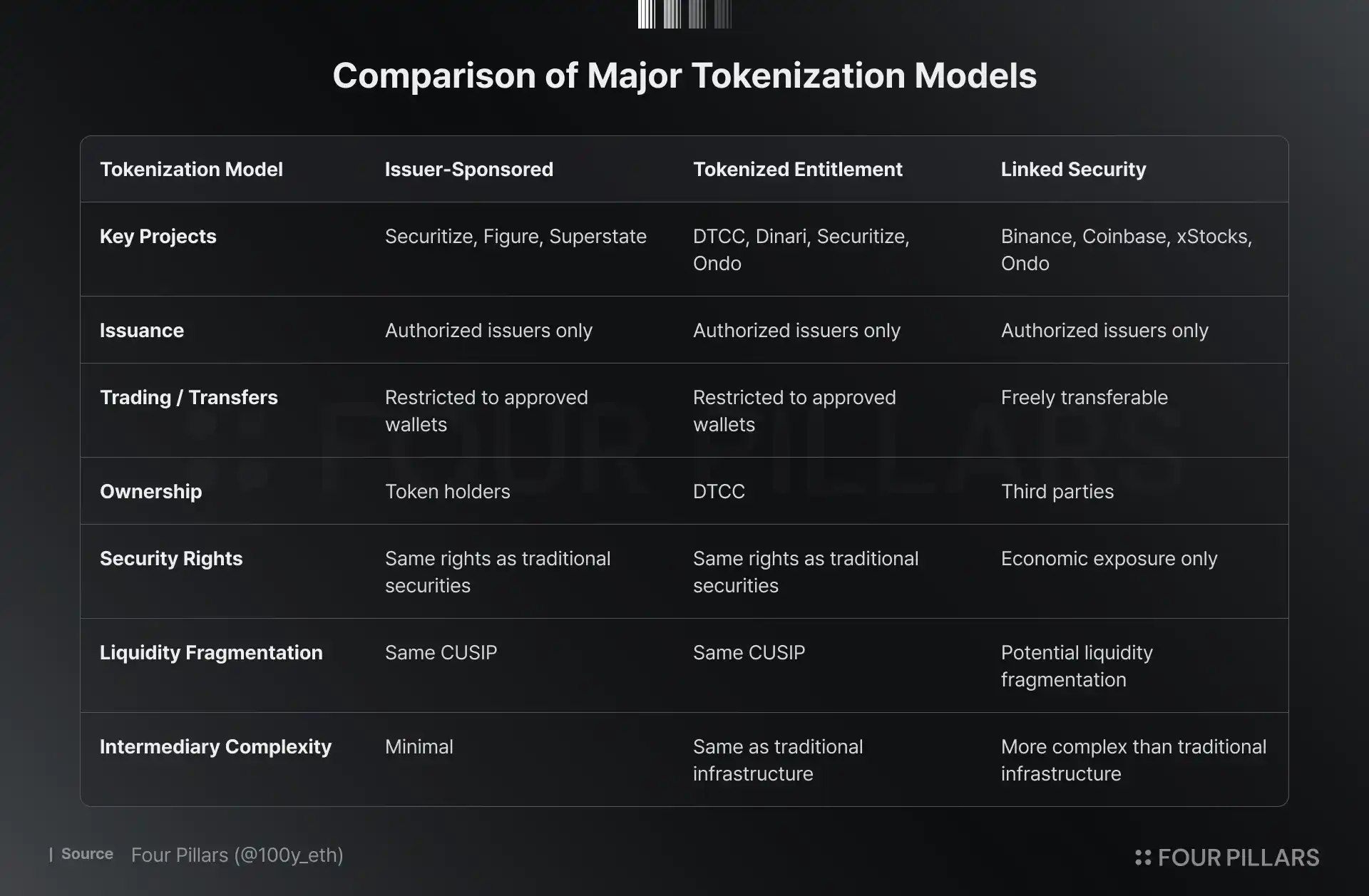
Four Pillars says keeping the same CUSIP codes and legal rights is clearly positive because it helps preserve fungibility between traditional holdings and tokenized holdings, reducing the risk of fragmented liquidity. But the report also notes that DTC still maintains the official books and the broader market structure is largely intact, which limits the scale of any immediate efficiency or scalability gains.
DTS is not a DvP settlement system
The report highlights another point that could be misunderstood: using blockchain does not automatically mean DTS supports delivery versus payment, or DvP.
One of blockchain’s best-known advantages is the ability to use consensus and smart contracts to settle both sides of a transaction atomically. In theory, securities and cash can change hands at the same time, reducing the risk that one side delivers assets but does not receive payment.
That might lead some observers to assume DTS supports DvP by design. Four Pillars says that is not the case.
Under the SEC no-action letter, DTS is structured as a Free of Value, or FOV, service. That means the transfer of securities is not directly linked to the corresponding cash payment.
DTS handles the tokenization and transfer of security entitlements, but it does not manage the related cash obligations and does not provide final cash settlement. As a result, institutions that want to execute DvP transactions using DTS-tokenized securities would need separate payment infrastructure, such as stablecoins or other forms of digital cash, along with a mechanism to coordinate both sides of the trade.
Why Four Pillars still sees long-term significance
Even with those limits, the report says DTCC’s entry into tokenization is significant because of the institution’s role in traditional securities markets. Financial markets have relied for decades on infrastructure built long before blockchain existed. For an institution like DTCC to adopt blockchain as part of next-generation market infrastructure is, in the report’s view, a strong signal for the sector’s long-term direction.
Still, a close look at what DTS currently offers shows how little has changed so far. Tokenization remains constrained by the existing securities stack, and the service operates inside a strict regulatory perimeter. For now, its practical value is concentrated in making collateral transfers more efficient and less dependent on traditional trading-hour limits.
Four Pillars also compares DTS with other tokenized securities models that have drawn attention in onchain markets. One is the issuer-sponsored model, which can bypass the traditional DTCC intermediary holding structure and allow issuers and transfer agents to bring securities onchain directly. Another is the linked security model, which may not offer the same level of access to U.S. investors under current securities rules but can provide much broader accessibility and flexibility for investors in other permitted jurisdictions.
The report says DTS is unlikely to stop here. Based on DTCC’s roadmap, the next phase could include several major additions:
- Support for more blockchain networks, expanding from Besu and Canton to networks such as Stellar and Arc.
- A broader set of eligible securities.
- Stronger institutional-grade security controls, including additional security, authorization, and operational safeguards.
- Expanded corporate action processing for dividends, stock splits, and other events.
- More unified recordkeeping between traditional DTC books and onchain securities holdings.
- Broader settlement capabilities for settlement and collateral management, including onchain netting and digital cash.
Four Pillars concludes that DTCC’s launch of DTS is only a starting point. The immediate effect may be limited, but if those incremental steps continue to build, tokenized securities could eventually become part of the mainstream foundation of financial markets.




