


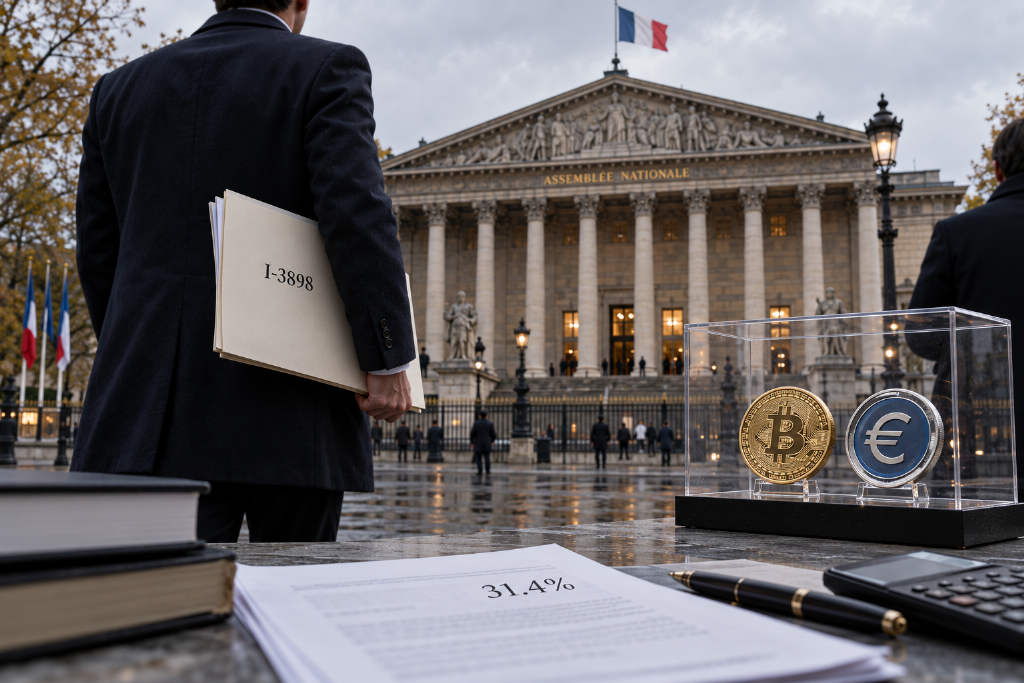
France’s National Assembly approved amendment I-3898 on Oct. 16 by 38 votes to 37, with 25 abstentions, adding gains from converting cryptocurrencies into stablecoins to the scope of the country’s 31.4% capital gains tax. The measure is part of the 2027 budget bill and would apply from Jan. 1, 2027, covering transactions involving stablecoins that comply with the European Union’s Markets in Crypto-Assets regulation, or MiCA.
The amendment has cleared a floor vote in the Assembly, but it has not completed the full budget legislation process and could still be revised or removed. According to the Assembly’s voting record, the proposal had already passed the finance committee before reaching the full chamber, where it advanced by a single vote.
Current tax deferral for crypto swaps would be removed
Under current French tax rules, investors who exchange one cryptocurrency for another, without moving into or out of fiat currency, generally benefit from tax deferral. In practice, that means gains are not immediately taxed at the moment of the swap.
Amendment I-3898 would end that treatment for conversions into compliant stablecoins. An investor who swaps crypto for a stablecoin could be considered to have realized a gain even if no money is withdrawn to a bank account.
France’s default capital gains tax rate for private investors is 31.4%, though taxpayers can choose to be assessed under progressive income tax rates instead. The French tax authority’s explanation also says the revised rule would change the method used to calculate gains: instead of using the overall portfolio approach, it would rely on the acquisition cost of the asset being sold. Where units of the same token were bought at different prices, cost would be calculated using a weighted average method.
Government officials argued against the proposal
David Amiel, France’s minister for public accounts, publicly opposed the amendment during the parliamentary debate and called for it to be withdrawn. He said the government has not yet completed a clear definition of “stablecoin,” and lacks the ability to effectively monitor how investors reallocate assets within crypto portfolios.
“We need to define stablecoins first, so that we can ensure we are able to track asset transfers within portfolios,” he said.
Philippe Juvin, rapporteur for the finance committee, also leaned toward keeping the current tax deferral system. His argument was that the crypto market is highly volatile, and taxing every move into stablecoins would force investors to face taxable events more often, raising compliance burdens.
Chainalysis warns of a shift to DeFi and offshore venues
Francois Volpoet, head of business for Chainalysis in France, warned that the tax change could produce a “reverse effect,” pushing investors toward decentralized finance, or DeFi, peer-to-peer trading, or offshore exchanges in jurisdictions that do not have international tax information-sharing agreements with France.
If capital moves into those less visible channels, France would lose not only tax revenue but also visibility into the crypto market, according to that warning.
MiCA is in force, but tax policy remains national
The debate sits within a broader European regulatory setting. MiCA formally took effect in 2024 and introduced reserve, authorization, and transparency requirements for stablecoin issuers, but tax treatment is still handled separately by each member state.
If the French amendment ultimately becomes law, it would make France the first major European economy to explicitly tax crypto-to-stablecoin conversions. The report said that could prompt other member states to review how their domestic tax rules fit with the MiCA framework.
Attention now turns to the Senate
The 38-37 result shows how divided lawmakers remain on the issue. As the budget bill moves to the Senate stage, the amendment could still be changed or removed.
Key points to watch are the Senate’s review, any official response from the finance ministry on the definition of stablecoins, and whether other EU countries publicly signal similar moves.