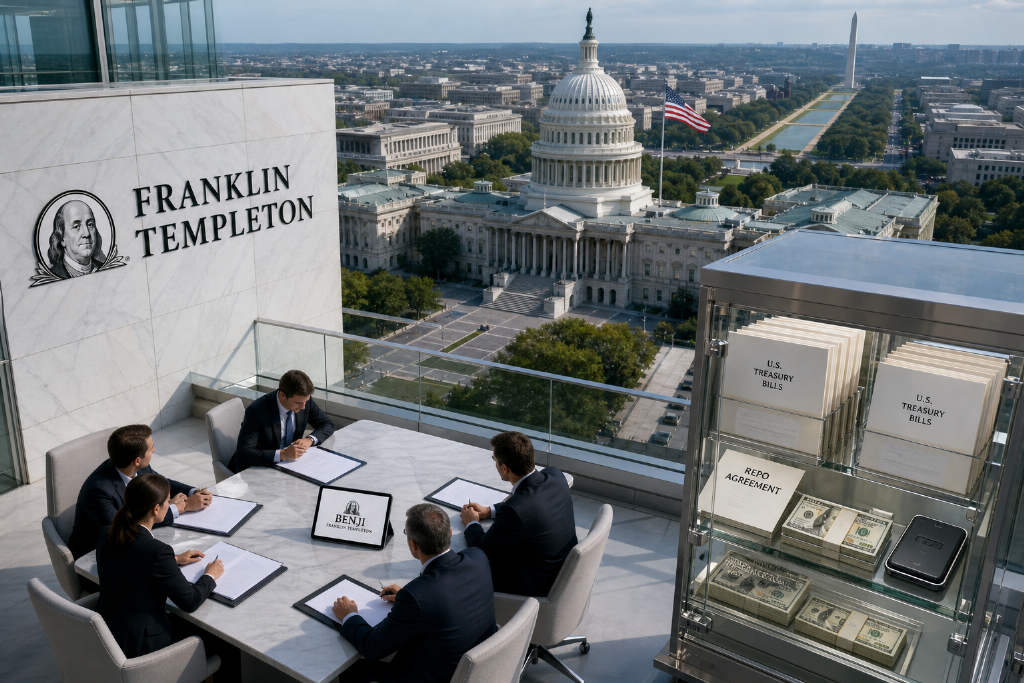
Franklin Templeton is moving to place its tokenized money market fund, Franklin OnChain U.S. Government Money Fund, or BENJI, inside traditional ETFs and mutual funds after receiving a no-action letter from the U.S. Securities and Exchange Commission’s Division of Investment Management.
Bloomberg reported on Aug. 20 that the firm plans to use BENJI for cash management and securities-lending collateral. In practice, that means a fund could move idle cash into an on-chain money fund, keep earning short-term U.S. Treasury income while the cash is not in use, and then redeem intraday when it needs to buy other assets or return collateral.
Traditional fund investors may gain indirect exposure through internal holdings
The SEC staff letter opened a regulatory path for registered open-end and closed-end funds within the Franklin Templeton group to invest in BENJI. The fund records shares on a blockchain, with on-chain interests represented by the BENJI token.
Its prospectus says at least 99.5% of assets are invested in U.S. government securities, cash, and repurchase agreements fully backed by government securities or cash. It does not hold Bitcoin or Ether. When a traditional fund allocates cash to BENJI, it is still holding shares of a mutual fund governed by the Investment Company Act of 1940, and the yield still comes from short-term government assets.
That brings an on-chain instrument into a part of fund operations that traditional products deal with every day: cash. Ordinary ETF or mutual fund holders may never open a crypto wallet, but they could still gain exposure to BENJI through the fund’s internal positions.
As of July 31, Franklin Templeton had $1.80 trillion in assets under management, including $80.8 billion in cash management assets. Its existing fund complex gives BENJI a potential distribution channel, though actual scale will depend on real allocations.
The SEC letter did not identify the first funds that will use BENJI, the amount they may invest, or when deployment will begin.
Custody rules built for paper securities created the main hurdle
The biggest obstacle was custody. Section 17(f) of the Investment Company Act of 1940 and Rule 17f-2 were written in an era of paper securities and in part assume that a fund can physically hold certificates, place them in a vault, and segregate them. On-chain fund shares are controlled by private keys, not paper certificates that can be locked away.
Franklin Templeton Investor Services, or FTIS, serves as BENJI’s transfer agent and is also an affiliate within the group. If a traditional fund places BENJI shares with FTIS for custody, the arrangement runs into affiliate self-custody rules.
In the no-action letter, the SEC cited a 1992 precedent that also involved the Franklin system and accepted that book-entry form could replace paper-certificate arrangements if control conditions were satisfied.
Why the SEC accepted the FTIS structure
BENJI maintains both off-chain books and on-chain records. FTIS keeps private information such as names and dates of birth in its internal systems, while the public blockchain records anonymized data including subscriptions, redemptions, dividends, net asset value, and transaction history. The two sets of records are linked in real time to form the official shareholder register.
FTIS controls the permission list, smart-contract administration rights, and the final record. It can also correct erroneous transactions, freeze or migrate wallet records, and restore ownership if a private key is lost.
Each traditional fund investing in BENJI will receive a separate Stellar wallet, with the private key held by FTIS. The fund gains on-chain settlement functionality, but the ultimate determination of ownership remains with a regulated transfer agent. That full control over the system and the records was a key reason the SEC accepted the arrangement.
Franklin Templeton pitched operational advantages in cash management
In its application, Franklin Templeton listed several practical benefits of using on-chain cash management: hourly NAV calculation, intraday trading, faster transaction processing, potential cost reductions, and stronger data security.
Traditional money market funds typically calculate NAV once a day and accept trades only within limited windows. For portfolio managers handling subscriptions, redemptions, and securities-lending collateral, more frequent cash movement may be more attractive than the token itself.
The structure also comes with oversight conditions. A fund’s board must approve the custody arrangement and review it at least once a year. Trade confirmations must be reconciled daily. Each fund’s account and wallet must be segregated from those of other holders. An independent accountant must perform at least three verifications each fiscal year, with at least two conducted without prior notice.
If FTIS is replaced as transfer agent, control over smart-contract administration and the records needed to restore ownership must also be transferred to the successor.
From putting ETFs on-chain to putting an on-chain fund inside ETFs
Franklin Templeton has already completed a different kind of bridge this year. On March 25, tokenized securities platform Ondo Finance said it had brought five Franklin Templeton-managed ETFs on-chain, spanning growth equities, large-cap equities, fixed income, equity income, and gold products. Ondo provides the tokenization and digital distribution layer, while Franklin Templeton continues to manage the underlying ETFs.
The earlier route took traditional ETFs into on-chain markets through a third-party platform and expanded product distribution. This new route does something else: it lets traditional ETFs and mutual funds hold an on-chain fund internally as part of their cash and collateral infrastructure.
BENJI remains small relative to Franklin Templeton’s overall AUM
BENJI has been operating in support of this step for five years. Franklin Templeton launched the product in 2021, making it the first U.S.-registered mutual fund to use a public blockchain as its official share registry system.
Company data shows that, as of April 29, the BENJI series across multiple markets and products had $1.98 billion in assets under management. From April 2024 to March 2026, the number of investors grew by more than 140%. Cumulative peer-to-peer transfers exceeded $211 million as of March 31.
Data from RWA.xyz shows that the U.S. on-chain government money market fund directly covered by this no-action relief managed about $726 million in August.
Those figures measure different scopes. The $1.98 billion total refers to the broader BENJI product family, while the $726 million figure covers only the U.S. fund addressed by this SEC relief. Even using the larger number, BENJI is still small next to Franklin Templeton’s $1.80 trillion in total assets under management. If traditional fund cash pools start flowing into BENJI, though, incremental capital could come from the firm’s existing fund base.
Adoption will depend on actual fund disclosures
Since 2025, the U.S. regulatory framework around tokenized products has been moving ahead more quickly. In December 2025, SEC staff sent a no-action letter to the Depository Trust Company, or DTC, supporting a pilot program for securities tokenization.
At the time, SEC Commissioner Hester Peirce described that effort as a gradual step in bringing markets on-chain and said different tokenization structures raise different regulatory issues. The BENJI custody arrangement pushes tokenization one stage deeper, from issuance and recordkeeping into internal fund cash management.
Which ETFs and mutual funds move first, what allocation caps they set, when BENJI is used for securities-lending collateral, and whether prospectuses are updated will determine how much real capital follows this regulatory opening. For now, the SEC has addressed how on-chain fund shares can be held in custody. Whether traditional funds adopt the structure at scale will depend on the first actual holdings disclosures.