

The Four Phases: Crypto at the Inflection Point from Experiment to Industry
New technologies typically pass through four phases: experimentation, hype, regulatory intervention, and industrialization. The internet completed experimentation in the 1990s, endured the dot-com bubble, and evolved into a mature industry after bubble-induced regulatory standards were established. The crypto industry is currently in the transition between phases three and four: Bitcoin's early proof-of-concept (experimentation), the 2017 ICO boom and 2021 DeFi wave (hype), and the 2022 FTX collapse as a turning point — speculative demand filtered out, real use cases validated.
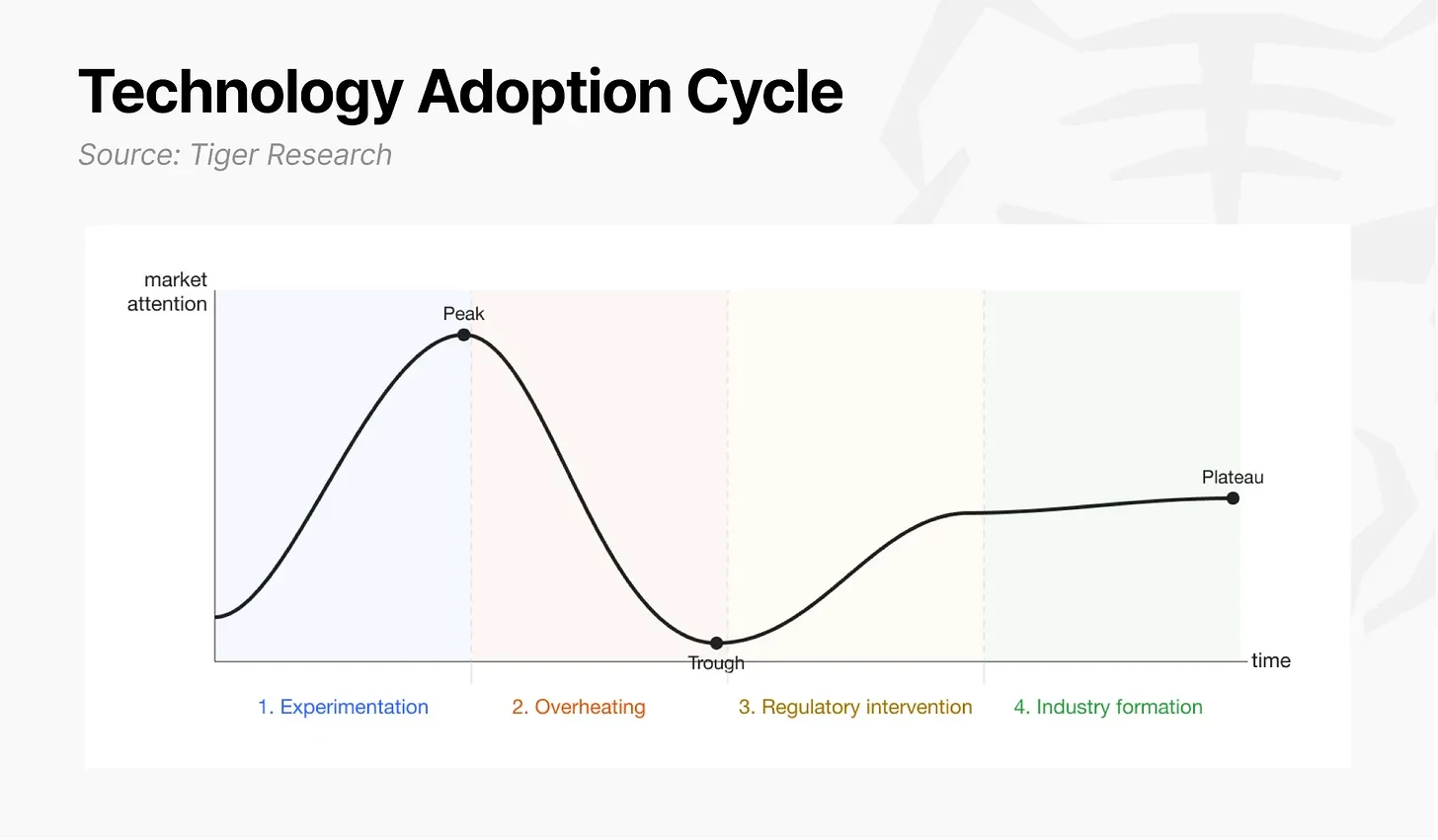
US regulators have shifted from laissez-faire or suppression to formalization. The crypto industry's attempt to directly replace core financial functions — settlement, payment, issuance — creates greater friction with traditional financial institutions, prolonging the absorption timeline. Today, crypto stands at the confluence of regulatory intervention and industrialization.
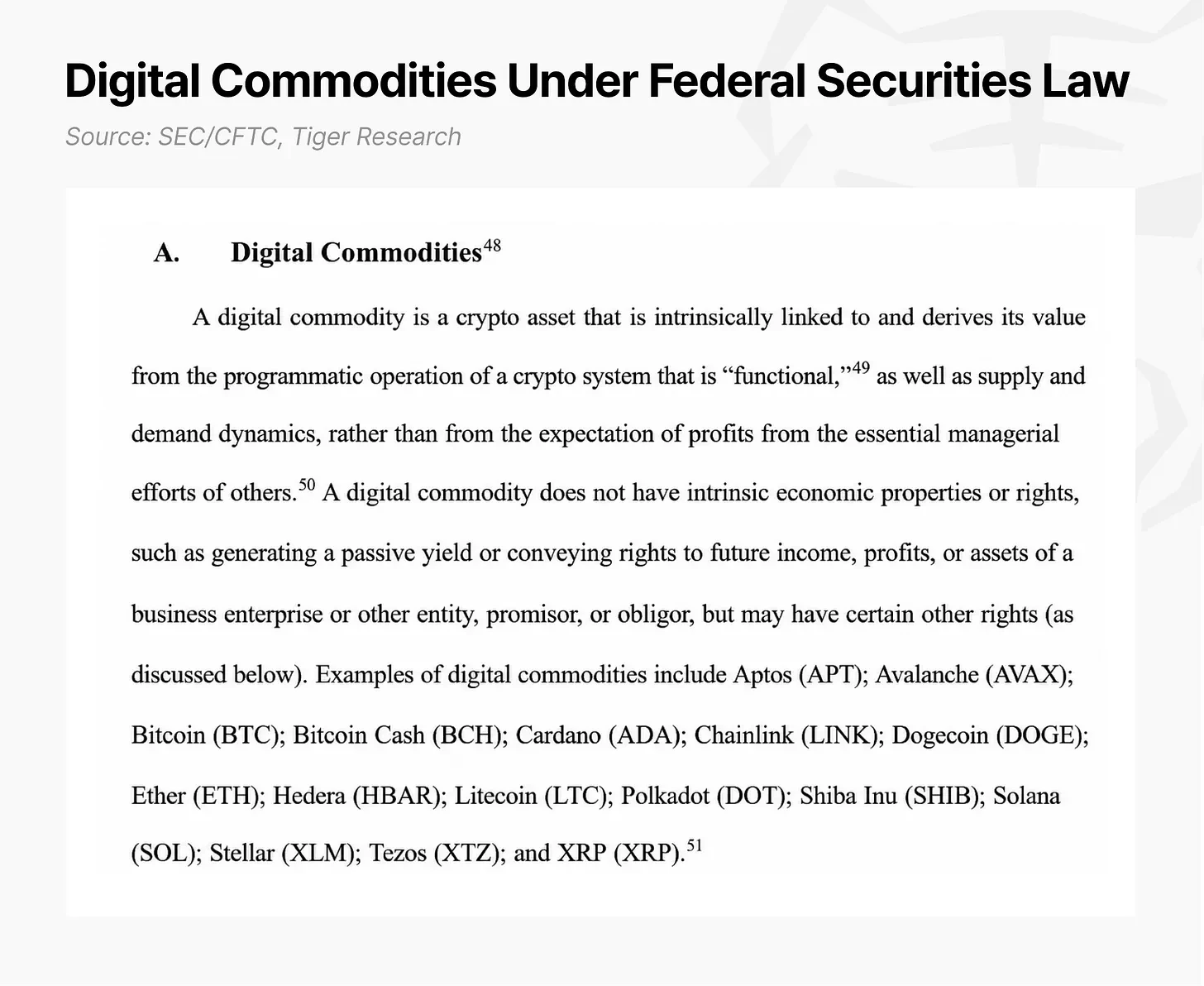
Regulatory and Market Confirmation: 16 Digital Commodities, Stablecoin Legislation, RWA Tokenization Boom
Regulatory progress has been substantial: the US Congress passed the GENIUS Act, clarifying the legal status of stablecoins; in March 2026, the SEC and CFTC issued joint interpretive guidance classifying 16 assets including Solana (SOL) as digital commodities, abandoning the old "security/non-security" binary classification and formally excluding protocol staking from securities law. Institutional adoption is accelerating: the tokenized RWA market grew approximately 257% in 15 months, from $5.4 billion in early 2025 to $19.3 billion by end of March 2026. Combined with stablecoins, total on-chain asset value has approached $300 billion.
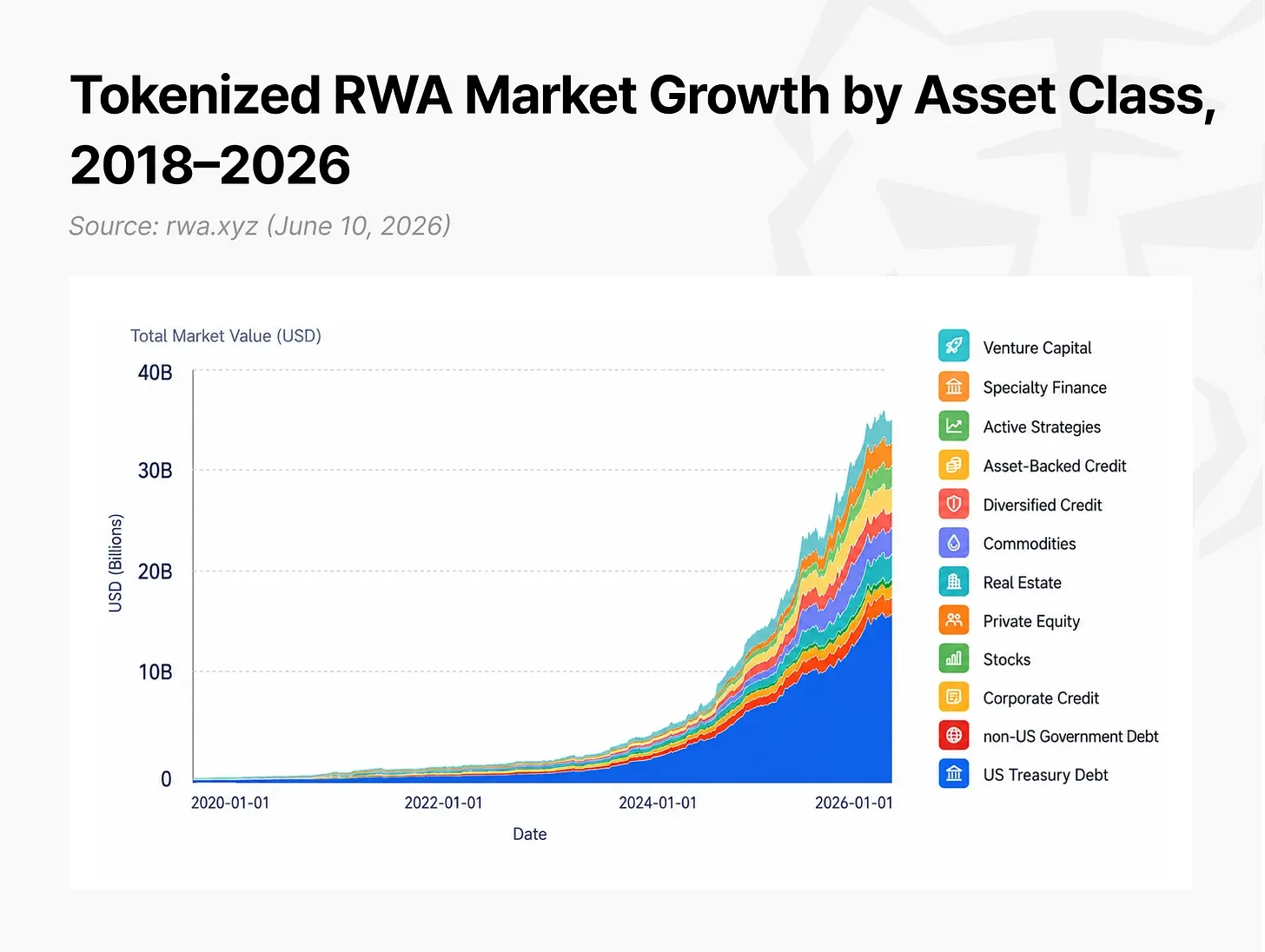
While not yet a mature industry, industrialization has begun in parallel with regulatory construction.
Internet Capital Markets (ICM): Code Replaces Clearinghouses, Settlement from T+3 to Seconds
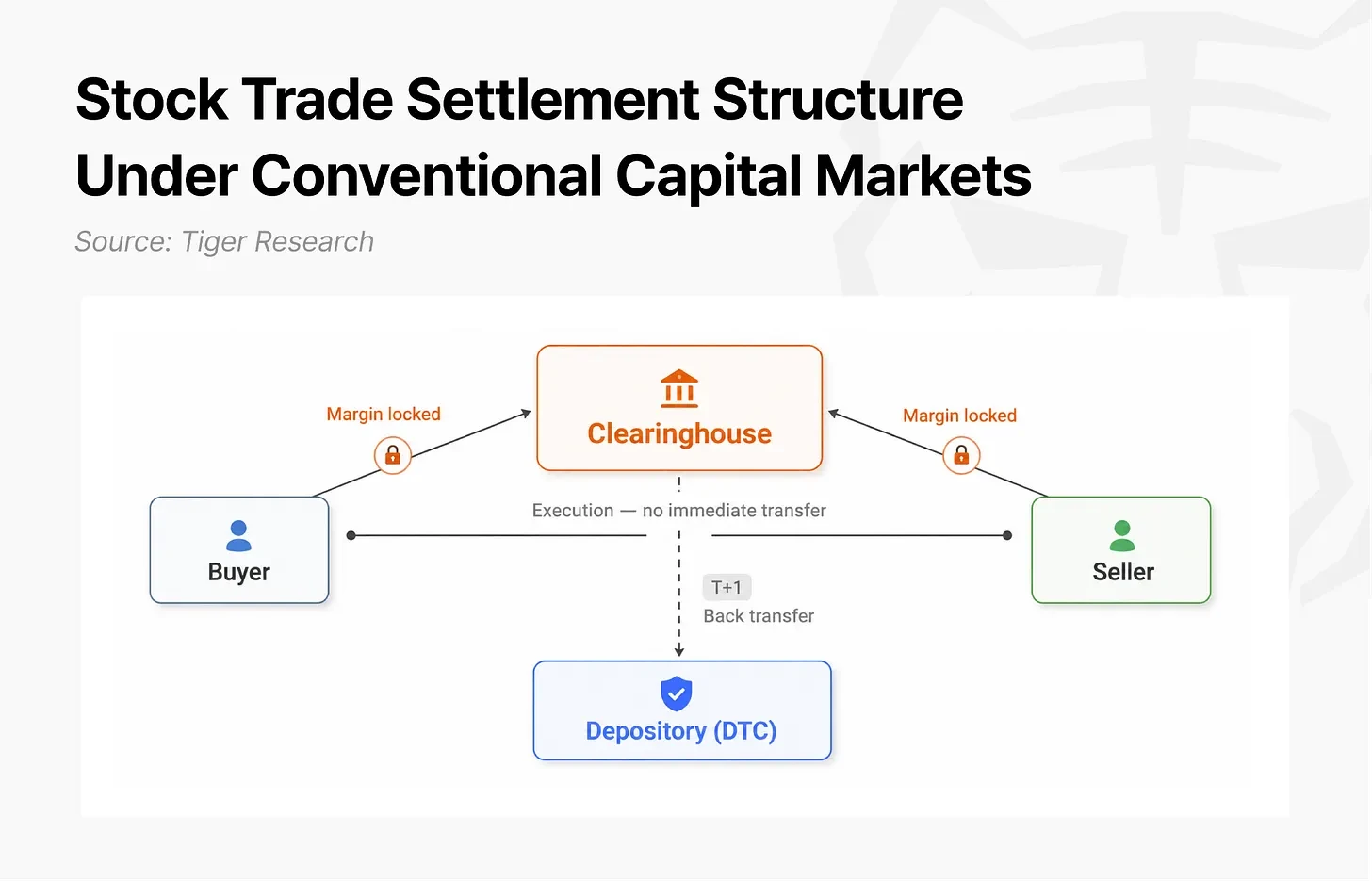
The future envisioned by crypto after entering the industrial phase is a fundamental restructuring of capital markets — where asset issuance, trading, and settlement all occur on a single public blockchain, defined as Internet Capital Markets (ICM). Today's capital markets operate on architecture designed before the internet: clearinghouses interpose between buyers and sellers, requiring margin that is locked until settlement; transfer at depositories takes T+1 or longer for cross-border (T+3 or more). Each institution maintains independent ledgers, requiring daily reconciliation that delays settlement. This architecture, built for an era of mutual distrust, has itself become a cost.
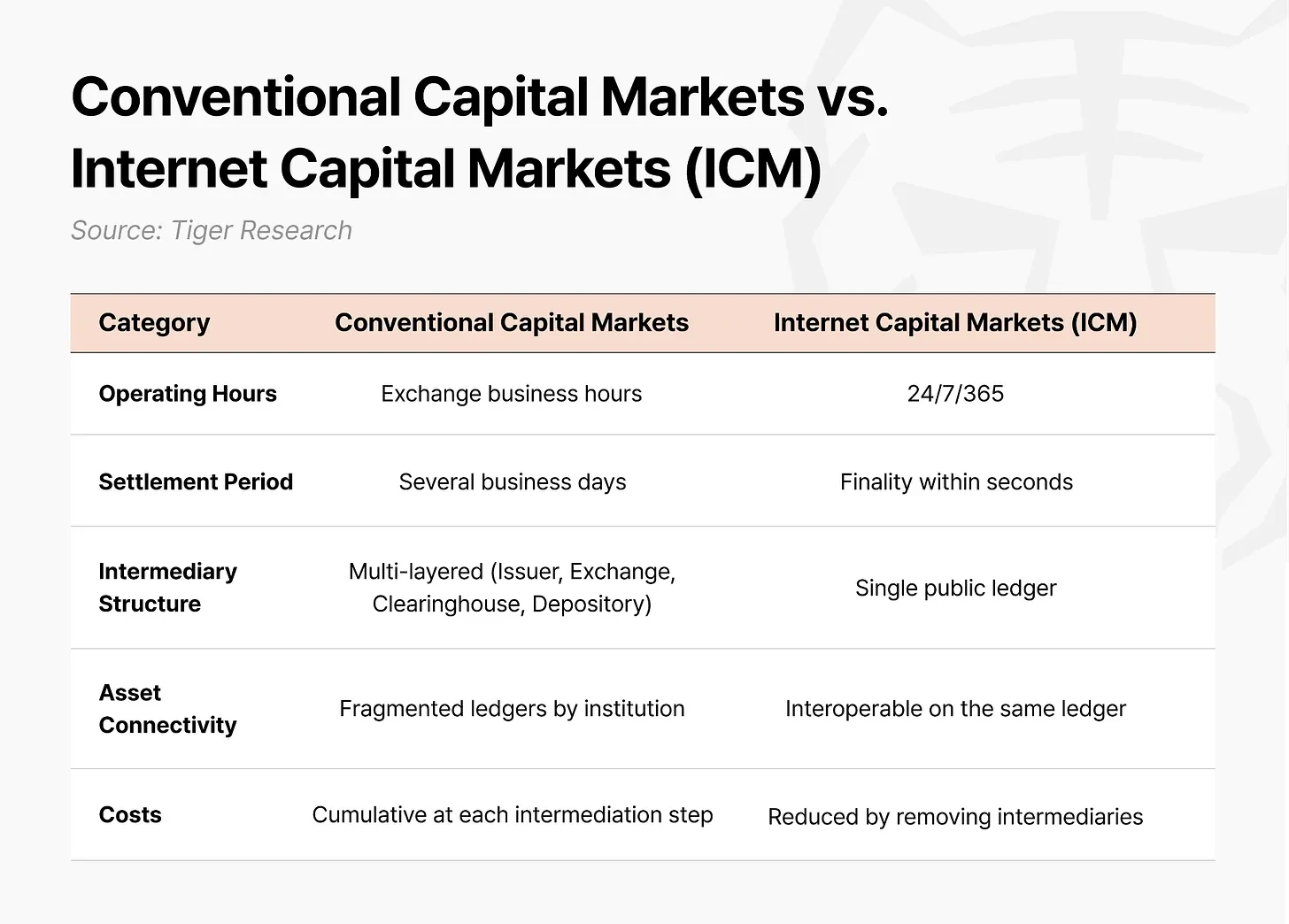
In ICM, code takes over the clearinghouse role: buyer's payment and seller's asset are placed into a smart contract simultaneously; the two transfers execute as a single transaction. If either side's condition is unmet, the entire transaction cancels automatically — no risk of unilateral outflow. Counterparty risk at the code level eliminates the need for clearinghouse margin. All participants share the same ledger in real time, eliminating inter-institution reconciliation. Execution and settlement are synchronized within seconds.
Solana Case Study: Seven Major US Financial Institutions' Real On-Chain Practices
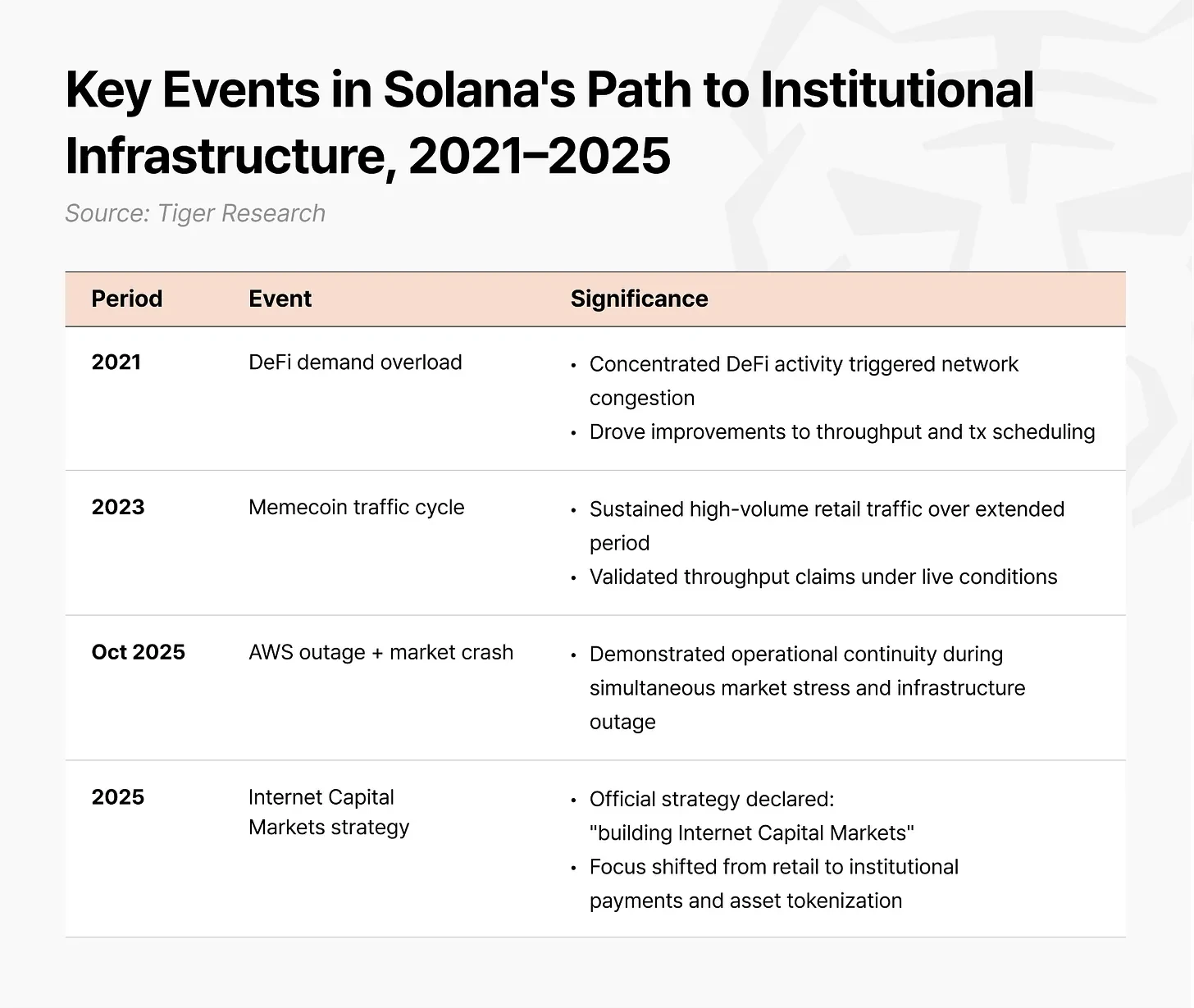
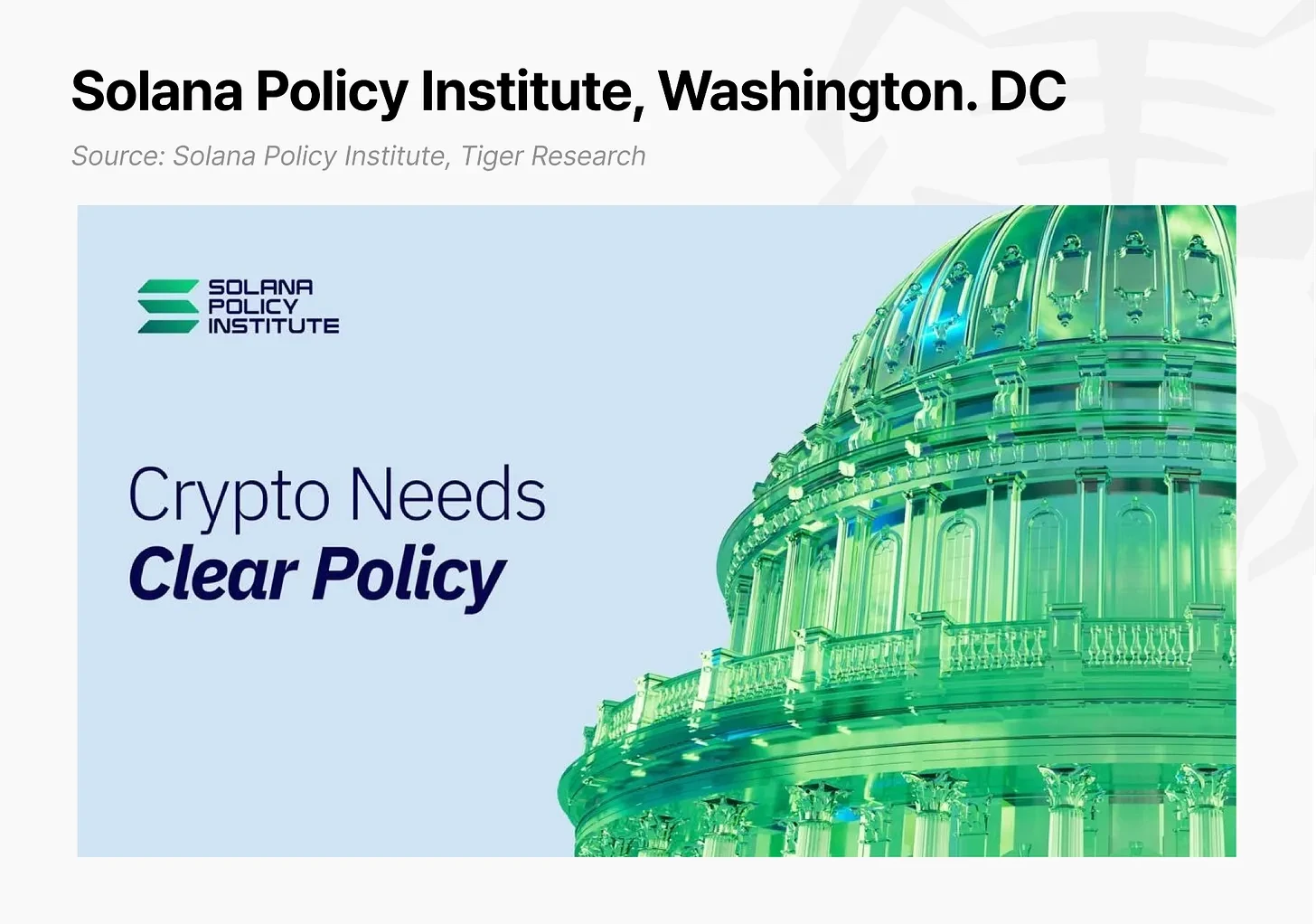
Within the US Internet Capital Markets landscape, Solana has emerged as a public blockchain integrating technological foundation, institutional practice, and regulatory design. In 2025, Solana formally adopted "Building the Internet Capital Markets" as its strategic direction, launching the Token-2022 standard that embeds freeze, seize, whitelist, and confidential balance functions into the token code itself. Issuers can achieve compliance inside the token without external systems. On this infrastructure, seven major financial institutions have launched proof-of-concepts or completed real transactions: J.P. Morgan, State Street, Citi, Franklin Templeton, Visa, PayPal, and Western Union. Three of these are among the eight US G-SIBs. The Solana Policy Institute (SPI) was founded in Washington DC in spring 2025, proactively submitting the "Project Open" pilot framework to the SEC Crypto Task Force, attempting to establish regulatory precedent before legislation is finalized.
Banking and Capital Markets: Atomic Settlement (DvP) Eliminates Hidden Costs
According to Tiger Research estimates, the annual opportunity cost of idle funds due to settlement delays in the US Treasury market alone is approximately $32 billion; extending to the entire US fixed-income market, the annual cost exceeds $45 billion. On ICM infrastructure, atomic settlement (DvP) bundles asset transfer and payment into a single real-time transaction, compressing execution and settlement to seconds (T+0). Key examples include: State Street × Galaxy's on-chain fund management SWEEP, accepting stablecoins or fiat deposits for short-term Treasury exposure, with a ~$200 million anchor investment from Ondo Finance; J.P. Morgan × Galaxy's $50 million commercial paper issuance (USCP) on Solana, with Coinbase and Franklin Templeton as investors; Citi × PwC's trade finance tokenization proof-of-concept, reducing settlement from days to minutes; Western Union's issuance of USDPT on Solana, transforming the paradigm from pre-funded reserves to real-time on-demand supply. Fiserv announced FIUSD white-label stablecoin platform (July 2026 on Solana), covering ~10,000 financial institution clients and 6 million merchants. Orca launched permissionless AMM infrastructure with token-level freeze/unfreeze controls; Nasdaq-listed Streamex used it for GLDY token secondary liquidity. Apollo issued tokenized tranche fund ACRED via Securitize, allowing leveraged strategies with ~2.5x effective leverage, boosting base yield from ~7.4% to 12-16%. Figure Technology bridged HELOC loan tokenization to Solana via Chainlink CCIP, enabling up to 9x leverage on Kamino lending protocol.
Infrastructure Diffusion and Regulatory Closure
When issuance, settlement, and touchpoints run on the same network, network effects emerge. Issuance layer: PayPal, Fiserv, Circle, Tether issue stablecoins or operate issuance infrastructure on Solana. Settlement layer: Visa expands stablecoin settlement to Solana, Worldpay migrates merchant settlement, YouTube uses PYUSD for creator payments. Touchpoint layer: SoFi enables 14.7 million clients to purchase SOL directly and operates bank-issued stablecoin SoFiUSD. The regulatory framework now covers: crypto asset custody (SAB 121 reversal), 16 digital commodities, stablecoins as an independent asset type via GENIUS Act, SEC approval of Nasdaq tokenized securities trading (DTCC pilot July 2026), and CFTC approval of Kalshi's Bitcoin perpetual futures. Unresolved areas include: free public stock trading limited to non-US residents (Reg S) or accredited investors (Reg D); DEX temporary guidance with five-year sunset rule but remaining AML/operational gaps; stablecoin interest payments prohibited. The CLARITY Act, which would define the overall digital asset market structure, faces uncertain passage in 2026 (≤50% probability).
Strategic Window for Asian Institutions: Executable, Transitional, and Exploratory Phases
The era of Asian financial institutions designing infrastructure from scratch is over. The pragmatic path is to be a fast follower, adopting US-validated infrastructure and regulatory references. The decision criterion is not whether policy exists but whether execution is truly possible: clear laws, guidelines, licensing regimes, and synchronized market infrastructure (custody, settlement, disclosure). Three phases are identified: Executable (Singapore MAS, Hong Kong SFC/HKMA, Japan FSA, UAE ADGM/VARA) — clear licensing and infrastructure ready, commercialization can start immediately; Transitional (Korea FSC/FSS, Thailand SEC, Malaysia SC, partial India) — policy direction clear but detailed rules pending, requiring pre-built structures that can convert to operations upon regulatory confirmation; Exploratory (Indonesia, Vietnam, Philippines partial) — legal definitions and asset classification unclear, requiring small-scale experiments to build capabilities. The variable for Asian institutions is no longer "whether to enter" but the order and entry point. The window of "validation complete but standards not yet frozen" is available for fast followers — how long it remains open is uncertain.