
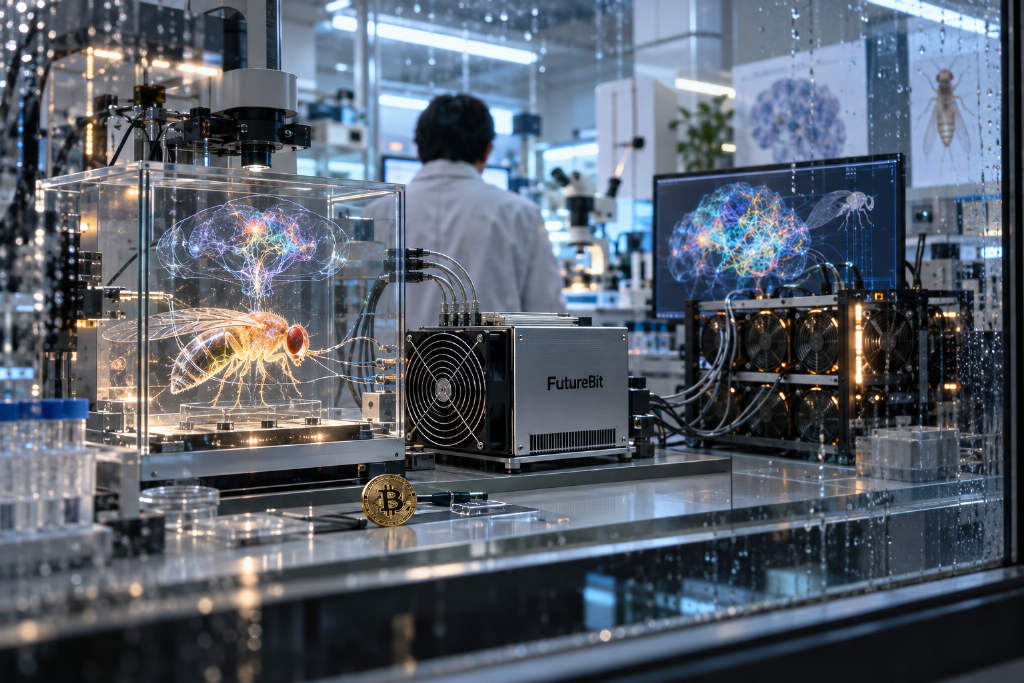
As Bitcoin miners keep shifting toward more specialized chips built for higher speed and lower power use, hardware maker FutureBit says it has tested a very different idea: using a simulated fruit fly brain in a web browser to carry out mining calculations.
HashFly simulates neural pathways for SHA-256 work
The HashFly demo models activity across 2,914 neural pathways taken from MaleCNS v1.0, a digital wiring diagram of an adult male fruit fly’s brain and central nerve cord.
FutureBit said on X that it is working to simulate all neurons in the dataset with SHA-256 and plans to publish its findings.
The company wrote: "Fun fact if this could be scaled on real organic neurons, it would hash at ~ 1 watt per terahash...10x the efficiency of the best silicon 3nm ASICs!"
Under that estimate, a mining system built from living neurons could perform 1 trillion calculations per second while using about 1 watt of electricity. Decrypt said the comparison implies about 10 times the efficiency of leading 3-nanometer ASIC miners. The estimate applies a fruit fly’s total power consumption to a hypothetical setup in which every neuron mines Bitcoin continuously.
The experiment does not compete with real Bitcoin miners
Despite the biological inspiration, the system runs on conventional computer hardware. It also lacks the hash rate and mining difficulty needed to compete with actual Bitcoin miners.
Bitcoin miners race to add transaction blocks by repeatedly running SHA-256 calculations, and hash rate measures the number of attempts per second. HashFly lets users adjust the target, but it runs at only a fraction of Bitcoin’s current mining difficulty. For comparison, FutureBit said its five-inch Apollo III ASIC miner can reach 18 TH/s.
FlyMiner uses a much larger fruit fly neural map
A separate project, FlyMiner, uses a digital map covering 139,255 fruit fly neurons and 16.8 million connections to control a standard Bitcoin mining program.
When simulated signals from the fly’s movement-control neurons hit a preset threshold, the program tests possible solutions to a mining problem supplied by solo mining pool CKPool. It can run at speeds of up to 700,000 attempts per second.
Part of a longer line of unconventional mining tests
The fruit fly efforts are the latest examples in a string of unconventional Bitcoin mining experiments.
In March 2021, an IT security researcher turned a 1989 Nintendo Game Boy into a miner that produced about 0.8 hashes per second. In June 2023, a Brooklyn bathhouse said it was routing heat from mining equipment into its pools. In August 2023, Utah-based Nodal Power raised $13 million to expand facilities that generate electricity from landfill methane and use some of that power to mine Bitcoin.