
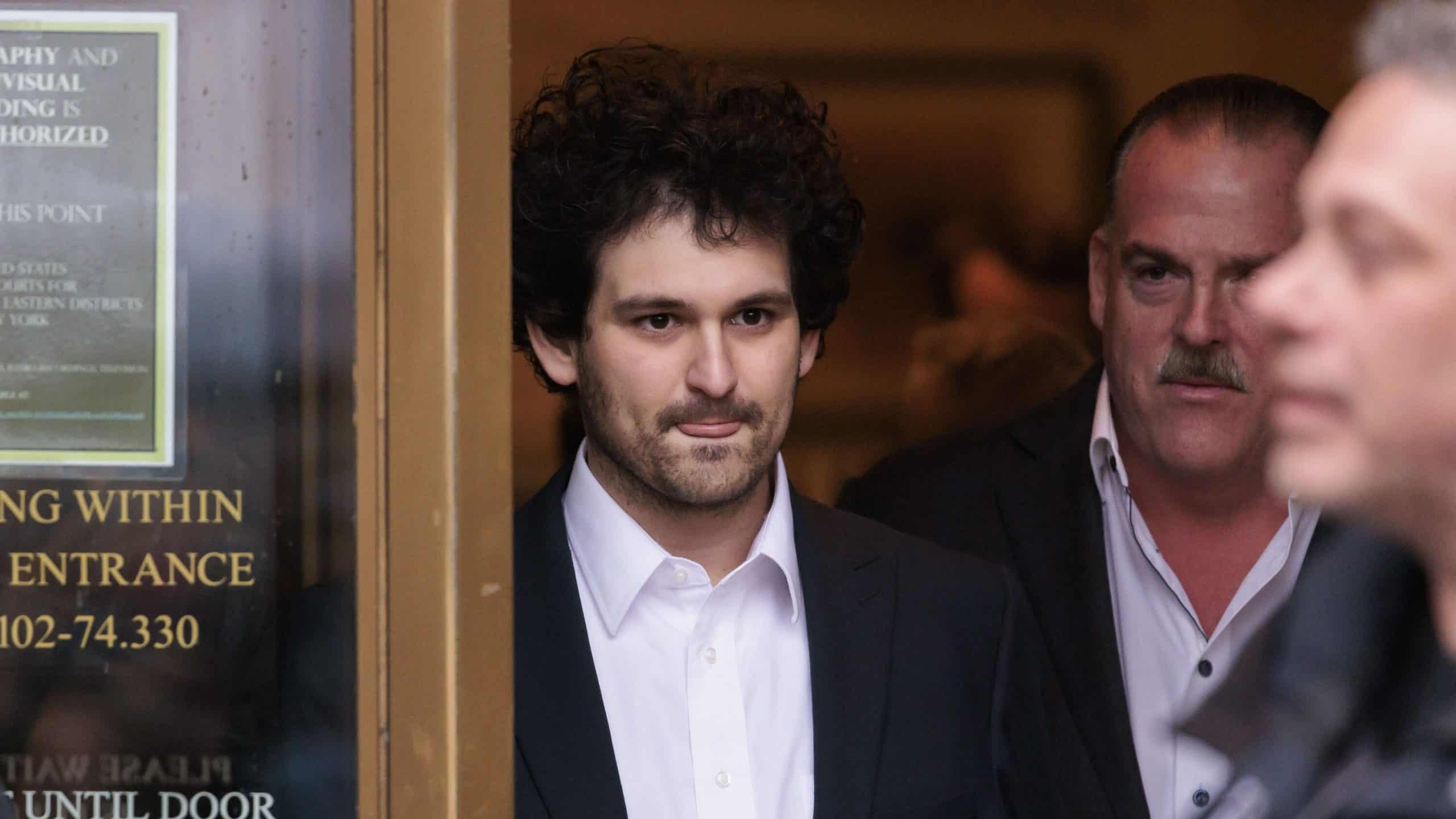
Sam Bankman-Fried’s attempt to overturn his criminal conviction and 25-year prison sentence has hit another wall. The U.S. Court of Appeals for the Second Circuit formally issued its mandate on Aug. 4, making its June decision rejecting his appeal effective and returning jurisdiction to the U.S. District Court for the Southern District of New York.
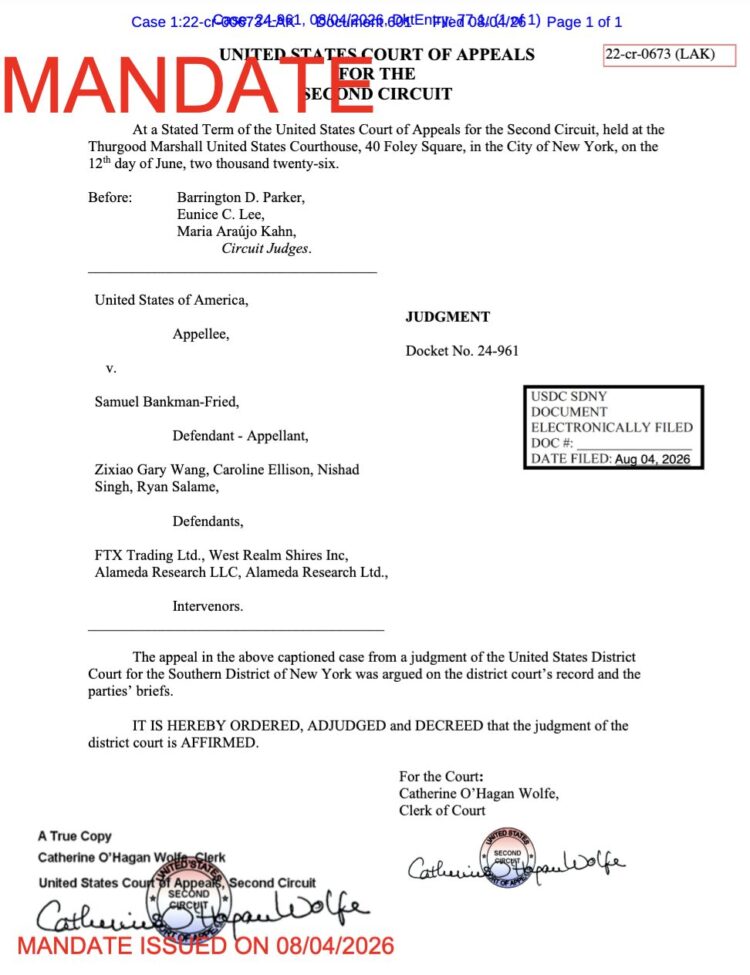
The report cited a court filing shown via Courtlistener, with the mandate marking the formal implementation of the appellate court’s earlier ruling.
Appeal setback becomes final
Bankman-Fried, the founder of FTX, was found guilty by a jury in November 2023 on seven counts of fraud and conspiracy. The case centered on the transfer of FTX customer funds to affiliated trading firm Alameda Research.
In March 2024, U.S. District Judge Lewis Kaplan sentenced him to 25 years in prison, three years of supervised release, and ordered the forfeiture of roughly $11 billion in assets.
A three-judge panel at the Second Circuit unanimously upheld that judgment in June. The mandate issued this month turns that earlier appellate ruling into an effective judgment.
Second Circuit rejects repayment-based argument
One of Bankman-Fried’s arguments on appeal was that the trial court had restricted the defense from presenting evidence that FTX had enough assets and that customers might ultimately be repaid in full.
His lawyers argued that later asset recoveries at FTX showed customer losses might not be permanent, which, in their view, could have affected the jury’s assessment of fraudulent intent.
The Second Circuit rejected that position. According to the court’s reasoning, the fraud was complete once customer funds were transferred to Alameda without authorization. Even if Bankman-Fried believed the money could be repaid later, that did not change the legal nature of the misappropriation.
The panel also found no error in the trial court’s evidentiary rulings or jury instructions serious enough to undo the conviction.
$11 billion forfeiture order remains intact
The appeals court also left in place the roughly $11 billion forfeiture order. Bankman-Fried had been convicted on two counts of wire fraud, two counts of conspiracy to commit wire fraud, one count each of conspiracy to commit securities fraud, conspiracy to commit commodities fraud, and conspiracy to commit money laundering. None of the seven felony convictions was vacated.
The U.S. Department of Justice had previously said Bankman-Fried misappropriated billions of dollars in FTX customer funds, while defrauding FTX investors of more than $1.7 billion and Alameda lenders of more than $1.3 billion.
After FTX entered a liquidity crisis and filed for bankruptcy in 2022, scrutiny over the movement of funds and the company’s governance escalated. The case went on to become one of the largest criminal cryptocurrency cases in the United States.
Regular appeal path at the circuit court has ended
With the Second Circuit’s mandate now issued, the ordinary appeal process for Bankman-Fried at that court has effectively run its course. His 25-year prison term and the $11 billion forfeiture order remain in force.
He still has a possible path to the U.S. Supreme Court through a petition for certiorari, which would ask the justices to review the case.
Another possible route would be a presidential pardon or sentence reduction. President Donald Trump said in January that he had no plan to pardon Bankman-Fried. The U.S. Senate also unanimously passed a non-binding resolution in July opposing a pardon, commutation, or other form of clemency for him.
With the federal appellate process now concluded at this level, any attempt by Bankman-Fried to change the current sentence would have to go through a higher judicial channel or an executive clemency process.