
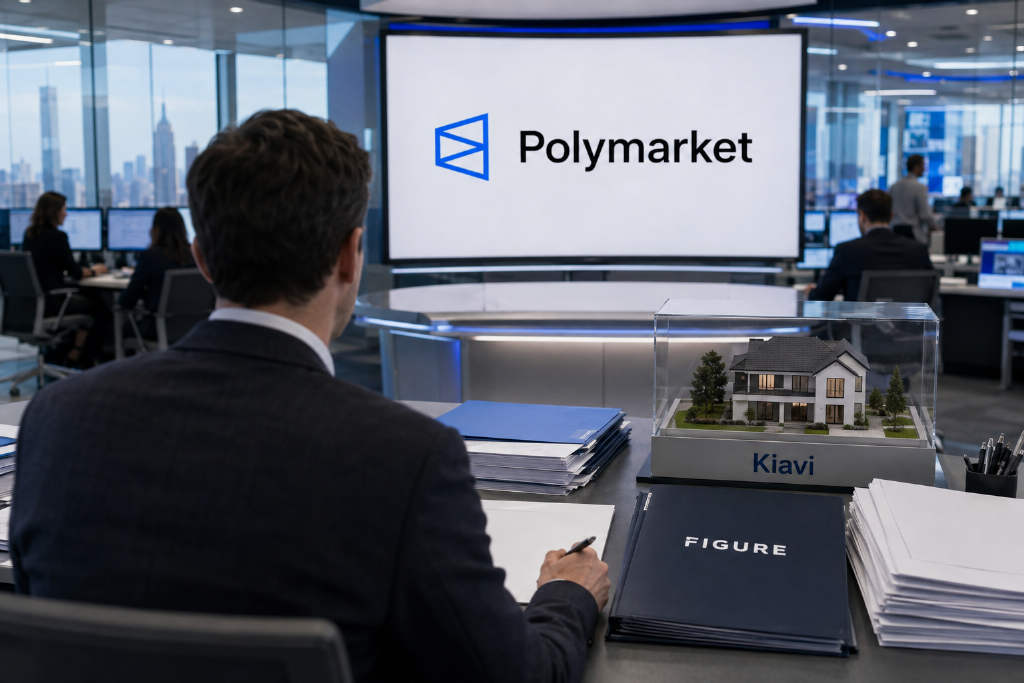
PANews counted 10 blockchain funding deals globally during the week of Aug. 31 to Sept. 6, with disclosed capital exceeding $1.28 billion. The biggest transaction in crypto financing was a new $1 billion round for prediction market platform Polymarket, while Figure Technology Solutions completed a $717 million acquisition of AI real estate lending platform Kiavi.
Key developments this week
In AI, data center developer Crusoe closed a $3 billion financing at a $30 billion valuation. The company had raised $1.38 billion at a $10 billion valuation only 10 months earlier, which means its valuation has tripled over that period. Heterogeneous compute orchestration company Gimlet Labs and optical interconnect maker iPronics also announced financings of $300 million and $125 million, respectively.
In robotics, physical AI company Lyte closed a $165 million Series C. Lianhe Yingxiang, a visual systems supplier to Unitree, also raised several hundred million yuan in a new round backed by industrial capital, state capital and market-oriented investors.
In crypto, Southeast Asia’s blockchain sector has attracted $680 million in equity financing so far in 2026, more than double the $319 million raised in all of 2025. Singapore remains the center of the region’s crypto investment market, accounting for 82.5% of the historical $6.2 billion raised by blockchain companies in Southeast Asia.
Crypto funding
Firelight Protocol raises $8 million
DeFi risk protocol Firelight Protocol raised $8 million in a round led by Gumi Cryptos Capital, with Maven 11, Metalayer, Joint Effects and Tribe Capital also participating. Firelight was incubated by DeFi infrastructure provider Sentora and plans to launch its first protection integrations in September, offering smart contract attack coverage to fintech companies participating in onchain yield.
The protocol currently uses XRP as protection capital and plans to expand to high-liquidity, non-native-yield assets including bitcoin and Stellar’s XLM. Its claims process is evaluated by independent risk firms including GFX Labs, Hypernative, Credora, Native and Cyfrin, with a target of reviewing, settling and paying qualified claims in about 10 days.
Catapult Trade says it has raised about $6.6 million across four rounds
Catapult Trade, a Solana-based gamified memecoin launch platform and synthetic leveraged trading platform, said it has raised about $6.6 million to date across Seed, Private, KOL and Early Public rounds. Investors include KuCoin Ventures, Oddiyana Ventures, Venture Vault VC, as well as the founder of LIS Skins, the founder of Trady and other institutional and angel backers.
The project said the full investor list and details of each round will be disclosed two weeks before its token generation event. The TGE is expected to begin in fall 2026, with more updates scheduled for September.
Cari secures $32.5 million from banks
Cari, a bank-led digital currency network, said it raised $32.5 million in its first outside financing. The entire round came from banking institutions, including First Horizon Bank, Huntington Bank, KeyBank, M&T Bank, Old National Bank, SouthState Bank and Glacier Bank.
Cari is built on an Ethereum-anchored permissioned Layer 2 blockchain. It aims to help banks move money onchain through shared infrastructure and programmable financial services. The new capital will be used to speed up bank onboarding and integrations and to expand the use of tokenized deposits and programmable money.
Diameter Pay closes a $10 million Series A
Stablecoin payments infrastructure startup Diameter Pay raised $10 million in a Series A led jointly by CMT Digital and Lightspeed Faction. SixThirty Ventures, Stellar Development Foundation, Tech Council Ventures, Onigiri Capital and BitRock Capital also joined the round.
This was the first financing since the company was founded. Founder and CEO David Lighton said Diameter Pay had previously been bootstrapped. The round started in April and closed in July, and it was structured as an equity deal. The post-money valuation was not disclosed.
Founded in 2023, Diameter Pay provides payments infrastructure for banks, fintech companies and digital asset exchanges. It helps clients access U.S. dollar virtual accounts, domestic and cross-border payments, stablecoin on- and off-ramps, and compliance controls through U.S. banking partners. Its dollar virtual accounts let overseas fintech firms offer USD accounts to their own users while Diameter Pay handles compliance and payment controls in the background, with links to stablecoin infrastructure.
DAC receives $1 million investment
Quantum-resistant EVM Layer 1 blockchain DAC said it received a $1 million investment from Unicorn Crypto Ventures. DAC is focused on building EVM-compatible blockchain infrastructure designed to withstand attacks from quantum computing.
According to the company, DAC is built on a Quadrans fork and uses a three-layer node architecture and PoQW consensus. Its dual-asset model, DACT and DACC, is intended to drive ecosystem activity and transaction execution for developers and enterprises seeking scalable, quantum-resistant blockchain infrastructure.
Felix Pago raises $200 million Series B
Stablecoin cross-border remittance startup Felix Pago said it has raised a $200 million Series B made up of $87 million in equity and a $113 million credit facility. Andreessen Horowitz, or a16z, participated in the equity portion, while the credit facility came from General Catalyst’s Customer Value Fund.
Felix Pago is one of Latin America’s better-known stablecoin remittance networks. It uses WhatsApp as its front-end interface and relies on USDC and blockchain rails for settlement, lowering costs and transfer times for remittances from the United States to Mexico.
OpenReserve raises $25 million seed round led by a16z crypto
Onchain bank OpenReserve announced a $25 million seed round led by a16z crypto, with Jump Capital, Acrew, Coinbase Ventures, Clocktower, Quona and Middle East venture fund AAF Management also participating.
OpenReserve wants to build what it describes as a bank that never closes. Its core ledger uses a programmable architecture similar to blockchain to support continuous settlement, instant fund transfers and atomic transactions powered by stablecoins and tokenized deposits, while also extending onchain credit through regulated bank balance sheets.
a16z Crypto said the internet has reshaped retail, communications and payments over the past 30 years, but bank back-end infrastructure still depends heavily on traditional systems. Banking hours, ACH and wire settlement speeds no longer fit the needs of the internet economy, in its view.
Plenti closes $3 million seed round led by Tether
Colombian fintech company Plenti raised $3 million in seed funding led by Tether, with Verda Ventures also participating. The new capital will support its existing business in Colombia and help the company expand into Peru and Bolivia.
Founded in 2022, Plenti offers multicurrency accounts for freelancers and remote workers. Users can hold U.S. dollars, euros and Colombian pesos, earn yield on balances, and invest in U.S. stocks, ETFs, digital gold and crypto assets. The company says it serves more than 150,000 active users, processes more than $3.1 billion in annual transaction volume, and has handled more than 680 million USDT since 2023.
Polymarket completes new $1 billion financing
The Wall Street Journal, citing people familiar with the matter, reported that prediction market platform Polymarket completed a new $1 billion financing round. 1789 Capital led the round with roughly $300 million, and Polymarket’s post-money valuation is expected to reach about $21 billion.
1789 Capital had already invested about $200 million into Polymarket before this round and is set to become one of its largest shareholders after the deal. Intercontinental Exchange, or ICE, remains the company’s largest investor. It had previously disclosed holdings in Polymarket worth $1.6 billion, representing about 22% of the company’s outstanding shares.
ParlayX raises $1.25 million pre-seed round
Prediction market platform ParlayX raised a $1.25 million pre-seed round led by Dreamcraft Ventures. The platform is designed to address what it sees as the one-person-one-account limitation in prediction markets by allowing collaborative team trading.
Mergers and acquisitions
Figure acquires Kiavi for $717 million
Figure Technology Solutions completed its $717 million acquisition of AI real estate lending platform Kiavi and plans to integrate Kiavi’s lending business into Figure’s blockchain infrastructure. Kiavi is expected to add more than $7 billion in first-lien loan volume each year to Figure Connect, while more than $100 million per month is expected to flow into Figure’s onchain lending platform Democratized Prime.
The transaction has two parts. Figure acquired Kiavi’s technology platform and operating assets, while a joint venture between Figure and Six Street acquired Kiavi’s loans. Figure’s actual cash outlay was about $590 million, financed through the issuance of $600 million in 8.5% senior notes. Kiavi CEO Arvind Mohan is joining Figure as chief business officer.
Fomo buys Mobula’s data indexing software and team for $17 million
Onchain social trading app Fomo acquired Mobula’s data indexing software and team for $17 million. Fomo CEO Paul Erlanger said traders need timely price, transaction and wallet data to decide whom to follow and what to buy.
Selected AI and robotics financings
Crusoe raises $3 billion at a $30 billion valuation
AI data center developer Crusoe closed a $3 billion financing at a $30 billion valuation. The round was led jointly by Atreides Management and Valor Equity Partners, with participation from Mubadala Capital, part of Abu Dhabi’s sovereign wealth structure.
Crusoe’s customers include Meta, Microsoft and OpenAI. The company recently signed a five-year GPU and AI infrastructure cloud contract worth $13 billion with trading firm Jane Street.
The financing came only 10 months after Crusoe raised $1.38 billion at a $10 billion valuation in October last year. Founded in 2018, Crusoe initially used stranded natural gas for bitcoin mining before shifting into AI infrastructure and cloud services, where it became known for building hyperscale data center campuses. Axios reported last month that Crusoe had met with banks including Goldman Sachs and Morgan Stanley to discuss a possible IPO in the near term.
Gimlet Labs raises $300 million
AI infrastructure startup Gimlet Labs said it raised $300 million at a $3 billion valuation. Andreessen Horowitz led the round, with participation from Arm Holdings and Microsoft’s venture arm M12.
Gimlet Labs helps customers allocate AI workloads across different chip types and is working with Arm to make its software compatible with multiple Arm chip technologies.
iPronics closes $125 million Series B
AI data center optical interconnect company iPronics raised $125 million in a Series B co-led by Maverick Silicon and Light Street Capital. Investors also included NVIDIA, Triatomic Capital, Bosch Ventures, Catalight Capital and the European Innovation Council Fund. Total funding has now reached $177 million.
iPronics provides rack-scale optical switching equipment for AI infrastructure. Its programmable optical layer lets AI clusters adjust network connections in real time for training and inference workloads. The new capital will support a wider operating footprint and faster commercial deployment.
AIR raises $50 million
AI security startup AIR raised $50 million across two rounds: an initial $10 million round led by Sequoia Capital and a second $40 million round led by Greenoaks. Swish, Netz and multiple angel investors also participated.
The company was founded by Yair Saban and Niv Hoffman, both veterans of Israel’s Unit 8200. AIR offers a security platform for AI agents that can detect agents running inside enterprises, continuously review the skills and tools they use, block interactions with non-compliant software or outside sources, and provide a marketplace of reviewed agent plugins and skills.
AfterQuery reaches a $3.2 billion valuation in new financing
Y Combinator-backed AI training data startup AfterQuery completed a new financing at a $3.2 billion valuation, just five months after raising a $30 million Series A in April at a $300 million valuation. That implies valuation growth of more than 10 times in the period.
Y Combinator partner Gustaf Alströmer said it is the fastest startup in YC history to reach unicorn status from founding. AfterQuery’s founders are 22 and 23 years old and joined YC’s winter 2025 batch only 18 months ago.
The company said in April that its annualized revenue had reached $100 million. Customers include NVIDIA, Legora and South Korean AI lab Motif Technologies. AfterQuery focuses on training models and agents to complete tasks like professionals, rather than simply making sure answers are correct.
Empirik raises $21 million seed round
Empirik, an infrastructure prediction startup incubated by Sequoia Capital, has spun out as an independent company and raised a $21 million seed round from Sequoia, Canapi and Alumni Ventures.
Its platform uses AI to track system changes and predict their likely impact before outages happen. The company describes the tool as an autonomous traffic cop that approves low-risk changes, sets guardrails for large-scale changes and flags dangerous updates for human review. Empirik says it already serves Fortune 500 companies including S&P Global and Guardant Health. Its aim is to bring infrastructure engineers an efficiency gain similar to what Cursor and Claude Code have brought to developers. A Sequoia partner said Empirik can now act as a complementary layer for AI SRE platforms.
Zeit AI raises €5 million
German AI data analytics startup Zeit AI raised €5 million in seed financing. Investors include Y Combinator, the University of Oxford seed fund, Sequoia Capital Scout Fund, ACE Ventures and HPVC, the vehicle of SAP co-founder Hasso Plattner.
Angel investors include former German finance minister Christian Lindner, 2014 World Cup winner Mario Götze and Meta board member Charlie Songhurst. Zeit AI was founded two years ago by two former Palantir employees. Its product, ZeitMind, is an autonomous data analyst that can process raw data and generate reports, alerts and inventory optimization workflows without a human data engineer.
Lyte raises $165 million Series C
Physical AI company Lyte announced a $165 million Series C led by Maverick Silicon, with Fidelity Management & Research, Atreides Management, Key1 Capital and Ora Global also investing. The post-money valuation reached $1.6 billion.
Founded in 2021 by former Apple and PrimeSense engineers, Lyte focuses on a full perception stack for robots spanning custom chips, multimodal sensors and spatial software. Total funding has now reached $272 million. The new capital will be used to expand production of its perception chips and LyteVision platform and to advance AI perception capabilities and commercial robot deployments.
Lianhe Yingxiang raises several hundred million yuan
Embodied robotics vision company Lianhe Yingxiang raised a new round worth several hundred million yuan. The round included industrial capital, state-backed capital and market-oriented institutions, with investors including Dunhong Asset, Hangzhou Embodied Intelligence Industry Fund, Fuyang Industrial Investment and Zhipingfang.
Lianhe Yingxiang supplies vision systems to humanoid robot makers and AI hardware companies including Unitree, Zhipingfang, Zibianliang and Rokid. The company said its revenue has already reached the 2 billion yuan level. It plans to use the funding to upgrade its strategy as visual infrastructure for the physical AI world, linking optical design, vision modules, depth cameras, edge AI, data collection, AI Base engineering toolchains and mass manufacturing across the full cycle from idea to volume production. It is also advancing a smart vision industry project in Hangzhou with investment at the 1 billion yuan level.
Other M&A and fund activity
SLB to buy Kelvion for $3.4 billion in cash
Oilfield services company SLB will acquire data center cooling services provider Kelvion for $3.4 billion in cash and assume $700 million in debt. The deal is expected to close in the first half of 2027. Kelvion is currently controlled by funds managed by Apollo Funds, and SLB will also acquire minority stakes from funds affiliated with Triton.
SLB said the acquisition will expand its business in AI-driven data center infrastructure solutions. The company expects the deal to be accretive to earnings per share and free cash flow per share within 12 months of closing and to generate about $120 million in annual savings within three years through cost synergies and additional revenue. Guggenheim Securities and USB AG are serving as financial advisers to Apollo Funds and Kelvion.
a16z expands fifth growth fund to $8.5 billion
Andreessen Horowitz expanded its fifth growth fund from $6.75 billion at launch in January to $8.5 billion, adding $1.75 billion. Days earlier, the firm said it had raised $1.1 billion for a newly launched Machine Era Fund focused on AI hardware startups including chips, memory, networking and storage.
The growth fund has operated for seven years and invested in more than 100 companies. Its current focus includes enterprise and consumer AI, defense technology, robotics, infrastructure software and hardware, and health technology. In January, a16z also announced $15 billion in new funds, at a time when the firm managed $90 billion in assets.
Dragoneer’s continuation fund raises about $1 billion
Dragoneer Investment Group had planned a $2 billion continuation fund backed by private holdings including OpenAI and SpaceX, but the vehicle ultimately raised about $1 billion.
According to people familiar with the matter, Dragoneer considered adding stakes in Databricks and wealth manager Creative Planning to help move the deal forward and provide liquidity for investors in a weak exit market. The central purpose of the continuation fund was to extend holding periods for assets including Amwins Group and health technology company PointClickCare.
Coverage of the transaction said the pricing discount ranged from about 5% to 20%, with some assets sold without a discount. That compares with an average discount of 30% to 35% in venture and growth secondary transactions in the first half of the year.
Swish Ventures raises $250 million for Fund III
Swish Ventures, the venture firm founded by former NBA player Omri Casspi, raised $250 million for its third fund, bringing assets under management to about $800 million. Investors in the new fund include Sequoia Capital, U.S. pension funds, U.S. universities and family offices.
The fund is expected to back about 12 startups with an average check size of around $20 million, focusing on seed and Series A deals across cybersecurity, technical infrastructure, physical AI, defense, industrial AI and govtech.
Since launch, Swish has invested in 20 companies, eight of which have become unicorns. Its portfolio has a total valuation of more than $60 billion. The firm previously participated in Web3 company Antic’s $7 million seed round and in Web3 identity verification startup Dynamic’s $13.5 million financing.