
Futu Securities received approval in June 2026 for an upgrade to its Hong Kong Securities and Futures Commission Type 1 (dealing in securities) license, making it the first brokerage in Hong Kong to offer qualified clients financing for crypto trading. In practical terms, clients do not have to sell existing securities holdings to gain exposure to digital assets. They can pledge stocks as collateral and use the released buying power for crypto trades.
Eligible securities holdings can be posted as collateral. Futu Securities then assesses client credit, collateral haircuts and concentration before extending financing that can be used for crypto trading. The financing relationship stays on the brokerage side, while order execution and asset custody are handled by a licensed virtual asset trading platform.
From access to actual buying power
A year earlier, Foresight News had described Futu’s move into crypto as the opening shot in Hong Kong brokers’ turn toward digital assets. Back then, the most visible milestone was whether a brokerage app could directly offer crypto trading. A year later, having stocks and crypto on the same page is no longer the main story. The bigger question is whether those assets can draw on the same pool of buying power.
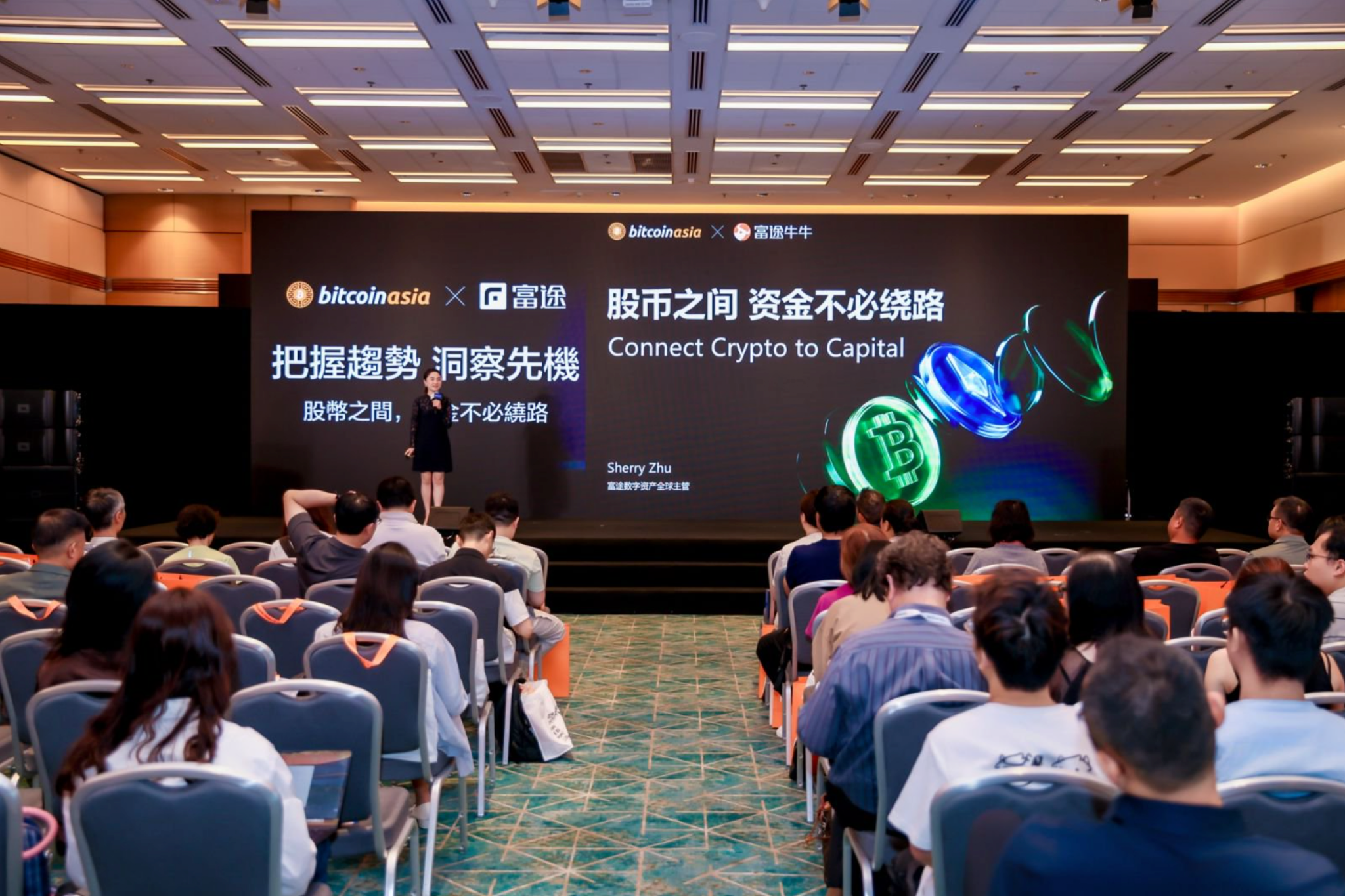
At Futu’s session during Bitcoin Asia 2026, Sherry Zhu, global head of digital assets at Futu Group, framed the shift as the difference between “account management” and “asset management.” She said users still keep stocks, ETFs, crypto and fiat spread across brokerages, exchanges, wallets and banks. Transfers, FX conversion, deposits and withdrawals take time, and while that can look like wealth management, “it is actually an account management action, not true asset management.”
As of June 30, 2026, Futu had 31.25 million users, 3.84 million asset-bearing accounts and HK$1.4 trillion in client assets. That stock of securities assets gives the idea of connected buying power real commercial weight.
Three product tracks presented by Futu
Futu laid out three product directions at the event:
- Using crypto deposits to buy stocks, aimed at moving on-chain money into the securities market faster.
- Using pledged securities to trade crypto, aimed at turning stock holdings into crypto buying power.
- In-kind subscription and redemption for crypto ETFs, aimed at converting native crypto into a securities format that traditional finance can recognize more easily.
In Futu’s framing, real cross-asset integration means account fusion: a shorter conversion path, unified buying power, more efficient clearing and settlement, and risk management at the account level.
The same app is not the same account
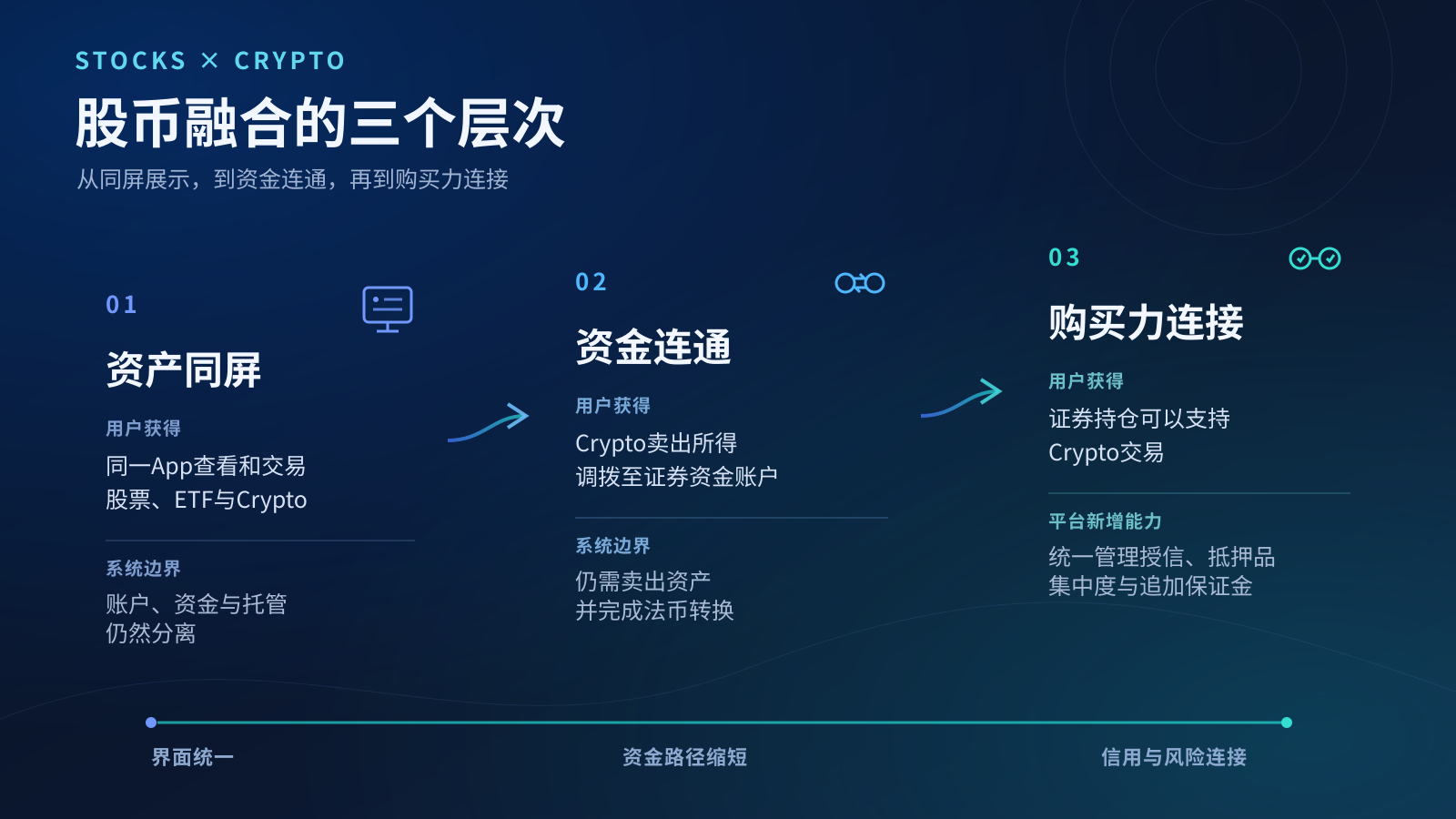
Putting stocks, ETFs and crypto into one app only means a user can view and place orders from one interface. It does not answer who holds custody of the assets, where the cash balance sits, or whether one asset class can support the buying power of another.
The report says stock-crypto integration can be read in roughly three layers, moving from shared display to connected funding and then to connected buying power. The third layer is the hardest. Securities and crypto are governed by different client asset rules, and stocks and native crypto do not simply enter a common custody pool. Futu Securities handles traditional assets, securities margin financing and client credit. A licensed VATP handles crypto order execution and custody. Client identification, collateral valuation, buying power allocation and risk monitoring have to be coordinated across two account systems, while asset segregation, anti-money laundering reviews and separate settlement rules remain in place.
For years, Web2 securities and Web3 assets looked like two parallel chains that did not intersect. Users trying to capture market moves had to act as the bridge themselves, shuttling money through fiat rails and compliance controls.
That is why the report identifies buying power, not trading access, as the real barrier. Futu’s model takes on the coordination cost that users previously carried. Traditional assets and credit risk controls stay within the brokerage base, while on-chain custody and matching are passed to a licensed platform, and the client sees a more unified source of liquidity at the front end.
Regulatory changes in Hong Kong opened the door
Hong Kong’s rule changes provided the opening for that structure. Before Feb. 11, 2026, licensed corporations in Hong Kong that offered crypto dealing services through omnibus account arrangements were not allowed to provide financing for clients to buy virtual assets. The Securities and Futures Commission later issued a circular allowing virtual asset brokers engaged in securities margin financing to let clients use financing lines for crypto trading, provided those clients had sufficient collateral and met credit-control requirements.
The article describes the framework as a dual-track approach that combines traditional financial standards with Ce-Fi innovation, and presents it as a step from simply licensing trading activity toward enabling asset mobility and a liquidity ecosystem in virtual assets.
As meme speculation cooled, capital looked for fundamentals
The report says the crypto market stayed weak through the first half of 2026, while U.S. equities kept rising on growth in the AI sector. Risk capital moved away from purely narrative-driven assets and toward assets with cash flow, earnings and valuation anchors.
Two very different types of institutions are now absorbing that demand from on-chain capital into fundamentals.
One path comes from offshore exchanges putting U.S. stocks on-chain. xStocks products offered by Kraken and OKX are backed by underlying shares or ETFs. Users can buy them with fiat, crypto or stablecoins, withdraw the tokens to compatible wallets, and in some cases access around-the-clock trading and on-chain lending. The figures cited in the article are these: xStocks has expanded to 714 stocks and ETFs, assets under management rose 1108% over one year to $684.5 million, cumulative trading volume topped $35 billion, and the number of wallet holders approached 200,000.
But the report also draws a clear line around that model. Users receive on-chain tokens linked to the price and economic interest of the underlying stocks. They do not directly own listed company shares, generally do not receive voting rights, and cannot transfer those tokens into traditional brokerage accounts. Corporate actions such as dividends are reflected through reinvestment or token multiplier adjustments. The article adds that Bybit’s U.S. stock offering also includes CFDs, where clients trade price movements and do not receive shareholder rights.
Futu, by contrast, is taking what the report describes as a compliant route into a real U.S. equities trading system.
The article says the platform has years of accumulated trading depth in U.S. equities, alongside margin infrastructure and portfolio risk controls. Futu’s total trading volume reached nearly $2 trillion in 2025. In the second quarter of 2026 alone, trading volume exceeded $800 billion, up 78.8% year over year. Within that framework, users’ Hong Kong stocks, U.S. stocks and ETFs remain in brokerage accounts. Clients can deposit on-chain funds into a licensed system, with custody provided by a Hong Kong-licensed VATP, and after selling, the proceeds can be used in one place to buy stocks, funds, bonds and other traditional financial products. The end result is direct ownership of listed shares and regulated positions in a securities account, not a price-linked token.
That difference ultimately sits at the regulatory layer. Tokenized equities choose on-chain composability and 24/7 trading. The trade-off, as set out in the article, is giving up shareholder rights, giving up mutual recognition with the traditional financial system, and taking on compliance uncertainty in the issuer’s jurisdiction as well as banking and payment-rail risk. Futu is choosing a fully licensed path in exchange for legal certainty over assets and direct acceptance by traditional finance.
Three routes for three conversion problems
The report argues that the more important issue is no longer whether users can buy an asset, but whether the asset can be mobilized after it is bought.
Crypto to stocks: moving assets across systems
On-chain funds and securities assets belong to different systems. For investors who hold both, friction often appears outside the trade itself, when money has to move between exchanges, banks and brokerages. Futu is trying to shorten that route and let both asset classes coexist and interoperate within one app.
Stocks to crypto: resolving the conflict between holdings and buying power
When investors already hold sizable stock positions, a turn in the crypto market often forces a choice: sell existing assets or bring in new cash. Securities-backed financing creates a third option. Clients can keep their positions and still release fresh buying power.
Crypto to ETF: giving native crypto a recognized place in compliant finance
Native crypto is already an asset class for many investors, but it can still face differences in recognition and verification when it enters bank lending, proof-of-assets processes or traditional wealth management systems. In-kind subscription and redemption for crypto ETFs creates another route. Eligible clients can use native crypto to subscribe to spot ETFs, or redeem ETF units into the corresponding crypto, shifting between on-chain assets and securities units.
That means crypto no longer exists only as coins sitting in a wallet. Once converted into ETF units, it can appear in a securities account, be held and displayed as a regulated security position, and be folded into portfolio management. For high-net-worth and institutional investors, the report says, this creates an additional form of native crypto that is easier for traditional finance to identify, verify and allocate.
In the article’s framing, these are not three isolated product features. They represent three forms of capital efficiency: moving assets less, unlocking buying power, and bringing crypto into a compliant asset system.
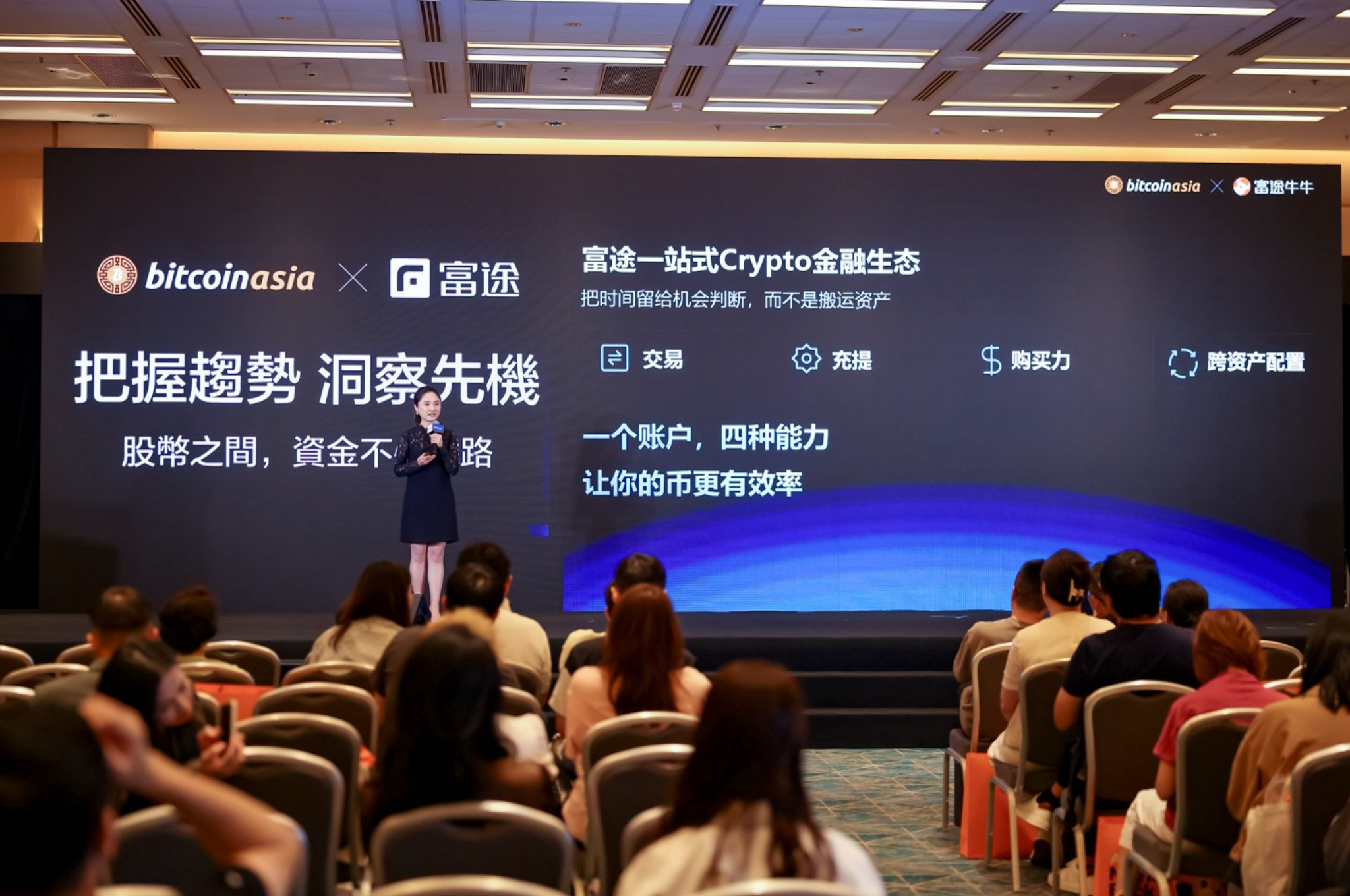
Futu summarizes its one-stop crypto financial ecosystem around four capabilities: trading, deposits and withdrawals, buying power, and cross-asset allocation.
PantherTrade as the compliance base for stock-crypto integration and RWA
The article breaks the market’s stock-crypto integration approaches into three models.
The first is the crypto-native route, where exchanges take traditional assets such as U.S. stocks directly on-chain. The strengths are token variety, liquidity and composability, but brokerage accounts, bank funding and traditional financing systems usually remain off-chain, leaving a boundary between asset pools.
The second is a broker connecting to a licensed VATP. That can add a crypto trading gateway relatively quickly, but trading, custody, credit extension and later product development still have to be coordinated across separate institutions.
The third is a brokerage group building its own VATP. That comes with higher investment and compliance costs, but if the securities and crypto businesses sit within the same group, the interfaces spanning client identification, order execution, custody, financing and fund transfers can be redesigned from the ground up.
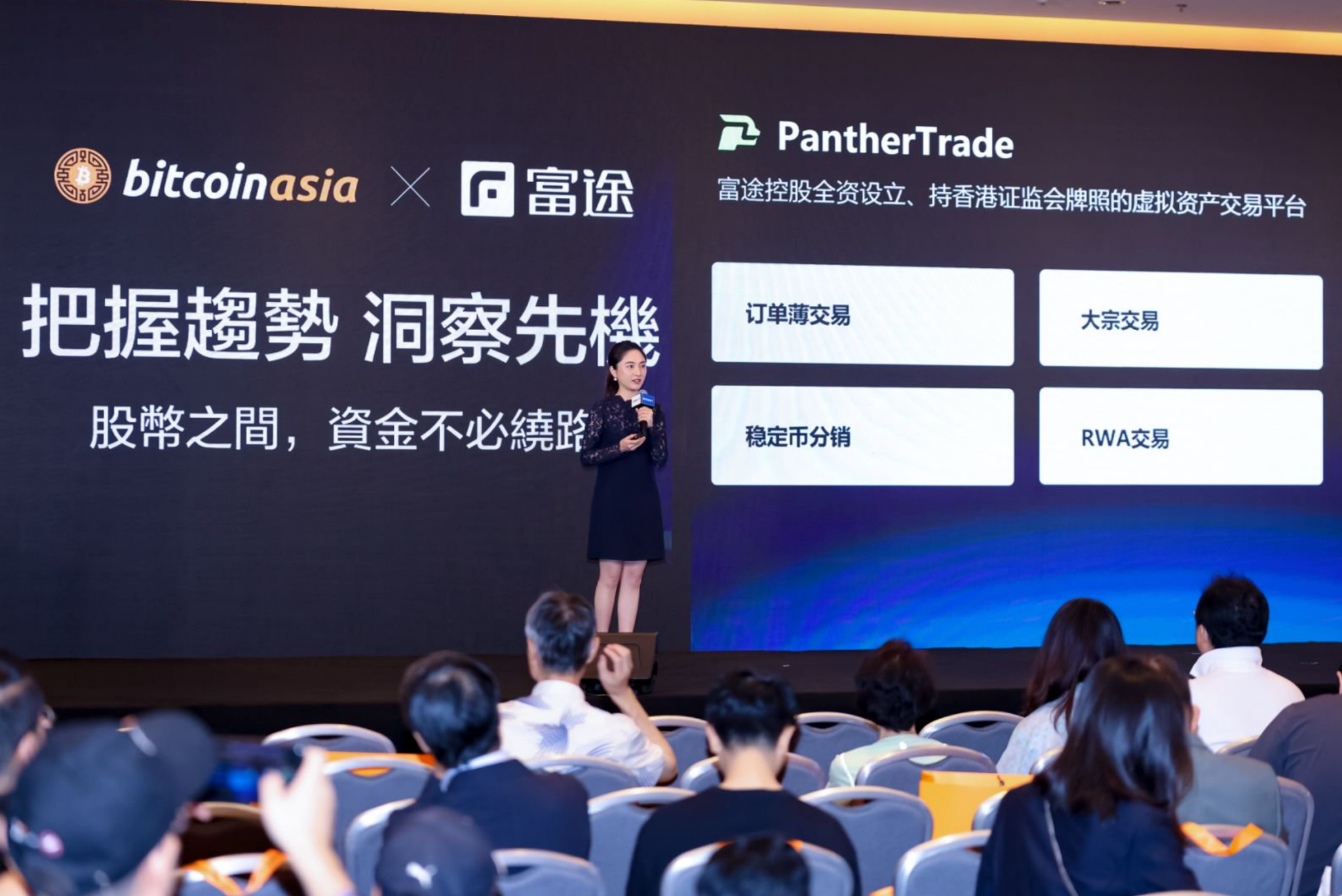
Futu is following the third route. PantherTrade, a wholly owned licensed virtual asset trading platform under Futu Group, obtained a Hong Kong VATP license in January 2025 and fully launched operations in March 2026. With PantherTrade connected to Futu Securities, the former handles virtual asset matching, custody and related technical functions, while the latter keeps the traditional brokerage roles of securities handling, client relationships and margin financing. The article describes that combination as an effort to build Asia’s first true closed-loop Web2+Web3 ecosystem.
For retail users, that first shows up as the ability to allocate between stocks and crypto inside one familiar app. For high-net-worth and institutional clients, the significance may extend to OTC block trades, tailored virtual asset services and more complex allocation needs across traditional and digital assets.
The report also says the infrastructure can be extended into RWA. Futu has launched a tokenized money market fund and is exploring compliant secondary-market trading for it. PantherTrade is also advancing tokenized products and related services for institutions. For Futu, that means the existing capabilities in trading, custody and compliant asset transfer can be pushed further into tokenized products.
A platform taking on more of the bridge function
As asset connectivity deepens, the user value is not limited to shaving off a few operational steps. In the past, investors holding stocks, ETFs and crypto at the same time often had to manage assets, transfers and currency conversion across multiple brokers, exchanges, banks and wallets. As those assets become linked within one platform, the platform starts to take on the bridge role itself, letting users handle allocation and conversion more directly in one place.
The article says that is also central to whether account connectivity can become a durable business: whether clients are willing to bring in more assets, whether they use financing tools, and whether conversion across asset classes is smooth enough. For users, the real gain is not simply one more trading venue. It is fewer accounts to manage, fewer money transfers to execute, and less self-directed asset shuttling.
As Sherry Zhu put it at the event, the aim is to “leave clients more time to judge opportunities, and less time to move assets around.”