
WhiteLine Daily said the market is still rewarding future demand, but the pricing framework is splitting. Nvidia is locking in computing demand with credit support, Unitree is pulling forward growth expectations through valuation, and Fabrinet’s earnings show that once growth starts to arrive, the next hurdle is whether revenue can turn into cash.
Capital is still pricing future demand ahead of time
Nvidia uses credit to secure long-term orders
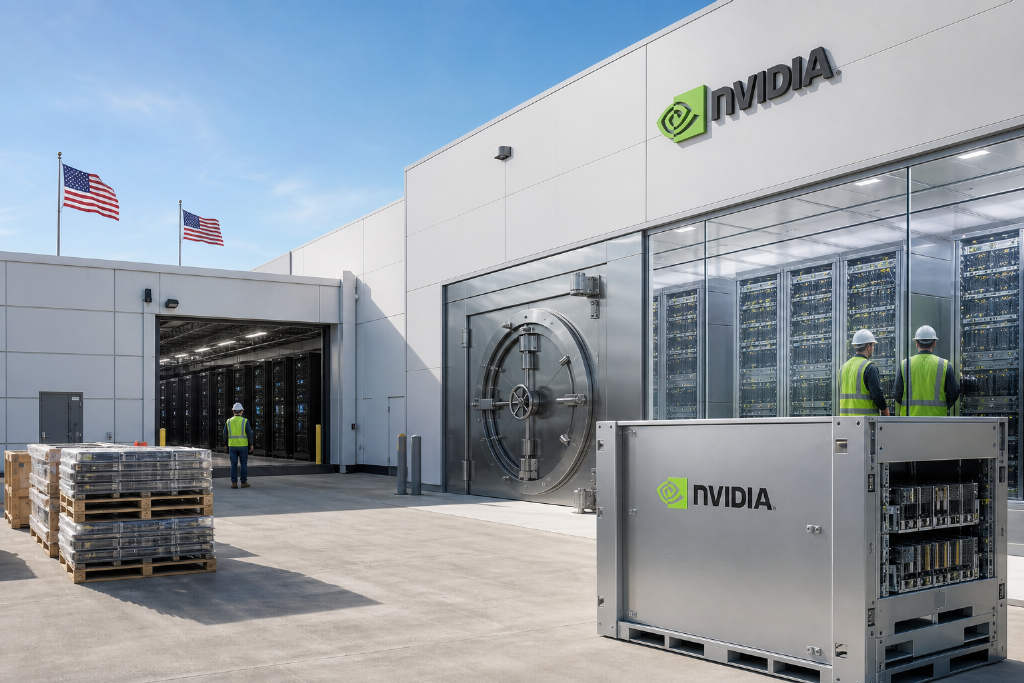
Nvidia has agreed to provide up to $105 billion in residual value guarantees for OpenAI’s lease of a large data center in Ohio. The project is being developed by SB Energy, a SoftBank subsidiary, and the initial guarantee covers about 4.25 GW of computing capacity. The campus is scheduled to come online in phases starting in 2028, with an initial tranche of about 800 MW. OpenAI’s lease term is 20 years.
The site will use Nvidia’s full DSX computing platform. Nvidia will also serve as the exclusive AI computing infrastructure supplier for the campus, invest $1.5 billion in SB Energy, and take on the roles of shareholder and credit support provider.
That does not mean Nvidia is immediately putting up $105 billion in cash. It would only need to cover a shortfall if OpenAI could not pay rent and the project still had a gap after being re-leased or sold. WhiteLine Daily said the key point is that Nvidia is beginning to use its balance sheet to turn a customer’s future demand into a financeable asset today.
That raises order certainty, but it also brings part of the customer credit risk back onto Nvidia. The next question is whether OpenAI can rely on external revenue to cover rent over the long term. If it cannot, the guarantee used to secure the order could become an actual burden for Nvidia.
Unitree uses valuation to bring forward growth expectations
On the other side of the market, China-based general robotics company Unitree will list on the STAR Market on August 19. Its preliminary valid online subscription multiple reached 8,288.82 times, while the final allotment rate after callback was only 0.0181%. The offering price is RMB 150.80 per share, implying a valuation of more than RMB 60 billion, or about 219 times 2025 profit and 36 times revenue.
The company said that as of July it had cumulatively produced and delivered about 18,000 bipedal humanoid robots. But the offering valuation clearly does not only reflect existing sales. It also prices in the possibility that robots move from research, education, and demonstration settings into industrial and consumer markets.
The two cases land in different places, but they point to the same market choice: capital is willing to take on credit risk or valuation risk in advance for scarce computing and robotics assets. Nvidia is taking on potential guarantee liability. Investors in Unitree’s IPO are taking on the risk of valuation pullback if growth does not materialize.
FN beat across the board, but the market still did not pay up
Fabrinet (FN) is an important manufacturer in the AI optical communications supply chain, providing optical component packaging and precision manufacturing services to customers. In its fourth fiscal quarter, revenue reached $1.316 billion, up 45% year over year. Non-GAAP earnings per share came in at $4.10, above the market expectation of $3.81. Data center revenue grew about 68% and accounted for 51% of total revenue for the first time. The midpoint of next-quarter revenue guidance was about $1.4 billion, also above market expectations.
Even so, FN had risen about 5% before the earnings release and then fell about 7% in after-hours trading after the results came out. After-hours price action alone does not show exactly what investors were trading, but cash flow stands out in the numbers.
For the full year, FN posted about $473 million in GAAP net profit, about $257 million in operating cash flow, and $253 million in capital expenditures. Using the rough approach of subtracting capex from operating cash flow, free cash flow was only about $4.2 million. Over the same period, inventory increased from $581 million to $1.021 billion. Capacity expansion and working capital needs absorbed almost all of the cash generated from operations.
WhiteLine Daily said there is no clear sign that FN’s orders are weakening. The issue is how much inventory and capital spending each new increment of revenue requires. If inventory growth slows after new capacity comes online and free cash flow recovers, the current pressure may ease over time. If revenue keeps hitting new highs but cash conversion still does not improve, the market will stop asking for the next upside surprise and start asking how much money the growth actually leaves behind.