
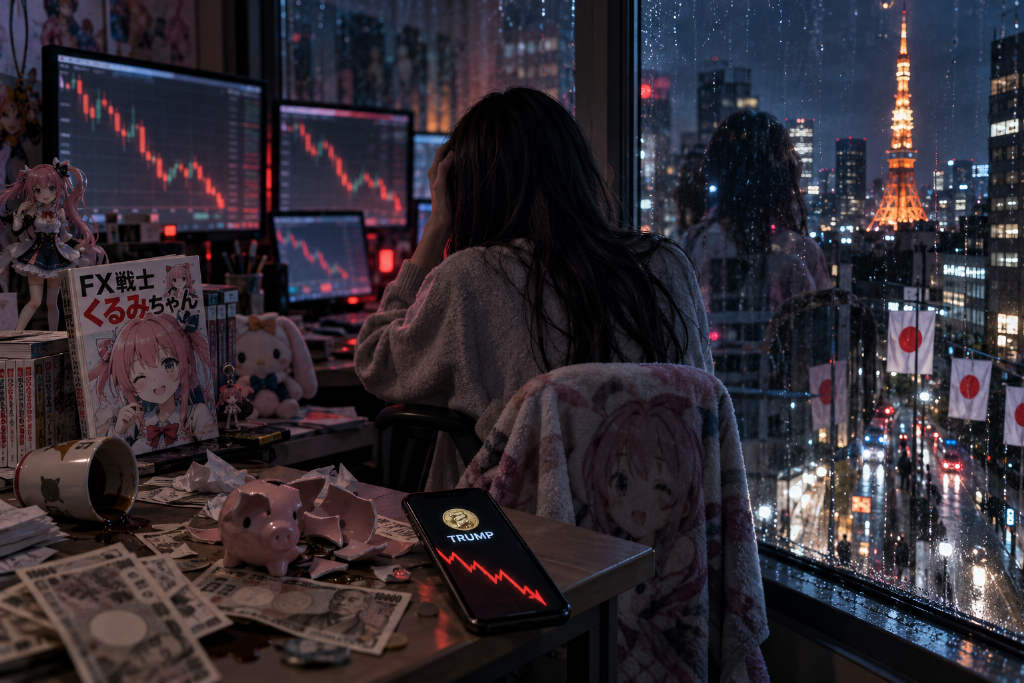
Japanese manga FX Warrior Kurumi (FX Senshi Kurumi-chan), a series built around foreign exchange margin trading, has been turned into an anime and began airing in Japan on Oct. 1. It wraps high-leverage trading in cute character designs, wild facial reactions, and breezy slice-of-life scenes. But the story itself goes somewhere much darker: blown accounts, forced liquidation, family collapse, even death. That gap is why some investors have described it as a financial horror story dressed up as a moe anime.

ABMedia said the original manga was written by Demunyan and illustrated by Tansan Daisuki. The first collected volume came out in 2021, and the series is still running in KADOKAWA’s Monthly Comic Flapper. After the anime started airing this October, the title also landed on the cover and opening color pages of the magazine’s latest issue.
A family tragedy in 2008 drives the story
The main character, Kurumi Fukuga, is a typical college student. She does not get into FX just because she wants to make money.
The story rewinds to 2008. Kurumi was still in middle school when she came home and found her mother broken after losing money in FX trading. Her mother had traded foreign exchange margin products without telling her husband, who spent long stretches away from home for work. During the global financial crisis, she lost 20 million yen. Her mental condition worsened, and four months later she died by suicide.
By 2014, Kurumi was a second-year college student and decided to enter the FX market herself. She had one aim: make back the 20 million yen her mother had lost. In the story, she says, “I’ll make 20 million yen easily!”
Why the setting tracks Japan’s retail FX boom
ABMedia said the series hits home for viewers who know financial markets because the mother’s story is set in the years when Japanese retail investors were piling into foreign exchange margin trading.
After Japan’s bubble economy burst, the country remained stuck in a very low interest-rate environment for a long time. Traditional bank deposits offered little in return. So Japanese households slowly shifted toward higher-yield overseas assets, and FX margin trading looked like a straight path in: sell low-yield yen and buy higher-yield currencies like the Australian dollar and New Zealand dollar. It was not just a wager on exchange-rate gains. Holding positions overnight could also produce the interest-rate gap between the two currencies, known as swap points.
Those traders became known in overseas markets as “Mrs. Watanabe.” It does not mean one person. It is a catch-all label for Japanese household retail traders, especially the housewife-style FX crowd.
And that also helps explain why the story is set in 2008. ABMedia said that from 2003 to 2007, volatility across global financial markets was fairly low, and the carry trade was highly profitable for a while.
Leverage turned a yield trade into a crisis trade
The trouble was simple. FX was never just about exchanging yen for Australian dollars and sitting on the position. A lot of Japanese retail traders were using foreign exchange margin trading, a leveraged product that expanded exposure through posted margin. In calm conditions, leverage could boost what would otherwise be limited carry income. Once the market moved against them, that same leverage blew losses up fast.
After the 2008 global financial crisis erupted, money rushed out of risk assets. Higher-yield currencies dropped hard, and carry trades built on short yen positions and long Australian dollar and New Zealand dollar positions started to unwind. Japanese retail traders were then hit from all sides at once: falling exchange rates, thin margin, and margin calls.
The realism is not only in liquidation, but in averaging down
ABMedia argued that the series feels real not just because it shows accounts getting wiped out. It also captures something very familiar from that era of Japanese retail trading: people fighting the move.
When the foreign currencies they held slipped a bit, some investors did not cut their losses. They added more. Why? Because they believed the market would come back eventually. In a low-volatility market, that kind of approach could seem to work. Buy the dip. Sell the bounce. Keep collecting the rate differential. It could look steady. Safe, even.
But when the move was not a mild slide and turned into a one-way market on the scale of a financial crisis, that strategy could break almost instantly. So the scenes in FX Warrior Kurumi where characters keep adding to losing trades and try to win back what they have lost are not just comic exaggeration. ABMedia said the behavior closely matches trading patterns that showed up in the real retail market.
Some social-media reactions moved in the opposite direction
ABMedia said the series could almost work as anti-leverage teaching material. But some reactions on social platforms after the anime debut went the exact opposite way.
One Threads user wrote after watching the anime, “Watching the Kurumi anime got me so fired up, I’m going to open an account and try it too.” Another user, talking about the recent plot, joked, “I wonder how much leverage the author used this time to short...”
ABMedia also quoted users who summed up the backdrop of the era in which Kurumi’s mother lived. After Japan’s bubble economy collapsed, low rates made ordinary deposits much less appealing, and household assets were often managed by housewives. In a period when plenty of people believed they could “easily make money from foreign-currency interest,” FX became the doorway into financial markets for many households.
The creator also bought TRUMP and later said the stop-loss came too late
ABMedia added that Demunyan, the original creator of FX Warrior Kurumi and the person behind @demk0814, bought the meme coin OFFICIAL TRUMP (TRUMP) in January 2025 and later stopped out.
At the time, he wrote: “Today’s survival strategy... reviewing the meme coins I’m holding and getting ready to chase the crowd... ride the trend...”
The next day, he posted again: “That certain president’s coin is finished. I did stop out, but it was already too late.” ABMedia said an unofficial “Kurumi-chan coin” then appeared, and he actually bought that too.
A risk warning appears before the opening song
ABMedia said almost every chapter of FX Warrior Kurumi has become meme material among market watchers. The anime even puts up an unusual risk warning for financial products before the opening theme starts. It tells viewers that FX is a high-risk product, losses can exceed posted margin, and excessive trading can affect everyday life.
Kurumi, though, is not shown backing off. She says, “I’ll make 20 million yen easily!” For many investors, 20 million yen might just be a target number. For Kurumi, it means something else entirely: her mother’s life after a failed trade, and the memory of being powerless as a child.
ABMedia said she wants to prove that if she had been older back then, with enough money and enough trading skill, she might have stopped her mother from ending up that way. That leaves her chasing something close to impossible. Even if she earns 20 million yen, her mother is not coming back. When a trading goal stops being about building a better future and turns into an attempt to repair an irreversible loss from the past, even hitting the original number may not be enough to make the trader quit.
The report said that same psychology shows up in the series’ portrayal of FX trading. When positions are in paper profit, the trader feels like she is in control of the market. When prices pull back a little, she tells herself it is normal volatility. When losses keep growing, she refuses to cut them because admitting failure hurts too much. “If I sell now, the loss becomes real.” And then it gets worse. A loss that could have been handled grows into one that cannot, and it ends in forced liquidation.
ABMedia also said Demunyan himself has gone through failed FX trading. In an afterword, he joked: “If I had been one of the winners in FX, Kurumi would never have been born.” That gives the work another angle. Not just entertainment built around financial trading, but also a story shaped by the creator’s own losses.