
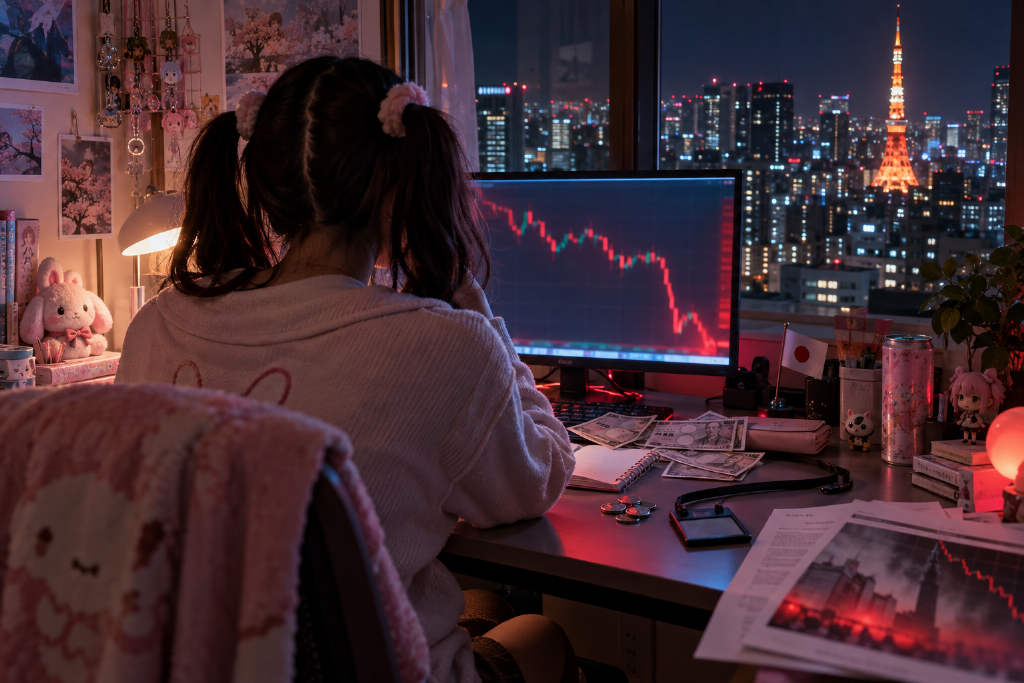
Japanese TV anime FX Warrior Kurumi premiered on Oct. 1, and its first episode made its point before the opening theme even began. Two warnings appeared on screen first: 「FX is a high-risk product, and losses may exceed margin.」 and 「Excessive trading may affect daily life. Please think carefully and proceed with caution.」 Viewers online joked that it was the first time they had seen an anime start with that kind of disclaimer.
The title of episode one can be rendered as “What Is FX?” On Bahamut Anime Crazy’s October seasonal page, the show was at one point labeled an “ultimate horror work” before that tag was removed.
A 300,000-yen account and a 20 million-yen target
The story is set in 2014. Its protagonist, 20-year-old college student Fukuga Kurumi, lost her mother Kozue during her school years after Kozue lost 20 million yen trading FX in the Lehman shock and later took her own life. Kurumi then opens an account with 300,000 yen saved from part-time work, aiming to earn back the 20 million yen through an overseas FX broker offering very high leverage.
Three companions surround her. Kogane Mochiko has assets of more than 10 million yen, keeps a cool head and likes watching other people lose money. Yamashi Mebuki has almost no knowledge and trades on instinct while carrying debt. Takane Yasuko believes she has no talent for speculation.
The official story summary is blunt about what the series is about: floating losses, forced liquidation, a heartbeat that will not slow down, and the urge to keep buying, selling and chasing profit.
The creator has his own history of FX losses
The original author is Demunyan (でむにゃん), with art by Tansan Daisuki. The work began as a web manga by Demunyan, then started a remade serialization in KADOKAWA’s Monthly Comic Flapper from the March 2021 issue. As of Sept. 18, 2026, 10 volumes had been published.
According to the article, Demunyan has personally experienced FX losses and has shared those losses on social media. In an afterword, he wrote: 「If I had been one of the winners in FX, Kurumi would never have been born.」 He also posted on X recently, in a message relayed by Game Corner, saying: 「Today I learned the Chinese word ‘jiucai.’」
The manga has long been described in joking but pointed terms as “hardcore realism, scarier than a horror film” and “kids won’t understand it, adults won’t dare watch it.” When the anime adaptation was announced, lead voice actor Aina Suzuki said the original looked cute but was cruel inside, calling it “an overly realistic FX world.” Chinese-speaking viewers were even more direct, describing it as “scarier than horror movies,” “kids won’t understand it, adults won’t dare watch it,” and “the best horror anime of the year.” Some said it should be shown in schools as financial education material.
Why traders may want to watch it
The need to win it back
The first reason given in the article is the mentality of trying to recover losses. Kurumi does not enter the market to make pocket money. She enters to fill a 20 million-yen hole left by her mother. Averaging up to recover losses and refusing to realize a loss are patterns many losing traders will recognize.
The weight of leverage
The second is leverage itself. Since August 2011, Japan has capped retail FX leverage at 25x, while overseas brokers can offer leverage in the hundreds. Kurumi uses one of those overseas brokers. With only 300,000 yen in capital, even a small move can separate a manageable trade from disaster.
The historical shadow of EUR/CHF
The third is the history behind EUR/CHF. On Jan. 15, 2015, the Swiss National Bank unexpectedly removed the 1.20 floor on the euro against the Swiss franc. EUR/CHF fell by about 30% intraday. UK forex broker Alpari UK went bankrupt, while U.S. broker FXCM survived only after securing an emergency $300 million loan. Because the story is set in 2014 and Kurumi is heavily positioned in EUR/CHF, viewers who know forex history may react to that setup immediately. The article does not spoil whether the plot goes that far.
Four retail trader archetypes
The fourth reason is the cast itself. Kogane represents the trader with capital and composure. Yamashi represents the trader with no knowledge and pure instinct. Takane represents the person who believes speculation is simply not for them. Kurumi represents the trader driven by the need to recover losses. The article says many viewers will probably see some part of themselves in one of them.
The crypto angle: even more leverage, no market close
The piece then shifts to crypto. Perpetual futures on crypto exchanges can offer leverage above 100x, well above Japan’s 25x retail FX cap, and the market never closes. A position remains exposed 24 hours a day, including while the trader is asleep.
The article closes with a simple caution: this is an anime, not a textbook. Watching it will not necessarily make anyone profitable. At most, it may show viewers how close they are to liquidation. For newcomers, it may be the cheapest risk-management lesson of the year. Better to get scared in front of a screen than to pay for the lesson with real capital in a live market.