
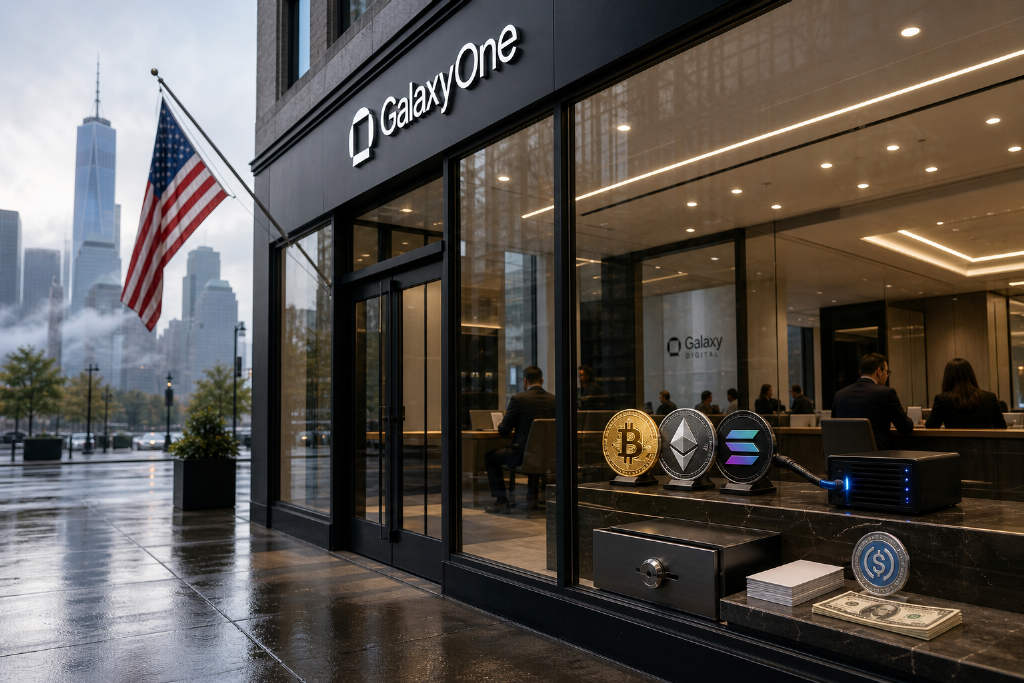
Galaxy Digital launched a Crypto Portfolio Line of Credit on Aug. 25 through its retail platform GalaxyOne, allowing users to borrow against BTC, ETH and SOL, including staked SOL, without selling those assets. The credit line offers funding in U.S. dollars or USDC at a fixed 8.99% annual interest rate, charges no origination fee, requires monthly interest payments, can be reused on a revolving basis and provides instant access to funds. The product is currently available in 40 U.S. states.
Galaxy said customer collateral will not be rehypothecated, and any SOL already staked can continue earning staking rewards while serving as collateral.
How the product is structured
The offering is built for retail users, but the bigger question behind it is whether on-chain assets can function as real-world purchasing power.
One feature is mixed collateral. Users can place BTC, ETH and SOL into a single credit line instead of applying for separate loans for each asset. That allows price swings across the basket to offset each other to some extent. If ETH falls while BTC rises, the overall collateral ratio of the portfolio may still remain in a healthier range.
SOL is another notable inclusion, especially because staked SOL is eligible. The original article described that as a clear statement from Galaxy on SOL’s status as an institutional-grade asset. Before this, most crypto-collateralized lending products focused on BTC and ETH. Adding SOL, while letting staking continue uninterrupted, gives the product a direct appeal to holders in the Solana ecosystem.
The 8.99% rate is not the cheapest in the market. Coinbase, through Morpho, offers crypto-backed borrowing rates as low as 5%, though those rates move with pool utilization. Ledn is about 10.4%, Figure about 9.9%, Strike starts around 9.5%, and Nexo advertises rates as low as 1.9% for users who hold NEXO tokens. That places Galaxy near the middle of the market. Its pitch is not the lowest cost. It is the predictability of a fixed rate and the company’s promise not to rehypothecate client collateral.
Use of proceeds is unrestricted. Borrowed dollars or USDC can be used for day-to-day expenses, taxes, a home down payment or investment opportunities. They can also be used inside GalaxyOne to trade U.S. stocks and ETFs. According to the article, when Galaxy launched GalaxyOne in October 2025, it had already combined crypto trading with U.S. stock trading. The new credit line extends that setup by linking holding, borrowing, spending and investing in a single platform flow.
Who the product is aimed at
The core user profile for crypto-collateralized lending is someone with large crypto holdings who does not want to sell. That may be because the holder expects long-term appreciation or wants to avoid triggering capital gains tax, yet still needs short-term liquidity.
Under U.S. tax rules, selling crypto is a taxable event. The article noted that the long-term capital gains tax rate for assets held more than a year can reach 20%, and with the 3.8% net investment income tax added, the marginal rate can approach 24%. It gave a simple example: if an investor has $1 million in unrealized BTC gains, a sale could result in a tax bill of more than $200,000. If that same investor instead borrows $500,000 against BTC, they gain liquidity without triggering a tax event and keep the BTC exposure. The tradeoff is roughly $45,000 a year in interest, based on 8.99% on $500,000.
Whether that trade makes sense depends on market performance. The article said BTC’s annual returns in 2024 and 2025 were both well above 8.99%. If price appreciation exceeds the borrowing cost, keeping the position may work in the borrower’s favor. If BTC enters a down cycle, the borrower faces a different setup: shrinking collateral value, ongoing interest expense and the risk of margin calls or forced liquidation.
Galaxy’s target customers are described as high-net-worth individuals, family offices and founders. Zac Prince, Managing Director of GalaxyOne, said the product uses Galaxy’s institutional-grade infrastructure to serve retail clients.
Prince’s background remains relevant. He was the founder of BlockFi, once a leading name in crypto-collateralized lending, before the company went bankrupt in 2022 following the FTX episode. At Galaxy, he is now building in the same category again, with a direct emphasis on the no-rehypothecation standard.
A market that is still shrinking
Data cited from Galaxy’s own research unit shows the crypto-collateralized lending market is contracting. Total crypto-backed loans stood at $67.42 billion in the first quarter of 2026, down 5.1% from the previous quarter and down 14.3% from the peak of $78.67 billion in the third quarter of 2025. In the second quarter, the figure fell again to $56.16 billion, a quarter-on-quarter decline of 16.78%.
Over a longer period, though, CeFi lending has rebounded 271.69% from its low of $6.8 billion in the fourth quarter of 2023. The article’s framing is that the market is going through a post-FTX, post-BlockFi reshuffle and consolidation rather than returning to zero. In CeFi lending, Tether holds a 62.25% market share, with Maple and Nexo ranked behind it.
Galaxy is entering while the market is shrinking. The article laid out two possible reasons. One is that a downturn can push competitors out, making market share easier to win. The other is that Galaxy sees demand for crypto-collateralized borrowing as structural, tied to tax management and the desire to keep long-term crypto holdings intact, rather than as a short-lived trade.
Risk has not gone away
Crypto-backed lending remains a leveraged product. With a 50% starting collateral ratio, borrowers may face margin calls or forced liquidation if collateral values fall by more than 50%. Galaxy has not publicly disclosed its exact maintenance thresholds or liquidation mechanics, which the article identified as key information for potential borrowers to confirm before using the product.
The lessons from 2022 are still close. BlockFi, Celsius, Voyager and Genesis all went bankrupt. The article said the central pattern was the same: when crypto prices dropped sharply, collateral values fell through loan balances and triggered chain liquidations. Another common thread was rehypothecation. Those platforms used customer collateral in other investments, and when those trades went bad, they no longer had enough assets to cover customers. Galaxy’s pledge not to rehypothecate is presented as a direct response to that period.
Still, removing rehypothecation risk on the platform side does not remove market risk for the borrower. If BTC falls 40% to 50% from current levels, borrowers could still come under margin pressure. In an extreme move, being forced to sell collateral near a low could leave them worse off than simply selling crypto and paying tax at the outset.
The 8.99% rate is also a real cost. For an asset held for a year without generating cash income, paying nearly 9% in interest is a meaningful burden for most retail users. The article argued that the product makes the most sense in a crypto bull market, where asset gains can far exceed the financing cost. In a sideways or bear market, it can look more like a liquidity trap.
The article closed by saying crypto-collateralized lending is best treated as a short-term liquidity tool rather than a long-term leverage strategy.