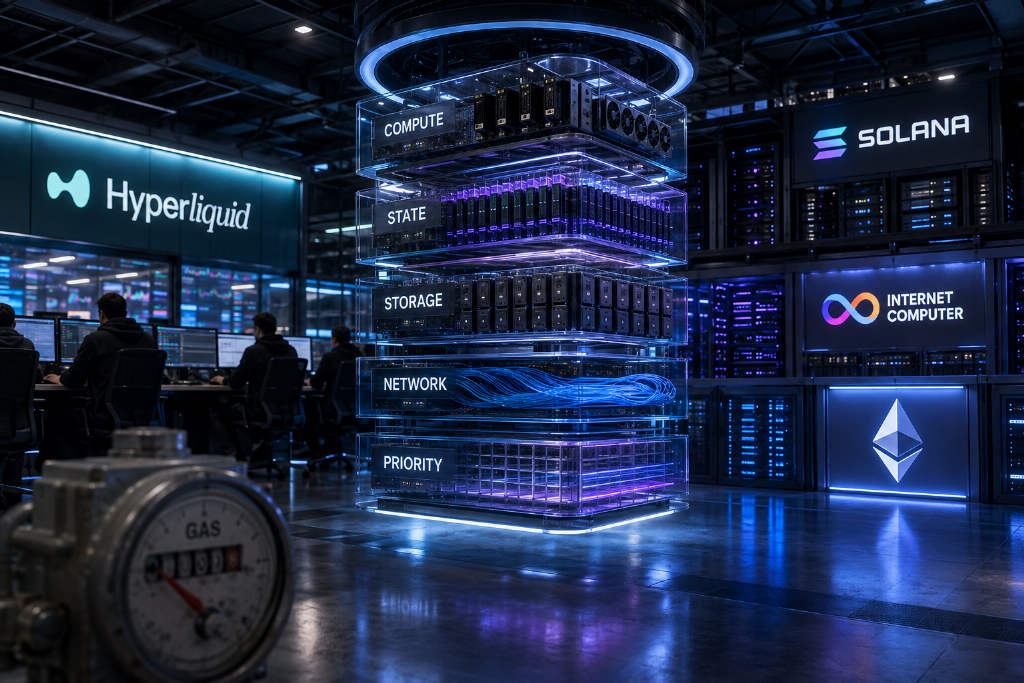
Blockchains have spent a decade asking users to understand gas before they can use a so-called world computer. A Foresight market analysis says that model is starting to break down. The article does not claim gas is about to disappear. Its argument is narrower and more structural: gas is losing explanatory power as the single abstraction for blockchain resource usage.
According to the piece, that conclusion does not come from one protocol upgrade or one chain design. It comes from four different directions that now point to the same outcome. Gas is moving away from the center of blockchain abstraction and back toward a lower-level settlement mechanism inside a broader resource market.
Four separate paths, one shared signal
Hyperliquid wraps gas inside the business price
The first example in the article is Hyperliquid. For core users of the decentralized perpetuals exchange, the visible cost is usually maker and taker fees, not a chain-native expression such as gas multiplied by gas price.
Foresight notes that HyperEVM still uses HYPE as gas, and EIP-1559 style base fee and priority fee mechanics are still in place. But at the product layer, the underlying infrastructure cost has been packaged into a trading service fee. If a user opens a BTC long, the thing being purchased is matching and settlement, not raw compute instructions inside blockspace. In that setup, gas has not been eliminated. It has been folded into the business model.
Solana separates inclusion from resource consumption
The second direction comes from Solana. The article says SIMD-0553 had entered accepted and merged status, but the related governance proposal SGP-0003 was rejected in August 2026, so the resource fee model has not gone live on mainnet.
Even so, the proposal is treated as a clear signal. Solana is trying to price two things separately: whether a transaction deserves inclusion in a block, and how much network resource it actually consumes. In the article’s framing, Base Inclusion Fee answers the first question, while Resource Fee answers the second.
That Resource Fee would be based on requested cost units, with listed components including signature cost, write lock cost, instruction data cost, program execution cost and loaded account data cost. The point, as Foresight presents it, is that Solana is unpacking gas back into the concrete resources that gas used to hide.
ICP sells execution environments, not only transactions
The third direction comes from Internet Computer. Instead of gas, ICP has long used cycles. The article says cycles are tied to XDR and measure real resources such as compute, storage, bandwidth and messaging.
It then points to Cloud Engines, launched in 2026. Users can choose nodes, node providers, geographic location and replication scale, and the protocol assembles a dedicated execution environment. The official term cited by the article is a user-owned slice of Internet Computer capacity.
Once the user is buying a computing environment rather than a single transaction slot, gas naturally moves out of the foreground.
Ethereum is also breaking gas back into components
The fourth direction matters most in the article because it comes from Ethereum itself. Foresight says Ethereum released the Platåberget testnet on Aug. 17, 2026 as an early public test environment for the Glamsterdam upgrade.
The warning from the official side, according to the article, was that wallets, indexers and gas estimators built around fixed gas limit assumptions could break. Glamsterdam changes gas costs for operations including state access. EIP-8037 and EIP-8038 raise and partially separate the accounting for state creation and state access, with the stated aim of making gas better reflect real node work. EIP-7999 is described as part of a push toward a unified multidimensional fee market.
Put together, the article argues, Ethereum is also unpacking gas into state access, compute, data and different categories of node work.
Across Hyperliquid, Solana, ICP and Ethereum, Foresight reaches a single conclusion: gas is moving from the main abstraction of blockchain use back to the settlement layer of a resource market.
The deeper issue may be the VM, not only gas
From there, the article turns to virtual machines. Its argument is that if gas is being decomposed, then the industry may have spent the last decade focusing too heavily on VM competition.
EVM remains the most powerful smart contract execution environment by ecosystem reach. Foresight points to the network effects around Solidity, OpenZeppelin, Foundry, MetaMask, Uniswap and Aave. But it says EVM is becoming less able, on its own, to serve as the full execution model for the next generation of globally verifiable compute infrastructure.
The issue, in this view, is not that EVM cannot run programs. It is that execution, state, resource usage and proving are bundled into one abstraction.
Execution model: stack machine versus register design
On execution, the article describes EVM as a stack machine with 256-bit stack items. Modern CPUs favor register architecture, while EVM’s ADD and MUL operations are surrounded by significant stack manipulation. FuelVM, with 64-bit registers, is presented as a direct response to that historical baggage.
Parallelism: hidden dependencies versus explicit scheduling
On parallelism, the article says EVM transactions do not declare state dependencies, so the execution layer cannot schedule work ahead of time. Whether two transactions touch the same state is largely opaque before execution.
Solana’s Sealevel takes the opposite route. Transactions declare which accounts they will access, the scheduler can inspect dependency relationships in advance, and execution can proceed in parallel where possible. Foresight says the design is close to the dependency graph logic used in modern CPUs. In its telling, Solana’s real breakthrough is not the sBPF instruction set by itself, but the decision to make parallelizability a first-class part of the execution model.
Proving: why RISC-V keeps gaining ground
On proving, the article argues that EVM’s 256-bit stack structure and state access patterns are not naturally friendly to ZK proving. zkEVM systems have struggled with proving costs, while future chains will increasingly need to assume that execution must later be proven.
That is where RISC-V enters the picture. Foresight says RISC-V gives blockchains something closer to a CPU-grade execution standard, one that can connect to LLVM and GCC ecosystems, register-based architecture and the standardization path for zkVMs. The article notes that Ethereum and Polkadot are both moving toward RISC-V and says that is not a coincidence.
Move shifts assets into the language layer
Move is treated as a different kind of contribution. The article says its significance is not faster opcodes, but the way it turns assets from contract-level data structures into language-level resources.
In Solidity, double-spend protection often relies on audits and libraries. In Move, the language and type system enforce the constraint directly. Foresight points to resource safety, ownership and abilities as mechanisms that solve a resource safety problem, not merely an execution speed problem.
Its conclusion is blunt: the VM race is a false framing. EVM offers composable general-purpose smart contracts. SVM offers explicit dependency declaration and parallel scheduling. Move offers resource safety. RISC-V offers a general execution ISA. zkVM offers provable execution. No single VM wins everything. What is being redesigned is the machine as a whole.
Blockchains are rediscovering resources
Foresight argues that blockchain is not inventing resource pricing for the first time. It is rediscovering what the computer industry already learned decades ago: compute is not one resource. It is a bundle of resources.
Ethereum’s classic model is one-dimensional gas, with fees calculated as gas used times gas price. The article says the simplicity hides an economic mismatch. Different resources are not interchangeable, yet they are priced through one number. A CPU-heavy but storage-light transaction and a storage-heavy but CPU-light transaction might both be labeled 100 gas even if they stress nodes in very different ways.
Older chains explored this earlier
The article revisits EOS, TRON and Hive. EOS, it says, had already separated CPU, NET and RAM in 2018. RAM functioned as a property-like resource that could be bought, used and sold back, with dynamic pricing through the Bancor algorithm. CPU and NET were rental-style resources, later expressed through the PowerUp model. Foresight says EOS distinguished between ephemeral and persistent resources years before Sui split computation from storage.
TRON followed a different route. Bandwidth mapped to transaction bytes, Energy mapped to contract execution, and TRON Power mapped to governance. Users could stake TRX to obtain resource quotas and delegate those resources to others. The article also points to a setting that lets DApp developers choose consume user resource percent and absorb users’ Energy costs directly, which it compares to later paymaster and sponsored transaction models.
Hive went further by dropping gas altogether. It used a conversion from HP to RC, where Resource Credits were not tokens but regenerative usage credits based on Hive Power. RC replenished automatically over a five-day period. Foresight describes this as a quota model that fit social and content applications better than complex DeFi or high-frequency computation.
In the article’s view, those chains solved resource metering but not resource markets or user-facing resource abstraction. Users still had to understand CPU, NET, RAM, Energy and Bandwidth just to use the chain normally. That, it says, is one reason they did not become the standard answer for user experience.
Newer systems are extending the same idea
The article says the underlying logic never disappeared. Solana isolates compute into CUs, turning transactions into resource requests. Sui splits fees into Computation and Storage, explicitly separating the economic act of running something once from storing 1 MB permanently. Polkadot uses ref_time and proof_size as a two-dimensional Weight model, with storage deposit added to handle long-term state growth.
For Foresight, the message is not that new chains are smarter than old ones. It is that the industry is gradually admitting that blockchain nodes consume far more than one kind of resource.
The real contest is resource pricing
Once resource usage is measured, the article says, the harder questions begin. Who sets prices? How are resources allocated? Can resources become tradable markets?
Hedera wraps multidimensional costs into a simpler interface
Foresight points to Hedera as a case worth studying. The network splits transaction costs into Node fee, Network fee and Service fee, with weighting based on Bandwidth, Processing, Storage and Duration. Scarcer resources get higher prices. The article describes this as resource cost accounting rather than opcode-based gas accounting.
It also highlights Hedera’s Simple Fees, introduced in 2026, which package complex resource pricing into a Base plus Extras format. That matters because it shows an engineering path where the system is multidimensional underneath while the user interface remains one-dimensional.
ICP and Filecoin show different pricing models
ICP takes a step beyond that, the article says. Because cycles are tied to XDR, a sharp rise in token price does not automatically make server resources proportionally more expensive. Developers face a more stable fiat-linked resource price. Compute Allocation can even be billed directly by core usage share, with a fixed cycles rate per second for one hundredth of a core. Foresight says this looks less like a transaction fee and more like a cloud bill.
Filecoin, by contrast, is presented as the clearest example of a pure resource market. Clients negotiate storage prices directly with storage providers, then publish the deal on-chain to form a Storage Market. Prices are not fixed by the protocol. They are set by supply and demand between the two sides. The article calls this the closest thing in the sector to a decentralized resource market.
Blockspace also contains a timing resource
The article adds one more dimension that is often ignored: time priority, framed as inclusion priority and ordering rights.
Priority fees, Jito-style auctions and execution tickets all amount to pricing who gets included first and in what order execution happens. If compute, storage and DA correspond to physical and verification costs on nodes, priority corresponds to scarce position inside the block. Foresight says MEV can be viewed as a rough and fragmented form of pricing for that resource. A mature market would bring it into the protocol explicitly rather than leaving it outside.
From these examples, the article extracts four layers: Resource Accounting answers how much was consumed. Resource Pricing answers how much it costs. Resource Allocation answers who receives the resource. Resource Market answers how the resource can be traded freely.
Its broader conclusion is that the future fee model will not be a better version of gas. It will be a multidimensional pricing system in which total fees are the sum of resource quantities multiplied by their prices. The resources listed include Compute, State, Storage, Bandwidth, DA, Proof, Concurrency, Messaging and Priority.
Chain-cloud: when blockchain starts acting like cloud infrastructure again
Foresight uses the term chain-cloud for the direction it sees emerging. It is not AWS plus a token. The article defines it as a globally verifiable compute resource pool that is managed by protocols, priced by markets, provided by nodes, proven by cryptography and tied together through common execution standards.
Its argument is that the world computer never really looked like a computer because it had execution without full resource management, scheduling, pricing, isolation or market structure. A real computer does not ask every program to define CPU pricing for itself. A real cloud does not make users think in raw RAM procurement terms before they can use a service.
Cloud Engines and application-level pricing
ICP Cloud Engines is presented as the first serious productization of a blockchain-plus-cloud approach. Users choose nodes, node providers, geography and replication scale, while the protocol assembles a dedicated environment. The official dashboard, the article says, already shows data centers, node providers and machine specifications.
Foresight stops short of calling ICP the final answer. Instead, it says the product offers a concrete chain-cloud prototype worth watching: a blockchain can organize nodes, hardware, geography, replication and execution environments into a cloud-like service.
The article then places Hyperliquid and GameFi on another branch of the same trend. Hyperliquid users buy a trading service. Game players buy gameplay. Immutable’s Orderbook allows fully gasless NFT listing signatures, separating the gas payer from the transaction signer. In that model, gas shifts from a user-visible cost to a platform operating expense. Foresight says that is very close to the Web2 economic model, where users pay for the product rather than the infrastructure.
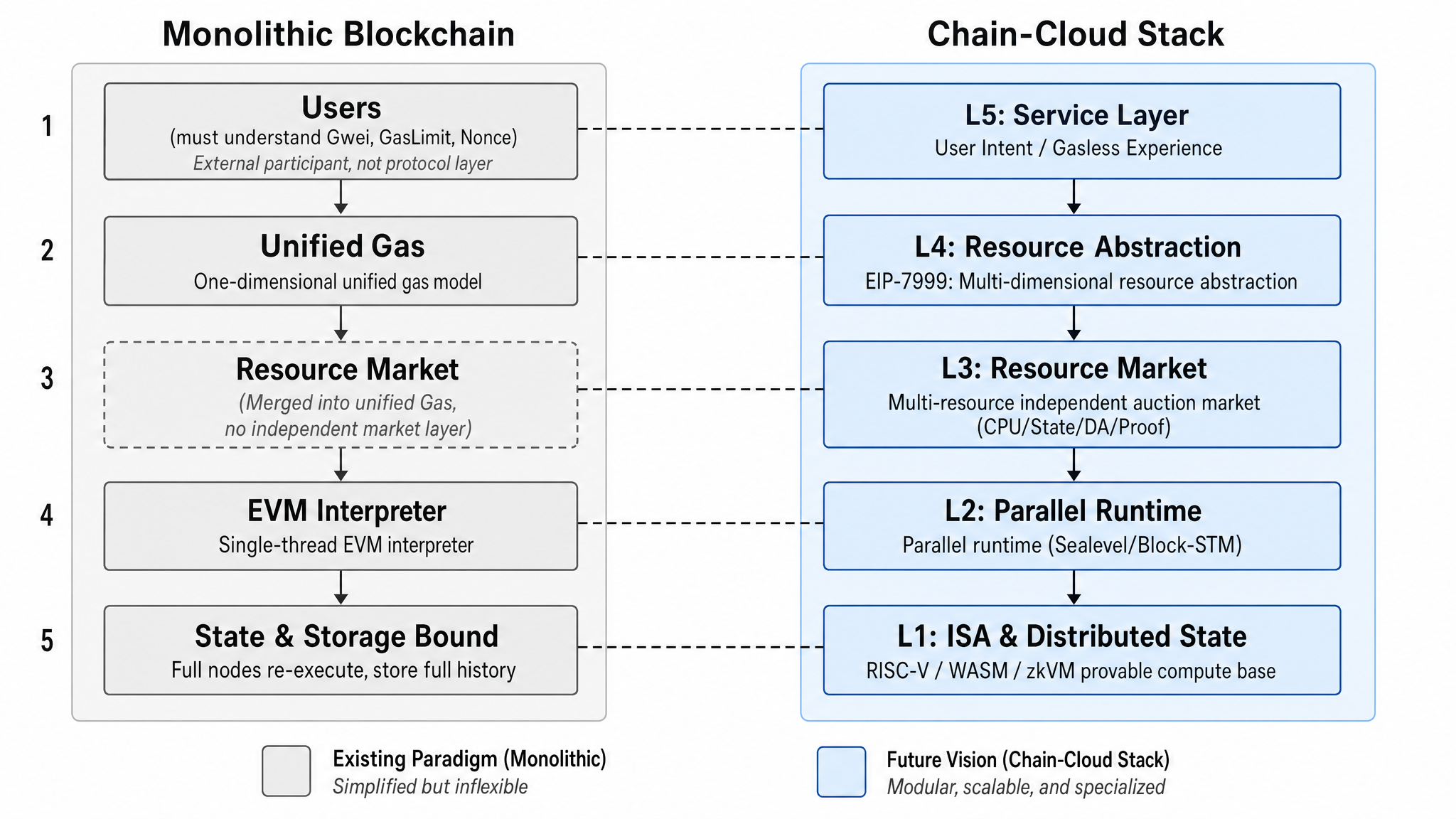
The next blockchain looks like a five-layer machine
Pushing the logic to its endpoint, the article says the next blockchain is no longer just one chain. It is a five-layer stack.
Service Layer
At the top is the Service Layer, where applications such as trading, gaming, storage and AI face the user directly. The visible price here is the business price, not the resource price.
Resource Abstraction
Below that sits Resource Abstraction, which packages multidimensional resources into interfaces that upper-layer services can consume. Foresight points to Ethereum’s EIP-7999 as an example of the direction: multidimensional costs underneath, a single max fee input for users on the surface, and internal protocol logic that allocates budget across different resource types.
Resource Market
Next comes the Resource Market, where Compute, State, Storage, DA, Bandwidth, Proof and Priority each have their own prices, shaped by supply and demand and forming tradable pools.
Parallel Runtime
Under that is the Parallel Runtime layer. This is where dependency graph analysis, concurrent scheduling and state access management happen. The article names Sealevel, Block-STM and the Sui Object Model as examples.
Execution ISA and Distributed State
At the bottom sit Execution ISA and Distributed State. RISC-V belongs here, the article says, but only as one general execution standard. The real core is the combination of ISA, runtime, state, resource market and proof.
Users should not need to see gas at all
The article closes by returning to the user. In the long run, users should not have to see terms like gas, gwei, CU, ref_time, proof_size or storage deposit. They should only see the service they are buying: swap 100 USDC for ETH, buy a sword, store 1 GB for 100 years, open a BTC long.
At the infrastructure layer, pricing gets more precise and more multidimensional: fee equals the amount of each resource used times that resource’s current price. At the user layer, the pricing formula changes. Foresight describes it as service value plus resource cost plus risk premium plus platform margin. The lower layer becomes more exact. The upper layer hides the machinery more completely.
After the world computer
Gas is not dying in this framework. It is stepping down. The article says it is moving from being the resource itself to being a packaging layer on top of a resource market.
Foresight sketches a progression from blockchain to world computer, then to resource computer, resource market and decentralized cloud, ending in chain-cloud.
The final claim is straightforward. Chains solve trust. Clouds solve resources. The job of the next generation of blockchain is not to put all computation on-chain, but to turn global compute resources into a public infrastructure that is verifiable, tradable and programmable. If that transition is completed, blockchain stops being just a faster chain and starts looking like a cryptographically secured cloud.
The article ends with a disclaimer stating that markets involve risk, the text does not constitute investment advice, and readers should judge whether any opinion, view or conclusion fits their own circumstances before making investment decisions.