Gate Research said in a new report that Robinhood Chain stands out as a closely watched case of a traditional financial company building its own blockchain infrastructure. In the report’s view, the network is not being propelled by a native token, an airdrop narrative, or a generic Layer 2 pitch. It is being built by Robinhood itself, with the stated aim of serving as financial infrastructure for tokenized stocks, ETFs, private assets, stablecoins and other real-world assets.
Robinhood describes the chain as an EVM-compatible Layer 2 based on the Arbitrum stack, designed to support 24/7 trading, self-custody, composable collateral and DeFi liquidity access for tokenized assets. Gate Research said the company is trying to secure a position across issuance, wallets, trading, liquidity and application access for tokenized financial products. In practice, though, early mainnet activity has not been led by RWA products. Trading volume, wallet growth and social attention have first been driven by Meme tokens, Launchpads and high-frequency DEX activity, with early headline assets including CASHCAT, PONS, TENDIES and SWOGE.
The report’s central argument is that Robinhood Chain currently has a two-layer structure: RWA as the long-term end state for assets, and Meme as the short-term engine for liquidity. Meme activity is bringing in wallets, trades, liquidity and attention. The value Robinhood hopes to capture depends on whether those users later trade stock tokens, use stablecoins, participate in on-chain lending, post assets as collateral and move into broader DeFi activity through Robinhood Wallet. That transition, Gate Research said, will determine whether Robinhood Chain remains a short-cycle Meme venue or develops into an on-chain brokerage infrastructure with longer-term network effects around financial assets.
Why Robinhood is building its own chain
A settlement layer that joins distribution, wallets and liquidity
According to the report, Robinhood already operates across stocks, options, crypto assets, wallets and tokenized securities distribution in Europe. As of May 2026, the company had disclosed 27.7 million funded accounts and about $377 billion in platform assets. Gate Research said those users, assets and trading entry points form the practical starting point for a chain of its own.
If tokenized securities lived only on third-party networks, Robinhood’s role would be limited to that of issuer, broker or wallet gateway, while trading, lending, collateral, DEX liquidity and later protocol revenue would disperse across outside networks. By building Robinhood Chain, the company can place asset issuance, on-chain identity, price oracles, corporate action processing, routing and compliance boundaries inside one infrastructure stack, and decide which assets enter the on-chain market, in what format, and which addresses or service providers take on key functions.
Gate Research said Robinhood’s choice of an Arbitrum Dedicated Chain fits that objective. The chain uses an EVM environment, ETH for gas, and a first-come, first-served transaction ordering model to avoid queue-jumping through higher priority fees. For a network meant to carry tokenized securities, the report said transaction ordering, failed-trade costs, market data latency and abnormal-trade handling matter more than headline TPS figures.
Stock tokens represent economic exposure, not direct equity ownership
The report said Robinhood Chain’s RWA story is often reduced to a simple “stocks on-chain” label, but the product setup is more complex. In Robinhood’s documentation, stock tokens are defined as debt securities issued by Robinhood Assets (Jersey) Limited. Holders receive economic exposure to the referenced assets. They do not directly own shares in the underlying companies, and they do not receive shareholder voting rights or legal beneficial ownership.
That structure means the ceiling for Robinhood Chain’s RWA segment depends first on issuance architecture, custody, jurisdiction and redemption mechanics. Pricing for stock tokens has to stay aligned with the underlying market, while stock splits, dividends, mergers and other corporate actions must also be processed on-chain over time.
Geographic restrictions set another boundary. Gate Research noted that Robinhood’s official announcement says stock tokens are available to eligible Robinhood Wallet users, while U.S. persons and users in certain restricted jurisdictions cannot participate. In other words, the “global” angle described in the report refers to cross-border distribution within compliance limits, not unrestricted access for every on-chain address.
Open EVM on the front end, permissioned controls underneath
Gate Research said Robinhood Chain presents an open EVM environment to users, with wallet connectivity, deployable contracts, Uniswap and multiple DeFi protocols available for liquidity. Underneath that, its governance and validator setup still carries a strong institutional profile. Governance documents cited in the report show a security council that includes Robinhood, BitGo, Chainlink, Fireblocks, Offchain Labs, Paxos and Talos. Routine operations require multisig approval and time locks, while emergencies can bypass the time lock. The report also said the current validator structure is permissioned.
That arrangement fits the issues a tokenized securities chain must handle, the report said. Issuers and custodians need to know who can respond to critical bugs. Institutional users need an auditable line of responsibility. If asset states or pricing break down, someone must be able to pause, upgrade or repair the system. For pure Meme traders, this lowers the score on decentralization narratives. For issuers hoping to bring securities, ETFs, Treasuries or collateral products on-chain, it improves operational viability.
Meme came first because supply moves faster there
RWA has a supply threshold; Meme mainly has a market threshold
Gate Research said RWA requires issuers, legal documentation, underlying prices, settlement arrangements, geographic restrictions and asset service processes. Meme tokens need a contract, a liquidity pool and traders willing to participate. Once Robinhood Chain went live, the market moved first toward the lower-friction side.
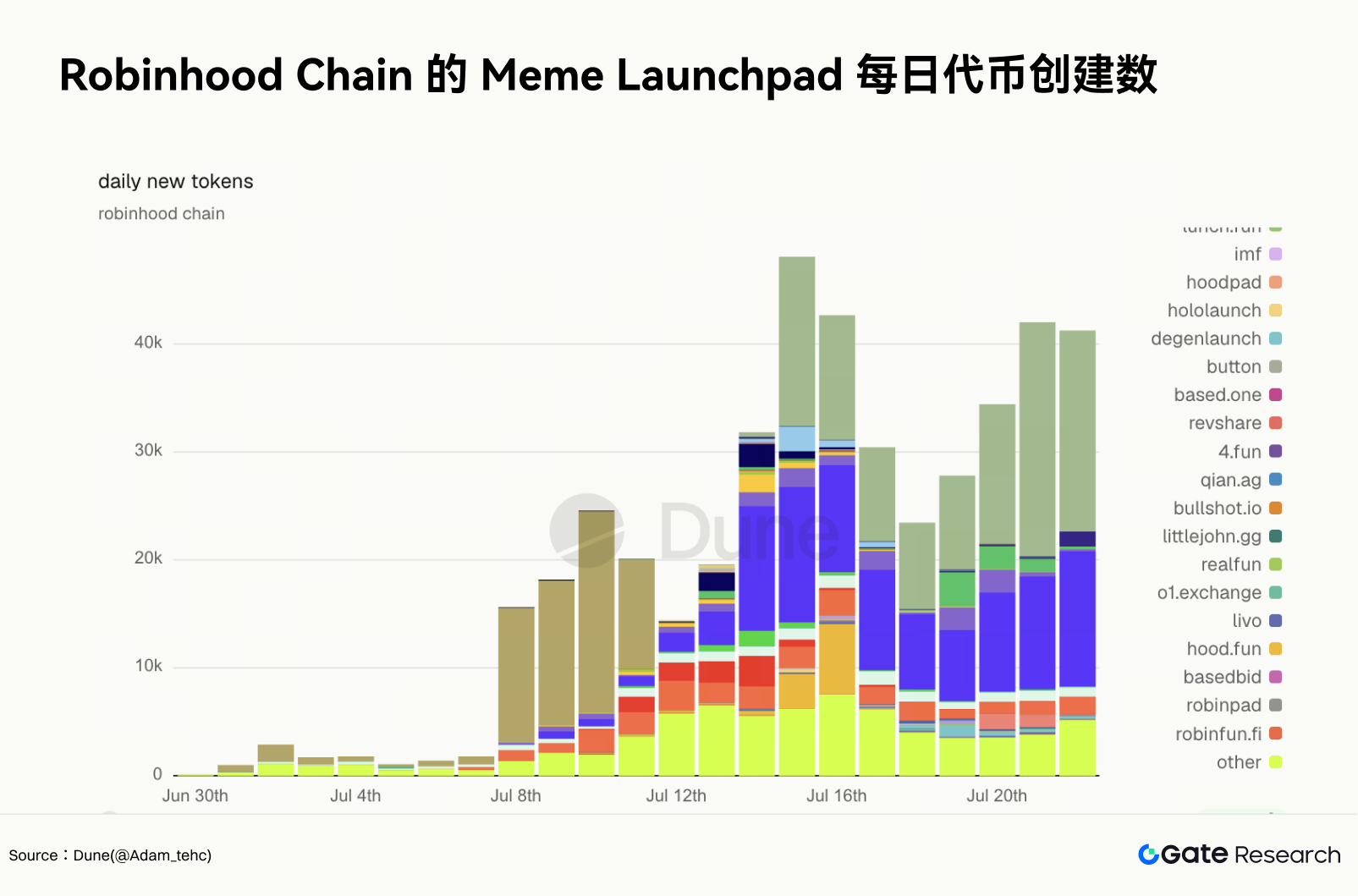
As of July 23, the report said Robinhood Chain had 101 RWA assets on-chain with a total value of about $21.84 million, which still puts the segment in an early stage. Over the same period, more than 40,000 new tokens were being created on the chain in a single day. The number of newly launched Meme assets far exceeded the total number of RWA assets.
Gate Research said this does not prove Meme has displaced RWA. The report’s point is that the two supply curves are fundamentally different. Tokenized securities expand at a pace set by legal structure and asset operations. Meme issuance is driven by tools and attention, and can scale sharply within days. When the mainnet opened, there was not enough freely tradable stock-token inventory on-chain, and Meme Launchpads filled the gap in available trading instruments.
At the market-structure level, the report said this sequence may actually help a new chain start. Traders, market makers, aggregators and wallets only spend time setting up RPC endpoints, routing, gas assets and trading tools when turnover is sustained. Meme functions as a cheap liquidity test ground. It is not the same as RWA demand, but it can warm up the trading infrastructure first.
Robinhood’s brand is natively tradable in Meme markets
The report argues that Robinhood is already part of retail trading culture. It is tied to simplified trading interfaces, zero commissions, retail speculation, heavily watched U.S. equity names and the 2021 Meme stock episode. Once Robinhood Chain launched, the market did not need to wait for a polished project story before creating tokens around Robinhood, stock tickers, AI themes, trading culture and platform-linked symbols.
Another force behind the Meme surge, according to Gate Research, is trader expectation. Market participants believe Robinhood has a larger potential user base and stronger spillover from a traditional finance brand. What gets traded is not only a cat joke, a dog joke or a stock reference. It is also an early pricing attempt around which on-chain assets could benefit first if Robinhood brings more users onto the chain. That expectation can quickly lift valuations for very early-stage tokens and direct liquidity toward a smaller group of assets with stronger platform narratives, community symbolism and trading depth.
Uniswap handles on-chain liquidity, Gate DEX expands external distribution
Public liquidity sits with Uniswap
Robinhood has explicitly positioned Uniswap as a key gateway for public liquidity, while also mentioning designs such as Pleiades for more specialized trading needs. Gate Research said Uniswap v2, v3, v4 and UniswapX were available on Robinhood Chain from day one. Public AMMs are well suited to price discovery for long-tail Meme assets, community tokens and tokenized stock products in open markets. Liquidity for larger trades, quote quality or specific client requirements can be handled through other, more controlled paths.
That matters especially for Meme markets. Token creators do not need to wait for centralized listing review or convince professional market makers to quote both sides in advance. The path from deploying a token to creating a pool, getting picked up by aggregators and being displayed in wallets has been tested across the EVM ecosystem for years. Gate Research said that is why Robinhood Chain’s trading heat was able to concentrate quickly on Uniswap.
v3 remains dominant, while v4 is gaining share
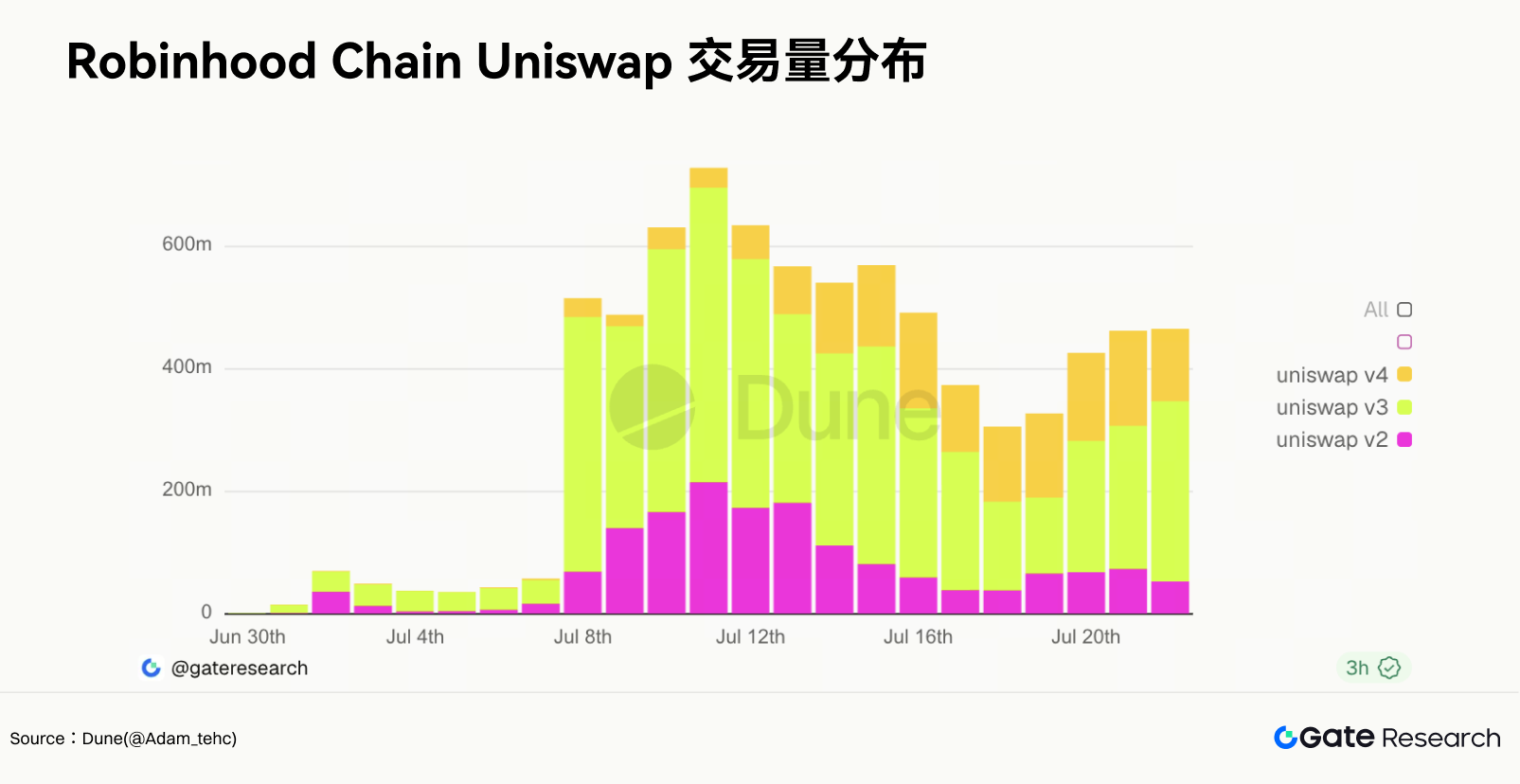
The report said Uniswap v3’s leading position is in line with expectations. It remains the main route for more mature assets, deeper liquidity and standard trade routing across EVM networks. The faster gain in trading share for v4 on Robinhood Chain matches the needs of newly issued asset markets. Launchpads, dynamic fees, specialized market-making logic, fee sharing and liquidity incentives are easier to implement in v4’s programmable framework.
On July 8, Uniswap v4 volume was about $31 million, according to the report. By July 22, that figure had climbed to roughly $118 million, with market share rising meaningfully. Gate Research said this may reflect an asset mix that is still evolving. A large number of new tokens need pools with custom rules set up quickly, while more mature liquidity still tends to favor the more universal and stable v3 route.
Gate DEX broadens how assets are discovered and funded
Gate Research said Uniswap addresses price formation inside Robinhood Chain: how tokens build pools, how routing works, and how trades clear in open markets. A new network has another challenge, though. Users need a way to find assets, move funds in from other chains, and trade without repeatedly switching across wallets and separate dApps. The report said Gate DEX’s full integration fills that gap.
Gate DEX, operated by Gate, has integrated Robinhood Chain, according to the report. Gate Alpha now supports display and trading of Robinhood Chain ecosystem assets and covers launch platforms including Noxa.fun, Pons, Virtuals, Flap, Bankr, Ape.store and Clanker. Gate Wallet supports asset display, transfers and dApp interaction on the chain. Gate DEX Swap supports both same-chain and cross-chain swaps, while professional trading and market data modules have also added Robinhood Chain tokens.
For users, that means tasks that previously required moving among Launchpads, wallets, DEXs and bridging tools are now compressed into one product flow. Gate Research said this can directly change the chain’s asset distribution structure. Earlier, users often had to search market data sites for a contract and pool, then work out whether a token came from Noxa, Pons or another launch platform. Gate Alpha places launch platforms, token screening and trading access into an exchange-style interface, lowering the threshold for discovery and trading in long-tail assets.
For assets that already have trading depth, such as CASHCAT and PONS, outside access can improve visibility. For newly deployed long-tail tokens, a more efficient entry point may also speed up the concentration of funds into leading narratives and popular platforms. The report describes Gate’s role here as a distribution layer and capital-routing layer. Pricing inside the chain still happens primarily on AMMs such as Uniswap, while long-term asset value still depends on holder structure, pool depth and real trading demand.
Launchpads are shaping Robinhood Chain’s Meme cycle
Token issuance is already concentrated on a few platforms
Gate Research said past market patterns show that token launches and trading volumes usually cluster around a handful of Launchpads. On July 22, Pons.family and Flap accounted for about 75% of newly created tokens, according to the report. During the first few days after mainnet launch, Noxa handled more than 90% of issuance. The report said Robinhood Chain’s issuance market has already developed clear concentration at the tooling layer: creators know where to deploy, traders know where to look for new assets, and bots and data platforms are monitoring the same entry points.
Volume is even more concentrated. Gate Research said Pons.family recorded about $113 million in trading volume, Noxa about $27.97 million and Bowfun about $9.9 million. Together, the three accounted for about 89% of Launchpad trading volume under that measurement, with Pons alone representing roughly two-thirds.
In a new chain with naturally thin liquidity, a Launchpad that controls issuance access, pool creation, trading front ends and community distribution can pull traffic toward itself. The report said these platforms do not determine project quality, but they do serve as the early filter for visibility and initial liquidity on Robinhood Chain.
The market has split into three layers
Gate Research said Robinhood Chain already shows a relatively clear tiered structure. The first layer is chain-level symbolic assets such as CASHCAT, which absorb expectations around a flagship early token for the network. The second layer includes platform or Launchpad-linked assets such as PONS and NOXA, where trading reflects expectations around traffic for issuance infrastructure. The third layer is the broad long tail of tokens tied to stock jokes, animal jokes and short-lived hot themes.
The report said CASHCAT has a recognizable symbol set, historical links to posts from a Robinhood Chain co-founder, an early-ecosystem label and enough turnover to support continued price discovery. Compared with tokens built entirely around a single hot ticker, CASHCAT uses a broader “cash cat” symbol that can stretch across trading culture, on-chain yield, platform growth, Launchpad fees and community identity.
At the same time, the report said PONS recently posted a slightly higher 24-hour trading volume than CASHCAT. In Gate Research’s reading, that means liquidity has not consolidated into one uncontested leader. Instead, funds are rotating between chain-brand assets and launch-platform assets, a structure often seen in the early life of a new chain. Traders want exposure both to the easiest symbol for new users to recognize and to the possibility of platform-related upside from issuance activity.
For the long tail, the report said short-term price performance is not enough. A more useful framework looks at sustained turnover, liquidity depth, holder structure, whether trading relies excessively on a single address, contract permissions, and whether there is any verifiable fee or product relationship. Even then, Gate Research said, only a small number of Meme assets tend to last.
Compared with Solana and Base, Robinhood Chain is changing the asset entry point
Still catching up to Solana on Meme market depth
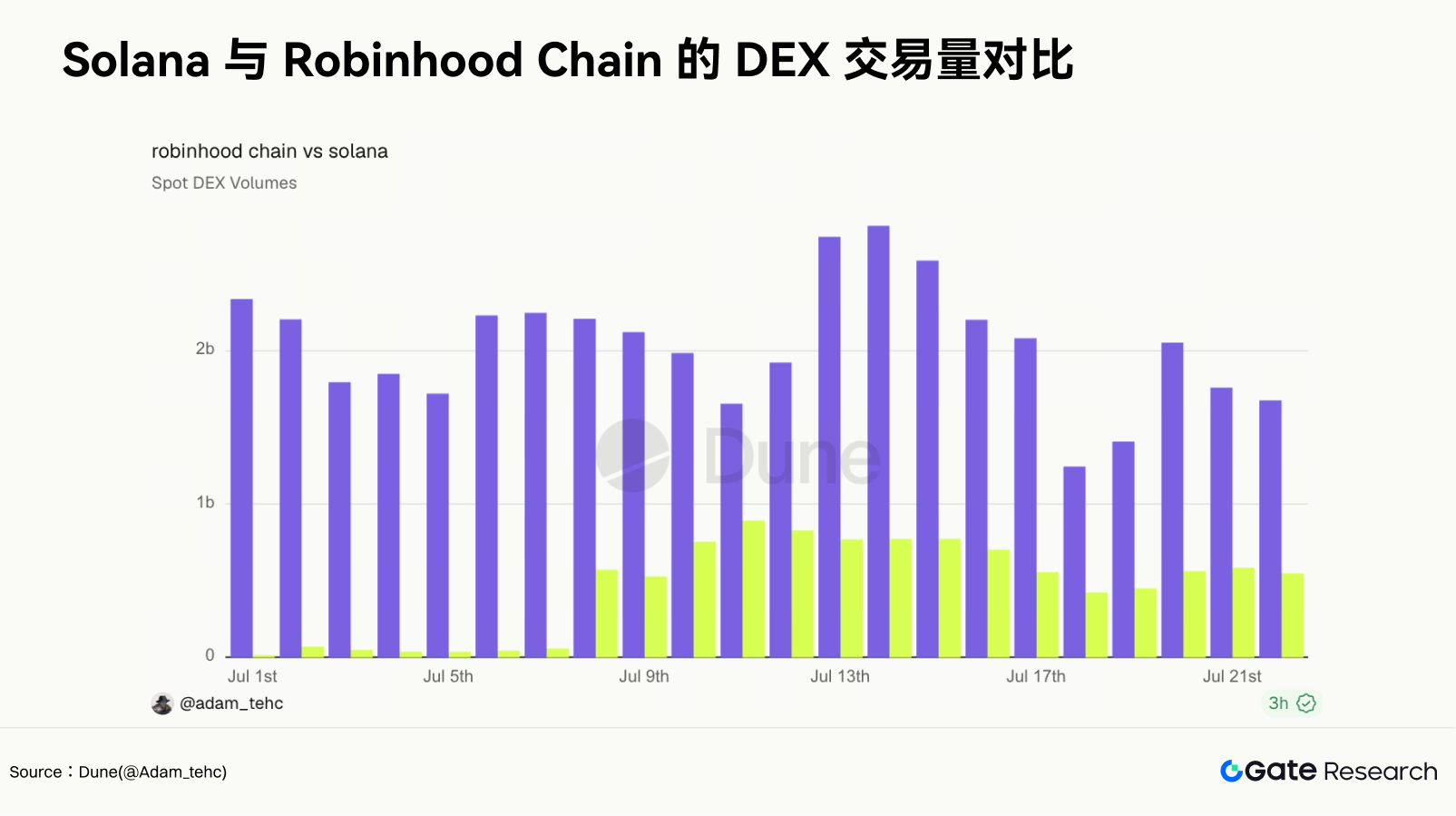
The report said Solana’s edge comes from years of accumulated network effects: high-frequency trading habits, mature wallets, aggregators, Launchpads, KOL distribution, bot tooling and deep historical liquidity. Robinhood Chain cannot replicate those effects only weeks after launching mainnet. Gate Research said that while the chain has reached part of Solana’s daily trading scale thanks to new-chain momentum and hot-money flows, the two ecosystems are not equivalent in maturity, trade measurement or automation.
Solana’s market logic is built around speed, high-frequency activity, native Meme trading and purpose-built tools. Robinhood Chain is different because its brand assets come from a traditional brokerage and from expectations tied to tokenized securities. Solana traders may focus on the next Meme breakout. Robinhood Chain traders, according to the report, are more likely to watch whether Robinhood brings more financial products, more wallet users and more regional asset coverage on-chain. Those are different sources of attention.
If Robinhood Chain wants to approach Solana on the Meme side, it will need a longer buildup in wallets, aggregators, social distribution and liquidity depth. If it wants to differentiate on the RWA side, it has to turn issuer relationships and financial distribution capabilities into a real product advantage, something Solana does not naturally start with. Gate Research said that route is harder, but also more likely to produce a lasting moat.
Base is the EVM comparison point
Gate Research said Base and Robinhood Chain both run in EVM environments and both can plug into Uniswap and the broader Ethereum developer stack. Base has advantages in the ecosystem of a major U.S. compliant exchange, social applications, developer networks and a longer asset accumulation cycle. Robinhood Chain’s edge, by contrast, lies in putting brokerage services, tokenized securities and a retail trading brand inside one narrative.
That is why the report treats Base as a reference point for EVM composability and Solana as a reference point for Meme market efficiency. The key question for Robinhood Chain, it said, is whether a financial platform with compliant assets can be turned into an on-chain financial market with open liquidity.
Three practical tests for the RWA thesis
First, tokenized securities still lack enough depth
Gate Research said Robinhood Chain’s total RWA value is still only slightly above $21 million. Asset listing and market launch have happened, but the chain remains far from a large-scale securities market where slippage can be treated as negligible. Tokenized securities liquidity cannot be sustained for long on small pools and short-term trading alone.
Larger capital needs clarity on legal rights, issuer and custody arrangements, price synchronization, treatment of corporate actions, redemption timing and regional access. The report said Robinhood has offered part of that framework in product documents, but the market still needs time to see whether those processes can scale consistently across more assets and more jurisdictions. Only if stock tokens, ETFs, Treasuries and commodity-linked assets gain deeper liquidity will Robinhood Chain start to look like a true on-chain securities market.
Second, cross-chain speed and trust boundaries remain friction points
According to the report, inbound transfers through the native Arbitrum bridge take about 10 minutes, while outbound transfers involve a challenge period and are expected, based on official documentation, to take around seven days. Cross-chain routes such as LayerZero, Stargate and Chainlink CCIP can improve routine capital movement, but the report said the setup still creates real friction for high-frequency traders and for users who need to move margin quickly.
Gate Research said Gate DEX offers a user-facing supplement here. Through Across and LayerZero, Gate DEX provides cross-chain swap routes between BSC, Ethereum, Base and Robinhood Chain, shortening the path for outside capital to enter the network and participate in Launchpads or secondary-market trading. That matters especially for capital chasing Meme rotations, where the trading window is often measured in hours.
Third, public liquidity and financial-grade market quality must coexist
The report said Meme markets can tolerate heavy volatility, long-tail liquidity and rapid turnover. Tokenized securities markets need steadier quote quality, auditable market data and lower extreme slippage. Putting Uniswap at the center of public liquidity is a reasonable start, in Gate Research’s view, but Robinhood Chain will still need a layered market structure: small public trades for retail users, deep quotes for larger capital, reliable valuations for lending and collateral, and risk-management tools for issuers.
The hard part is not simply deploying more protocols. It is maintaining a relationship that remains interpretable under stress between public DEX prices, off-chain underlying market prices, oracle prices and issuer redemption mechanics. If that relationship is unstable, the report said, tokenized securities will struggle to become long-term on-chain collateral for institutions or high-net-worth users.
Gate Research’s conclusion
Gate Research concluded that Robinhood Chain already has a functioning trading market, but its RWA capital-market buildout is still in progress. Early mainnet performance has been distinctive: while the scale of tokenized securities remains limited, Meme assets, Launchpads and Uniswap have already produced a high-frequency trading environment. The report said that outcome reflects the speed of product supply, Robinhood’s brand memory and the liquidity tools available in the EVM ecosystem.
In the report’s reading, the Meme breakout does not conflict with the chain’s RWA positioning. It has delivered users, wallets, trading routes and liquidity habits, while helping Robinhood Chain win market attention quickly. The real question is whether that heat can settle into a more durable asset market. If trading remains centered on stock jokes and constant new-token rotation, Robinhood Chain may end up looking like a Meme chain carrying a brokerage brand. If stock tokens, ETFs, Treasuries and collateral applications begin to develop independent demand, the network will start to show the outline of an RWA platform.
Gate Research also said distribution channels will matter in deciding whether that conversion can reach a broad enough user base. Gate DEX’s full integration gives Robinhood Chain outside access points for alpha discovery, wallet management, on-chain trading and cross-chain swaps, while expanding links with networks such as BSC, Ethereum and Base. That can push on-chain themes to a wider multi-chain audience, but it can also make the ecosystem more sensitive to cross-chain capital flows and promotional activity. The market has already shown that Robinhood Chain can attract trading. The next stage, the report said, is proving whether that attention can be turned into sustainable on-chain financial assets.