
This article was originally published by Bit.Fan. For more cryptocurrency news and market insights, visit www.bit.fan.
Gavin Baker Revises His View on AI Data Centers as Jensen Huang Backs the Case
N
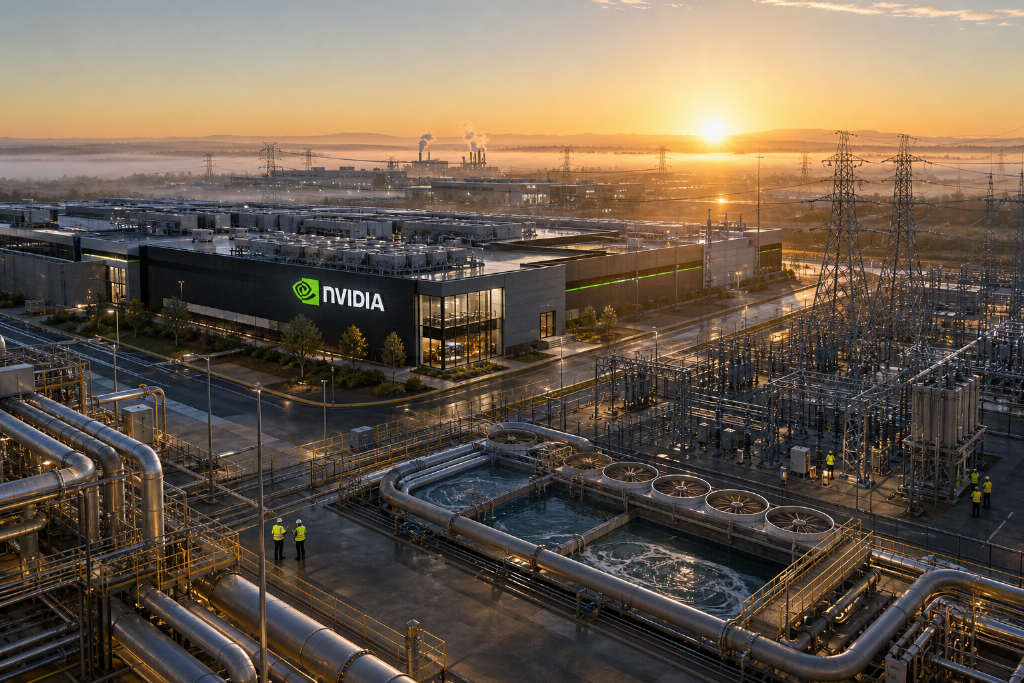
News EditorAtreides Management founder and CIO Gavin Baker said he had changed his tone on data centers after revisiting the debate over water use, taxes, jobs, power prices and environmental impact. He said many of the concerns raised over the past 18 months were fair, but argued that well-designed projects are increasingly addressing them. NVIDIA CEO Jensen Huang replied: “Gavin, spot on.” Baker said the case for AI data centers now runs through infrastructure spending, local tax revenue, electricity planning and a broader industrial buildout. He pointed to Loudoun County, Virginia, which he said collects about $1 billion a year from data centers, and Quincy, Washington, where data centers make up more than half of the local property tax base. Baker also said data center demand is creating work for electricians, plumbers, welders, HVAC technicians and contractors, while Huang described AI investment as a physical chain linking AI, data centers, chip factories, power plants, the grid, construction and manufacturing jobs. Huang said $400 billion has flowed into AI startups over the past six months.
Atreides Management founder and chief investment officer Gavin Baker said he had changed his view on AI data centers, after revisiting the criticism aimed at them over water use, tax incentives, jobs, electricity prices and environmental impact.
Baker said he regretted the tone he used when speaking about data centers the day before. He added that many of the concerns raised over the past 18 months were valid, but argued that well-designed data center projects are now addressing more of those issues.
NVIDIA CEO Jensen Huang responded directly to Baker’s post, writing: “Gavin, spot on.”
Baker said that about 18 months ago, he saw several reasons to oppose data centers: heavy water use, tax breaks from local governments, limited permanent employment, higher power bills for residents and pressure on the environment and small towns. In his view, recent developments have changed that picture.
On water, Baker said U.S. data centers use only a small fraction of the water consumed by golf courses, and that some of the early figures circulated about data-center water use were off by more than 1,000 times. He said newer facilities are increasingly using closed-loop cooling or recycled water.
On taxes, Baker argued that focusing only on sales-tax abatements misses a major part of the fiscal equation, because large data centers also pay significant property taxes. He cited Loudoun County, Virginia, one of the biggest data-center hubs in the world, where he said data centers now bring in about $1 billion in annual tax revenue. He also said data centers account for more than half of the property-tax base in Quincy, Washington.
That, Baker said, makes AI data centers an attractive fiscal model for some small local governments: companies spend heavily to build the infrastructure, while the local government receives a steady property-tax stream over time.
He also pushed back on the idea that data centers create too few jobs. If people count only permanent workers inside a completed facility, he said, they miss the broader infrastructure supply chain. Demand for electricians, plumbers, welders, HVAC technicians and contractors is rising quickly in the U.S., he said, and data centers do not stop requiring investment once they are built. As GPU generations change, power density rises and infrastructure expands, the buildings themselves still need upgrades.
Baker said that is why some U.S. building unions are now backing data center projects, and in some cases are factoring politicians’ positions on data centers into their endorsements.
That point feeds into Baker’s broader argument about reindustrialization: AI investment does not end with Nvidia GPUs or software engineers. It spreads into power, construction, cooling, equipment, manufacturing and skilled trades.
Electricity remains one of the biggest political hurdles. If a large AI cluster uses as much power as a city, residents naturally ask why they should pay for grid upgrades that support tech companies’ GPUs.
Baker’s answer is not to stop building data centers, but to change how power is priced. He supports Ratepayer Protection and new tariff structures designed for large loads, under which data centers would provide or pay for new generation capacity and sign long-term power contracts so existing residents do not bear the infrastructure costs.
He said that in some places using such rules, utilities have frozen or lowered residential power rates. If data centers’ costs are shifted onto ordinary residents, he added, local opposition is understandable.
Baker is not claiming that data centers do not push up electricity demand. Rather, he argues that the right market structure and rate design can turn that demand into support for new power plants and grid investment.
Huang agreed with that framing. He said AI is creating enough new electricity demand to drive investment into America’s aging grid and sustainable energy, and that this time the push is being driven by market forces rather than government subsidies.
He described the investment chain as a physical loop: AI, data centers, chip factories, power plants, the grid, construction and manufacturing jobs.
Huang also said $400 billion has flowed into AI startups over the past six months, arguing that AI is not only creating new demand for existing industries, but also forming new companies and new sectors.
Baker used Quincy, Washington, to illustrate how data centers can reshape a small town. He said the city’s poverty rate fell from 29% to 6%, while data-center tax revenue helped fund a new high school, a hospital, a library, police facilities and fire services.
For Baker, the key point is that these facilities are often built not in downtown New York or San Francisco, but in towns that have seen long stretches without major capital investment after declines in traditional manufacturing or agriculture.
Data centers need land, power, buildings, cooling and maintenance, he said, which allows tech-sector capital spending to flow into physical investment in those places.
700
Disclaimer:
The market information, project data, and third-party content displayed on this platform are for industry information sharing only and do not constitute any form of investment advice or return commitment.
Cryptocurrency trading carries high risks. Users should fully assess their risk tolerance and make independent decisions. All profits, losses, and legal responsibilities are borne by the users themselves.