
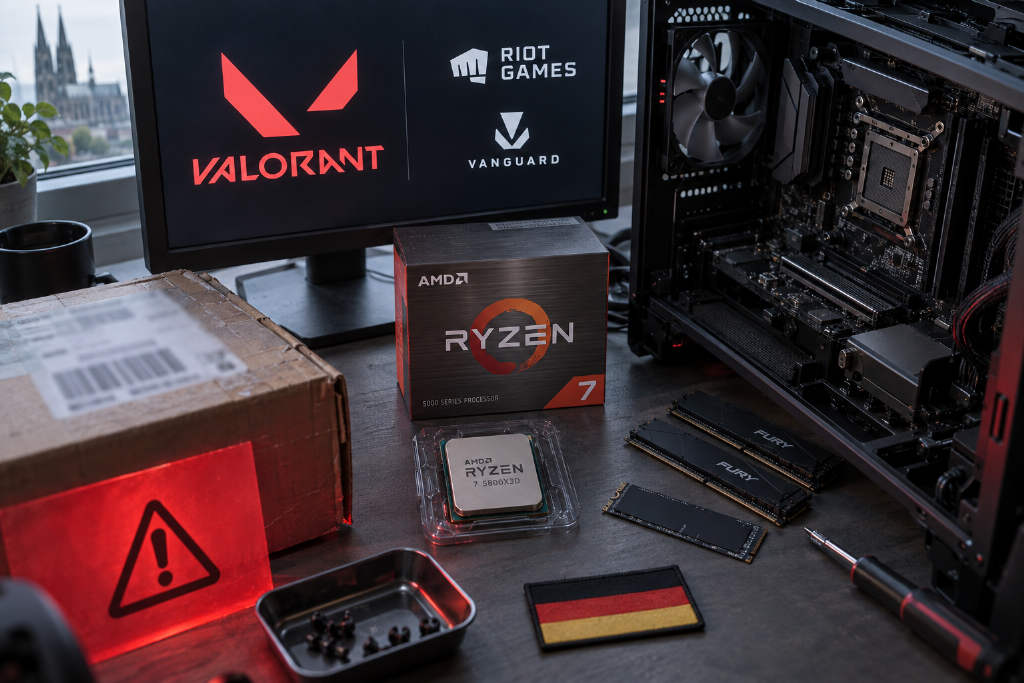
A German player says a used AMD Ryzen 7 5800X3D he bought in the second-hand market caused Riot Games’ anti-cheat system to block his machine from running Valorant. According to the player’s account, Riot support said the processor had already been hardware banned after the previous owner allegedly used it for cheating.
Reddit post describes a used CPU purchase followed by an instant kick from Valorant
The player posted on Sept. 26 in r/PCBaumeister, a German-language PC building subreddit on Reddit. He said he bought an AMD Ryzen 7 5800X3D through the used-goods platform Kleinanzeigen and received it on Sept. 21. On Sept. 25, one day before the post, he launched Valorant and was kicked out as soon as the game started.
He said the CPU itself was functioning normally. He also said the same PC had no issues running Valorant before he installed that processor.
The Ryzen 7 5800X3D was launched by AMD in April 2022. AMD lists it as a gaming processor for the DDR4 platform. It uses the AM4 socket, and AMD’s website lists X570, X470, B550, B450 and A520 among the supported chipsets.
Player says Riot support linked the ban to the previous owner
After contacting Riot Games, the player said support told him the CPU’s identifier and serial number had been placed on Vanguard’s blacklist. In his account, Riot support said the previous owner had likely cheated in Valorant using that CPU, and the hardware ban had been applied on Aug. 12.
That date was 40 days before he received the used chip.
Later the same day, he updated the Reddit post and said that after more discussions with Riot, there was no way for him to get the hardware ban removed. He also said that because the banned CPU had been installed in his system, other parts including the motherboard and hard drive were now blacklisted as well. In the comments, he added that even after removing the CPU, the computer still could not play Valorant.
On Sept. 29, he posted another comment saying he had opened a PayPal buyer protection case and that getting his money back for the CPU would be enough.
heise says the restriction could affect Riot’s broader PC lineup
German technology outlet heise reported the case on Sept. 30. The publication said the impact would not be limited to Valorant and could extend to other Riot PC titles.
heise listed the following games:
- Valorant
- League of Legends
- Teamfight Tactics
- Legends of Runeterra
- 2XKO
heise also said future Riot releases would likely be affected in the same way. Riot has not publicly responded to the case.
What Riot’s support pages say about HWID bans
According to Riot’s official support pages, a hardware ID, or HWID, ban targets physical PC components rather than only a user account. During the ban period, the banned player cannot create, log into or use an account on any Riot platform or game. Riot lists cheating tools, scripts and other third-party software among the possible triggers. A banned machine shows error code VAN 152 when trying to log in.
The company also says that if another person’s account is used on a hardware-banned computer, that account will also be unable to play on the device and may receive a temporary suspension because the system may treat it as an attempt to evade the original restriction. Riot recommends not logging in with any account if a PC is suspected to be under a hardware ban.
That guidance covers the case of someone else’s account being used on a banned machine. It does not explain what happens when a component is resold to a new owner.
Riot also says players who were hardware banned for misconduct or suspected cheating can ask support for a review, though removal is not guaranteed. The company says it generally discusses ban status only with the originally banned player.
How Riot could identify a single CPU remains unclear
Vanguard is Riot’s in-house anti-cheat system and normally runs in Windows kernel mode, the highest privilege layer in the operating system. heise said Riot released an update in June 2026 that relaxed the previous requirement for Vanguard to start automatically when the PC boots.
According to Riot’s support pages, the optional feature is called Vanguard Pre-Check. When enabled, Vanguard starts when the game launches instead of at boot. The PC must be running Windows 11 25H2 or later and have security features such as Secure Boot and TPM 2.0 enabled.
The player said Riot support referred to the CPU’s identifier and serial number. heise said it is still not clear how Riot would identify an individual processor, because the hardware ID reported by a CPU to the operating system only shows the model, which would not distinguish one Ryzen 7 5800X3D from another.
heise suggested two possible methods. One would be to build a hardware fingerprint from minor variations in clock speeds and voltage behavior, since no two processors perform in exactly the same way. The second, which heise said would be simpler for a game company, would be to write an identifying hash into the Trusted Platform Module, or TPM.
heise added that on many computers the TPM is built into the CPU in firmware form, meaning the data could move with the processor when it is installed in another machine. The outlet said Riot definitely accesses TPM data in Pre-Check mode, at least based on that feature’s design. These identification methods remain heise’s interpretation. Riot has not disclosed its actual implementation.
Known details from the case
- The buyer said he received the used Ryzen 7 5800X3D on Sept. 21.
- He said Valorant kicked him out on Sept. 25 when the game started.
- In his account, Riot support said the CPU had been hardware banned on Aug. 12.
- He later said the motherboard, hard drive and other parts were also affected after the CPU was installed.
- heise reported the case on Sept. 30, while Riot has not issued a public response.