

GigaDevice Semiconductor has come under heavy market scrutiny after a sharp decline in its share price was followed by a package of insider support measures from chairman and actual controller Zhu Yiming.
The stock, described in the original article as a former “memory leader,” traded near 350 yuan after standing at 846.66 yuan a month earlier. Over 22 trading days, the company’s market value fell by more than 330 billion yuan.
The debate is tied to Zhu’s earlier disposal of shares worth about 4.4 billion yuan, followed by a support package that included a plan to increase holdings by no less than 1 billion yuan and a company buyback proposal of as much as 2 billion yuan. That sequence left investors questioning the timing of both steps.
How the timeline unfolded
On April 8, 2026, GigaDevice disclosed a share reduction plan under which Zhu intended to sell no more than 11.21 million shares.
From May 6 to June 12, Zhu sold a total of 11.1106 million shares through centralized bidding and block trades, equal to 1.58% of the company’s total share capital. The sale price ranged from 339.44 yuan to 538.90 yuan per share, with total cash proceeds of about 4.4 billion yuan.
After the transaction, Zhu’s direct holding fell from 6.53% to 4.94%, which meant he was no longer a shareholder holding more than 5% on an individual basis. Together with acting-in-concert party Hong Kong Yingfude Co., Ltd., however, he still controlled 6.8% of the shares.
On June 29, GigaDevice touched an all-time intraday high of 846.66 yuan. On July 1, the stock fell 5.27%, marking the start of a steep slide. On July 27, ChangXin Technology listed on Shanghai’s STAR Market and surged 465% on its debut; GigaDevice hit limit down intraday the same day. By July 29, GigaDevice had closed at 364.03 yuan.
That evening, Zhu released four separate announcements: notice of the completed reduction, a holding increase plan worth no less than 1 billion yuan, a proposal for the company to repurchase 1 billion to 2 billion yuan of shares, and a commitment not to reduce holdings again within 12 months.
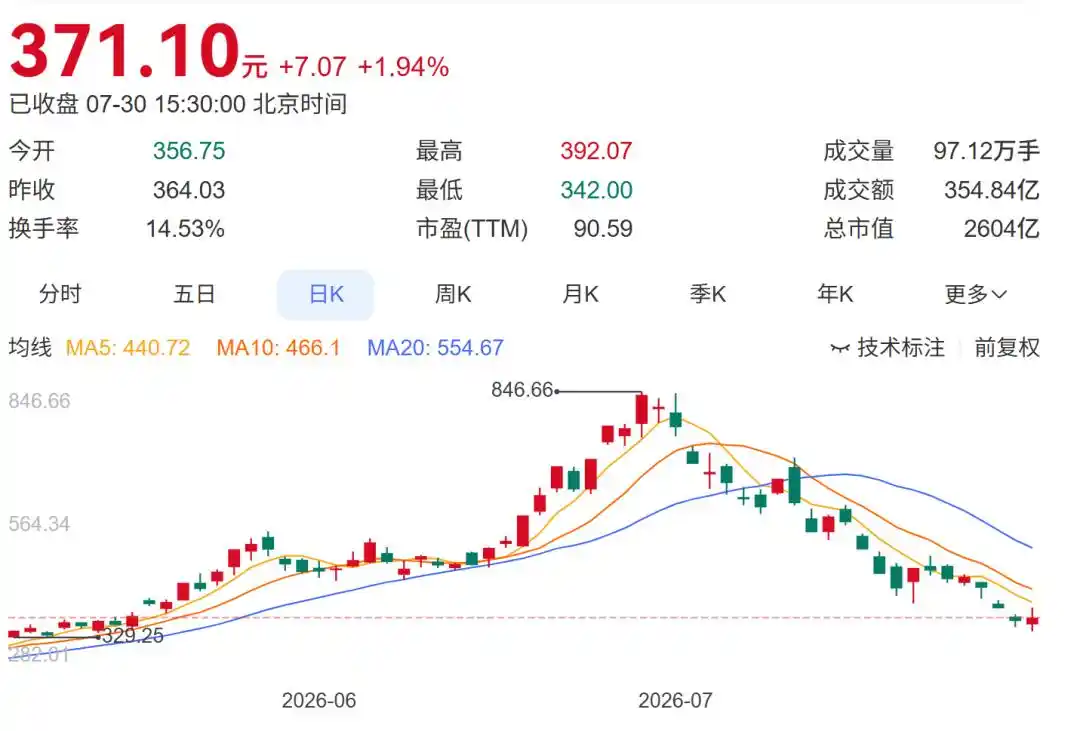
The original article draws attention to the timing: the reduction was completed on June 12, and the stock peaked on June 29.
Three factors cited for the sell-off
The “shadow stock” thesis weakened after ChangXin listed
The article says GigaDevice had previously been treated by part of the market as a “shadow stock” for ChangXin Technology. Both companies were founded by Zhu Yiming, and GigaDevice still held a 1.62% stake in ChangXin after its listing.
Before ChangXin was public, investors looking for exposure to domestic memory often used GigaDevice as a proxy. Once ChangXin officially listed on July 27, that logic weakened. The article notes that ChangXin posted 141.1 billion yuan in turnover that day, with a turnover rate of 66.4%.
A Morgan Stanley report raised concerns over the memory cycle
The article also points to a recent Morgan Stanley report warning that the AI-driven boom in semiconductor memory was nearing an inflection point, with contract memory prices expected to peak in the fourth quarter.
According to the same report, the momentum in earnings upgrades for memory names had weakened, with the net profit revision rate falling from a peak of 92% to 77%. Because GigaDevice is concentrated in cyclical product categories such as NOR Flash and niche DRAM, the article says the company would be more exposed if the cycle turned.
The scale and timing of the sale hurt sentiment
The article argues that the main problem for investors was not the company’s operating performance, but the signal sent by the insider sale. Even with earnings rising sharply, the disposal by the controlling shareholder at elevated prices damaged confidence in the stock.
Compliant under the rules, but still controversial
From a procedural standpoint, the article says the reduction followed the rules. The plan was disclosed on April 8, executed between May 6 and June 12, carried out within the announced price range, and then disclosed after completion.
Still, the article separates legal compliance from market acceptability. It argues that finishing a roughly 4.4 billion yuan sell-down near the top of the cycle and then proposing share support measures after the stock had effectively halved did little to calm investors.
It adds that after the announcements were released, GigaDevice continued to fall by more than 5% on July 30 and hit its lowest intraday level since May 15. In the article’s reading, the support package failed to steady the market and instead deepened concern.
Strong headline earnings, but not all from recurring operations
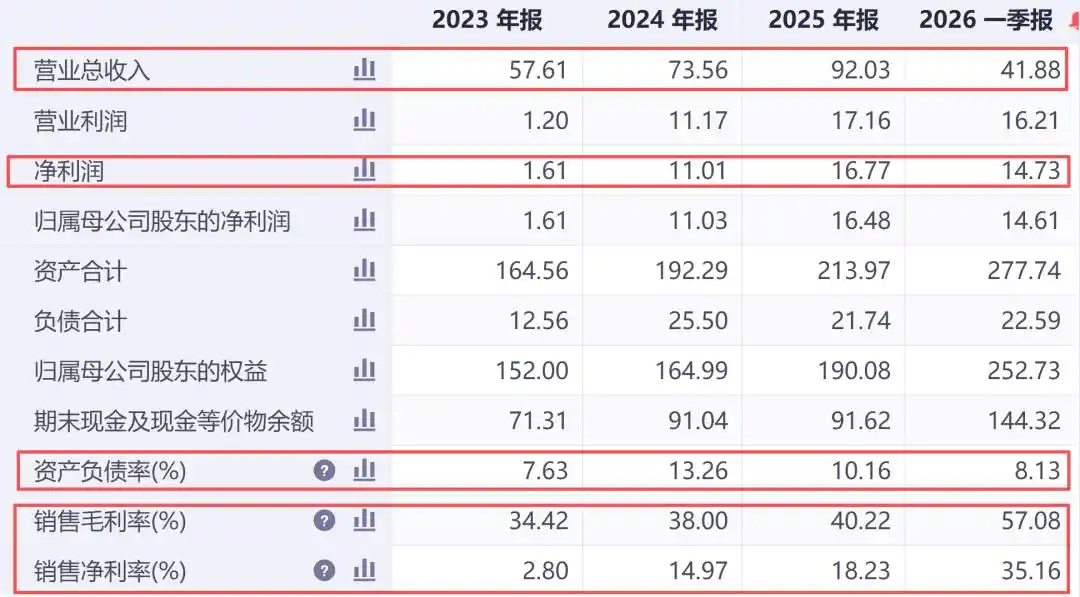
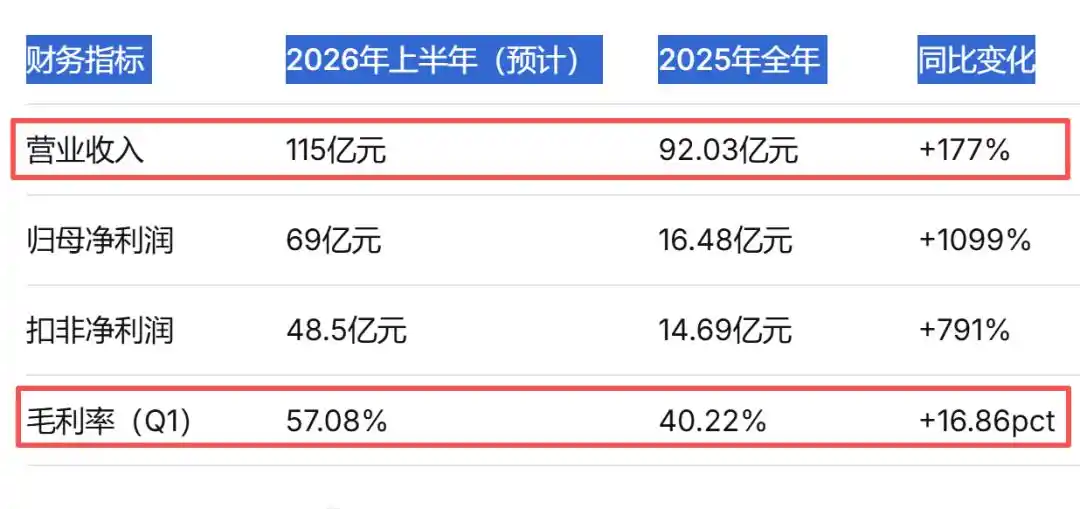
The company’s operating figures remain a major part of the story. GigaDevice estimated first-half 2026 revenue at 11.5 billion yuan, up 177% year on year, and net profit attributable to shareholders at 6.9 billion yuan, up 1099%.
For comparison, full-year 2025 revenue was 9.2 billion yuan and net profit was 1.648 billion yuan.
The article notes, however, that 2.05 billion yuan of the 6.9 billion yuan profit came from non-recurring gains and losses, mainly from higher fair value on securities investments. Excluding those items, net profit was 4.85 billion yuan, up 791% year on year.
Citing company disclosures, the article says first-quarter gross margin reached 57.08%, up 12 percentage points from the prior quarter. Memory chip volumes and prices both rose, while MCU demand stayed strong.
The company itself also warned in its earnings preview that the industry is highly cyclical and that future earnings could retreat.
Industry opportunity and structural questions
The article cites a BOCOM International estimate that the global specialty memory market will expand from $13.6 billion in 2024 to $40.3 billion in 2026. It also says Samsung and SK Hynix continue to exit niche DRAM and SLC NAND capacity, opening a substitution window for GigaDevice.
Deep cooperation with ChangXin is described as a core support for GigaDevice’s DRAM business. In 2026, the quota for related-party procurement was raised sharply from 1.182 billion yuan to 5.711 billion yuan.
On the sell-side, BOCOM International initiated coverage with a Buy rating and a target price of 798 yuan for the A-share stock, while HSBC Global Research gave a target price of HK$936.
At the same time, the article says the company’s fabless model leaves production capacity dependent on foundries, which can create a “designs without capacity” problem in shortage cycles. It also says the close relationship with ChangXin continues to invite debate around related-party transactions and potential overlap in business lines.
The real issue is trust
The article closes with several blunt observations. One is that “sell high, call for buying later” is not unusual in China’s A-share market. Another is arithmetic: based on the figures cited, a 4.4 billion yuan sell-down versus a 1 billion yuan holding increase and up to 2 billion yuan in buybacks still leaves 1.4 billion yuan in net cash-out.
It also notes that the increase in holdings cannot start immediately. Under the rule cited in the article, directors may not buy back shares within six months after selling them, meaning Zhu’s increase would only be able to begin after Dec. 13.
Even so, the article does not describe GigaDevice’s fundamentals as weak. It says domestic substitution in memory remains a long-term direction and that the company has real competitiveness in NOR Flash and niche DRAM. Whether that is enough to offset the damage from the reduction is the question left to the market.
The original piece was published by the WeChat public account “投行圈子” and attributed to the author “投行君.”