
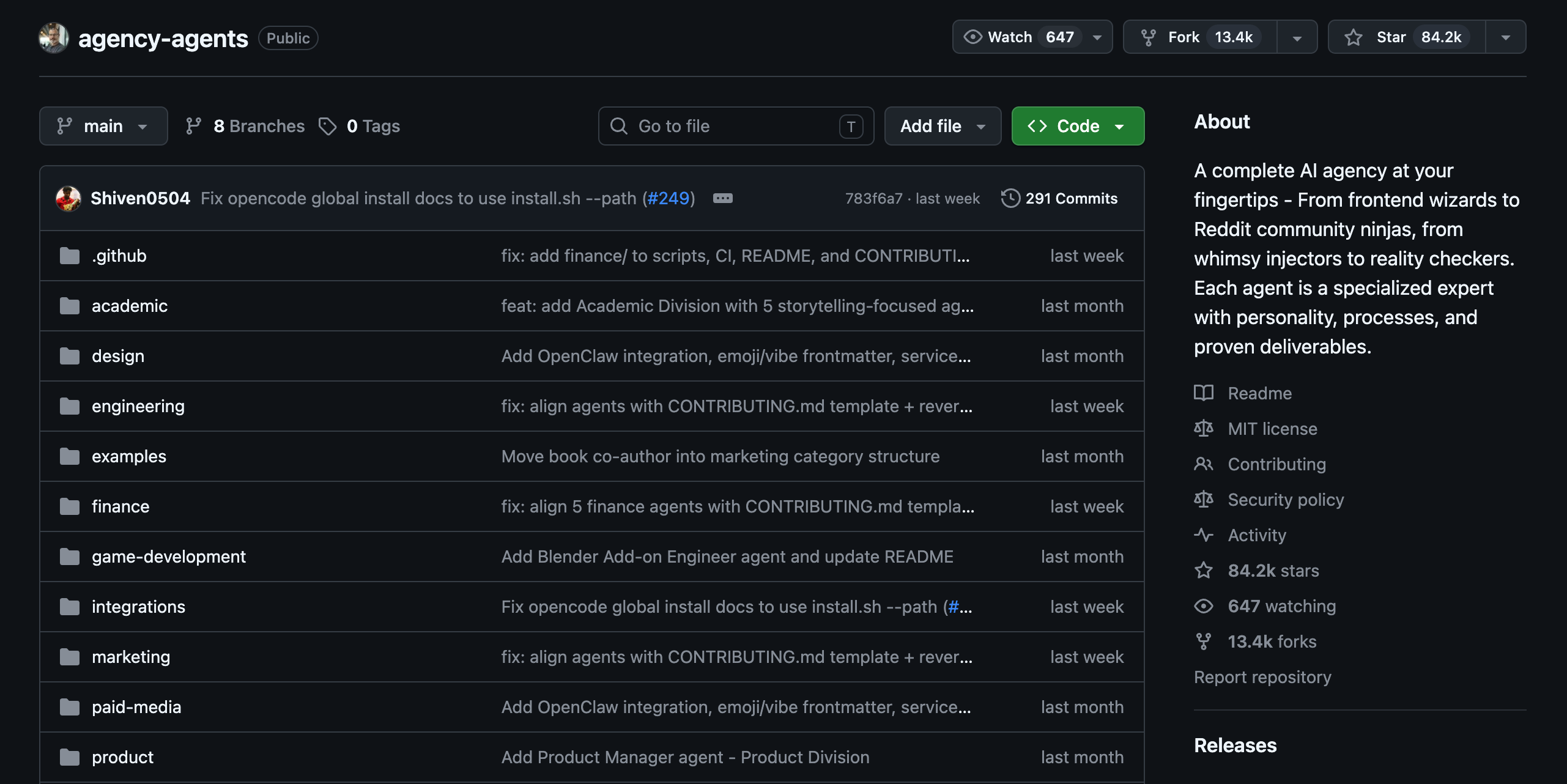
agency-agents, an open-source project on GitHub, has surged to more than 84,000 stars and 13,000 forks. It is not a new AI model and not a heavyweight orchestration framework. Its main asset is a library of AI “employee” personas, with over 144 roles organized across 12 departments. Each one comes with a defined personality, workflow, deliverables, and measurable KPIs.
A one-command setup for a full AI team
The project is built around Markdown files. Each file acts like an onboarding guide for a specific role, spelling out who that AI is, how it should work, and what output it is expected to produce. Installation takes a single command, which deploys the agent configuration files into supported AI development tool directories. The project currently works with more than 10 AI coding tools, including Claude Code, GitHub Copilot, Cursor, Aider, and Windsurf.
Once installed, developers can call an AI by role name and have it respond from that specific professional standpoint. The 12 departments listed in the repository include engineering, design, paid media, sales, marketing, product, project management, testing, customer support, spatial computing, game development, and academic research.
Each persona is structured like a job description
Instead of relying on conventional prompt engineering alone, agency-agents defines every persona through four parts: domain expertise, personality and communication style, deliverables, and success metrics. The setup resembles an HR position file. In the project’s examples, a frontend engineer agent is described as more than someone who knows HTML and CSS; it also carries its own architectural preferences. A paid media strategist is framed around a fixed review process and performance evaluation system, not just ad execution.
Engineering alone includes 27 agents, covering frontend, backend, mobile, AI, DevOps, security, smart contracts, and even an incident commander. Marketing includes 25 roles, with platform-specific personas for TikTok, Reddit, WeChat, Xiaohongshu, and Douyin. The repository is released under the MIT license, allowing free personal and commercial use without restrictions on modification.
An 8-department example of parallel execution
The repository also includes a complete case called Nexus Spatial Discovery. In that example, 8 agents from different departments work on the same product discovery task in parallel, with no human coordination in the loop. The output includes market validation and competitive analysis, a full system architecture with SQL schema, brand strategy and visual identity direction, a go-to-market plan with pricing, a customer support and community blueprint, UX personas and journey maps, plus a 35-week execution plan and 65 sprint tickets.
The example highlights a shift in how some developers want to use AI systems. The emphasis is less on getting a single assistant to answer one prompt, and more on assigning an entire project to a set of specialized roles. That division of labor appears to be a major reason the repository has gained such rapid traction on GitHub.