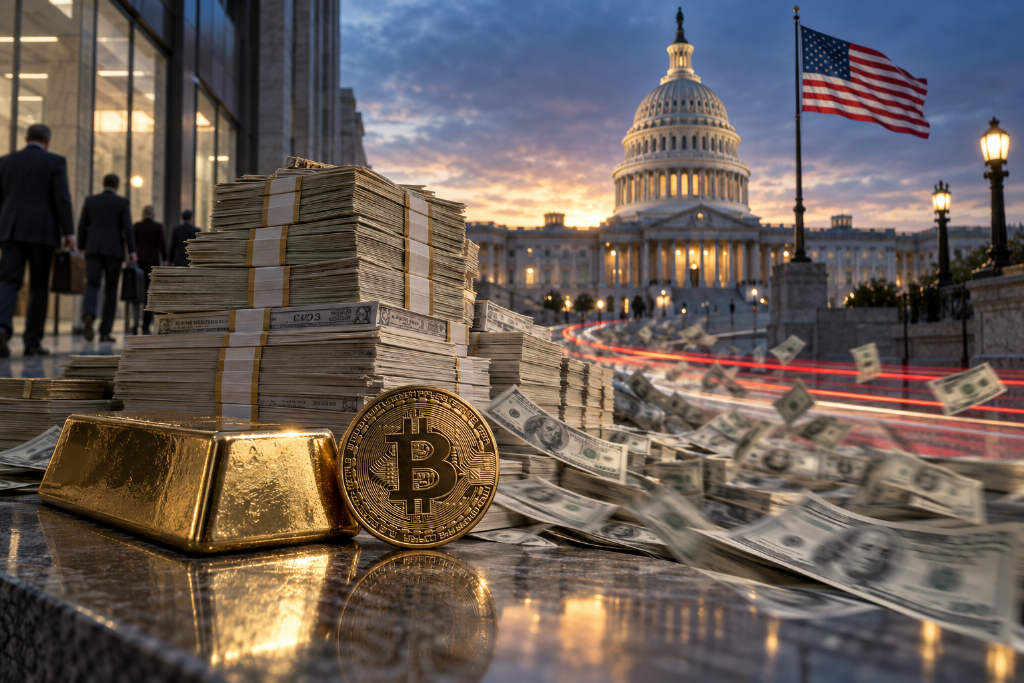
Bitcoin came close to $90,000 earlier this month, according to Forbes, as a broader macro trade tied to weakening fiat purchasing power continued to draw attention. The report said rising global debt has become one factor supporting assets such as Bitcoin and gold, with investors looking at so-called currency debasement trades.
Data from the Institute of International Finance showed global debt rose by $10 trillion in the first half of this year, pushing the total above $365 trillion. In the United States, debt has exceeded $40 trillion, while annual interest costs have climbed to $1.27 trillion. Forbes said that figure is now higher than defense and Medicaid spending, trailing only Social Security. The institute also warned that interest costs are likely to keep rising as benchmark rates move higher.
Coin Bureau founder and cross-asset analyst Nic Puckrin said the current backdrop favors Bitcoin and gold as debasement assets, and described that as part of the reason behind Bitcoin’s recent gains. Separately, analysts at The Kobeissi Letter said the U.S. dollar’s purchasing power has fallen 23% since 2020. They added that if an asset rose only 30% over the same period, an investor would have roughly broken even in real purchasing-power terms. U.S. inflation has also remained above the Federal Reserve’s 2% target for 60 straight months.
Bitcoin came close to $90,000 earlier this month, according to Forbes, as rising global debt and weaker fiat purchasing power remained in focus.
The report said a so-called currency debasement trade has been one factor lifting assets such as Bitcoin and gold. The idea centers on declining purchasing power in fiat currencies as debt levels keep climbing.
Data from the Institute of International Finance showed global debt increased by $10 trillion in the first half of this year, taking the total above $365 trillion. U.S. debt has already surpassed $40 trillion. Annual interest expense has climbed to $1.27 trillion, exceeding defense and Medicaid spending and ranking behind only Social Security. The institute warned that interest costs will rise further if benchmark rates continue moving higher.
Nic Puckrin, founder of Coin Bureau and a cross-asset analyst, said the current environment favors Bitcoin and gold as debasement assets. He said that is part of the reason behind Bitcoin’s recent advance. In his view, the larger the debt load carried by major economies, the more likely policymakers are to suppress real borrowing costs and allow inflation to erode the real value of debt, making the trade more attractive.
Analysts at The Kobeissi Letter said the U.S. dollar’s purchasing power has fallen 23% since 2020. They added that if an asset gained only 30% over the same period, an investor would have been roughly flat in real purchasing-power terms. U.S. inflation has now stayed above the Federal Reserve’s 2% target for 60 consecutive months.
This article was originally published by Bit.Fan. For more cryptocurrency news and market insights, visit www.bit.fan. Disclaimer:
The market information, project data, and third-party content displayed on this platform are for industry information sharing only and do not constitute any form of investment advice or return commitment.
Cryptocurrency trading carries high risks. Users should fully assess their risk tolerance and make independent decisions. All profits, losses, and legal responsibilities are borne by the users themselves.