
One overlooked reason Morgan Stanley survived the 2008 financial crisis was that the market closed for the weekend, according to a market analysis published by TechFlowPost. The article argues that nights and weekends have long functioned as a natural circuit breaker for the financial system, but that protection is now being weakened as major exchanges move toward longer trading hours and tokenized stocks trade on blockchains that do not shut down.
Morgan Stanley was running out of time in 2008
Ahead of the Columbus Day long weekend in 2008, Morgan Stanley looked like the next major casualty of the financial crisis. The bank began that week with $130 billion in cash, which management believed would be enough to withstand the storm. But hedge funds that had already helped bring down Bear Stearns, Lehman Brothers and Merrill Lynch started pulling money from Morgan Stanley as well, withdrawing $65 billion in a single day.
That amounted to a run. The article says the only realistic way to stop it was to secure an equity investment from a large outside backer. Morgan Stanley CEO John Mack later recalled the stakes plainly: "If we hadn’t done that deal, it was over. We would not have been able to continue to operate."
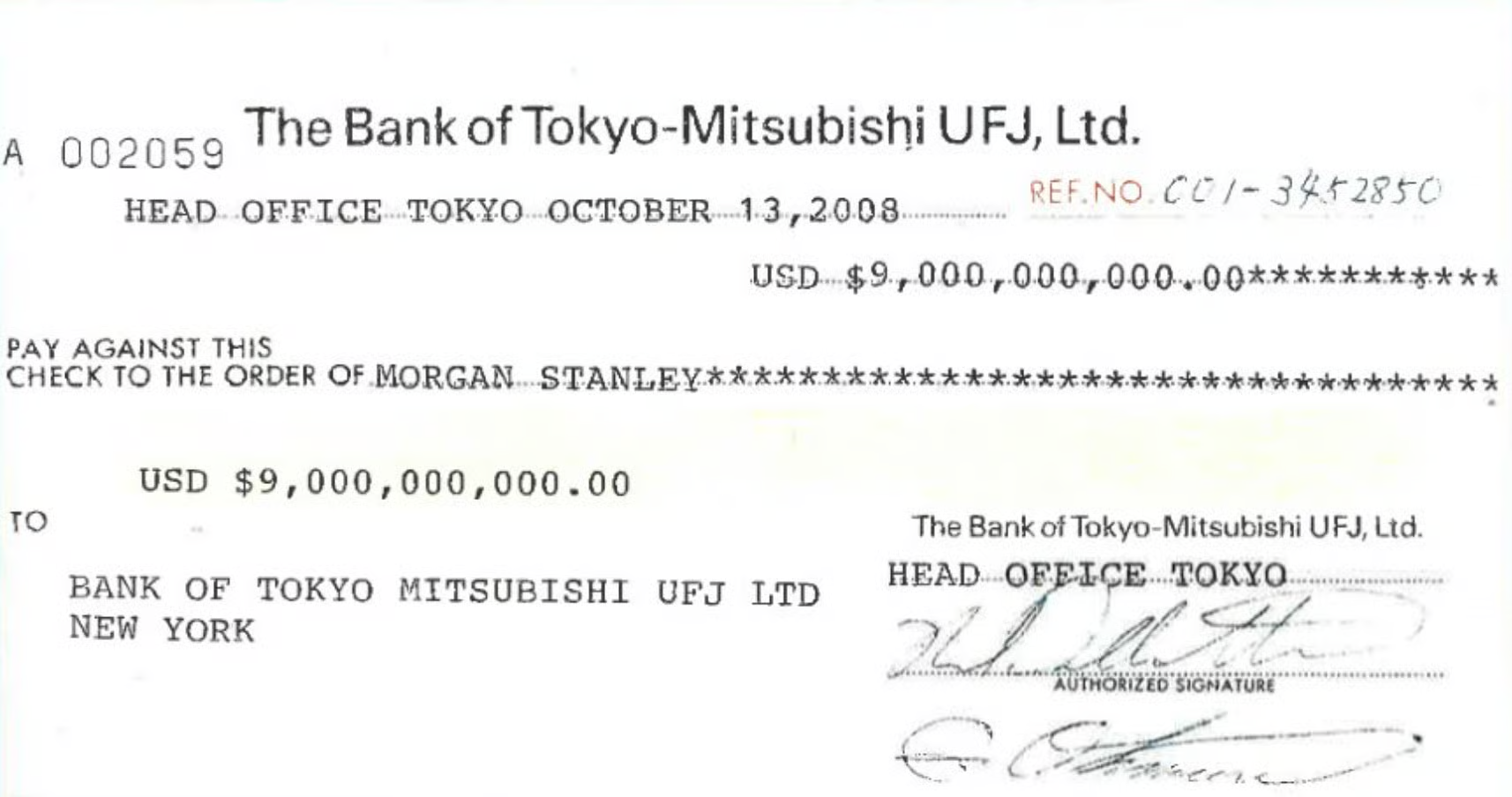
Mack already had an agreement in place. Two weeks earlier, Mitsubishi UFJ Financial Group, or MUFG, had agreed to buy a 21% stake in Morgan Stanley for $9 billion. The article describes MUFG as the world’s second-largest bank at the time, with $1 trillion in customer deposits.
The problem was that the deal had not closed. Investors were increasingly doubtful that it ever would. The transaction valued Morgan Stanley at $25.25 a share, but the market was signaling something very different: the stock closed at just $14.22 on the day the deal was announced, then fell below $10 nine days later.
That created a vicious loop. The lower the stock fell, the less likely the deal looked to close. The less likely the deal looked to close, the more the stock fell. At the same time, the falling share price fed more client withdrawals, which added to the pressure. Morgan Stanley was trapped in a downward spiral that kept intensifying each trading day.
Charles Smith, the bank’s head of business development, later summed up the immediate objective in simple terms: "We just had to make it to the weekend."
The weekend gave both sides time to finish the rescue
The article describes the weekend as a circuit breaker. Those two days gave Morgan Stanley time to work through the transaction with MUFG without the stock sliding in real time. On Saturday, MUFG said it remained committed to the investment but wanted to renegotiate. By Sunday, the two sides had reached a revised agreement under which MUFG would receive preferred shares rather than mostly common stock.
Only the payment remained. But the analysis notes that a renegotiated agreement alone would not have stopped the death spiral from restarting as soon as trading resumed Monday morning. To restore confidence, the deal had to be fully completed.
MUFG Chairman Nobuo Kuroyanagi? No—the article identifies the chairman as Nobuo Hirano, who later recalled: "We knew that if the money could not be delivered, the market would sell Morgan Stanley stock, perhaps to zero."
MUFG was ready to send the money, but the payment system posed a problem. The Federal Reserve was closed for Columbus Day even though the stock market was not, and Fedwire, the system used for transfers of that size, would not reopen until Tuesday. In a market already in panic mode, Tuesday could have been too late. By then, Morgan Stanley might have faced outflows several times larger than the $9 billion investment.
That left one option: MUFG had to write a check. Morgan Stanley vice chairman Rob Kindler proposed the idea on Sunday, and MUFG agreed. At 7:30 a.m. Monday, Kindler was waiting in a conference room at Wachtell Lipton to receive a physical check.
The article cites Andrew Ross Sorkin’s Too Big to Fail, which described Kindler this way: "He looked awful. He hadn’t slept in at least a day." Kindler had assumed the check would arrive by courier, so he had not bothered to shave or change out of the khakis and flip-flops he was still wearing after cutting short a vacation in Cape Cod. Instead, the check was delivered by a delegation of MUFG executives in business suits, accompanied by a camera crew.
Kindler rushed to borrow a suit jacket from a lawyer, but the lawyer’s shoulders were narrower and the back seam split. He then told the Japanese executives, "I assure you, I am vice chairman of Morgan Stanley."
Whatever the appearance, MUFG handed over the check in time for Morgan Stanley to tell the world the money had arrived before trading reopened. The stock rose as much as 70% that day. The run ended, the article says, because the weekend had bought enough time for the rescue to be completed.
Nights and weekends have long served as shock absorbers
The analysis then widens the frame. Under current market rules, a 7% drop in the S&P 500 triggers a trading halt of at least 15 minutes. A 20% drop stops trading until the next day. These marketwide circuit breakers were introduced after the 1987 Black Monday crash to interrupt panic selling before it could become self-reinforcing.
Exchanges also retain discretion to halt trading in individual stocks, whether because of pending major news or simple order imbalances. The point is to create time when investors need it most.
Companies often release earnings before the market opens or after it closes for much the same reason. Berkshire Hathaway even publishes on Friday evenings, giving investors the full weekend to absorb the numbers.
Regulators have also relied on weekends when trying to stop bank runs. The article points to rescues involving Continental Illinois, Barings and Bear Stearns, and says the Federal Deposit Insurance Corporation almost always closes failed banks after markets shut on Friday. That allows time to reorganize ownership without disrupting depositors’ access to funds.
In that sense, nights and weekends are not empty space on a market calendar. They are part of the system’s safety design.
Longer trading hours are now colliding with tokenized competition
That may not last. The article says the London Stock Exchange became the latest major exchange to announce plans to move toward 24-hour trading, five days a week. The New York Stock Exchange, Nasdaq and Cboe are pursuing similar plans.
One reason is competitive pressure from tokenized stocks, which trade on blockchains that never close. That model is pulling the market toward a near-24/7 structure.
Nasdaq has said longer hours would "expand investor access, broaden opportunities for wealth creation, and redefine how markets function." The article does not dispute that claim outright. Its question is narrower and more practical: what gets lost when the pause disappears?
Morgan Stanley is now a $340 billion bank employing 83,000 people. The analysis closes with that example to make its point. The firm survived because the market stopped long enough for somebody to save it. MUFG still owns a 24% stake.