
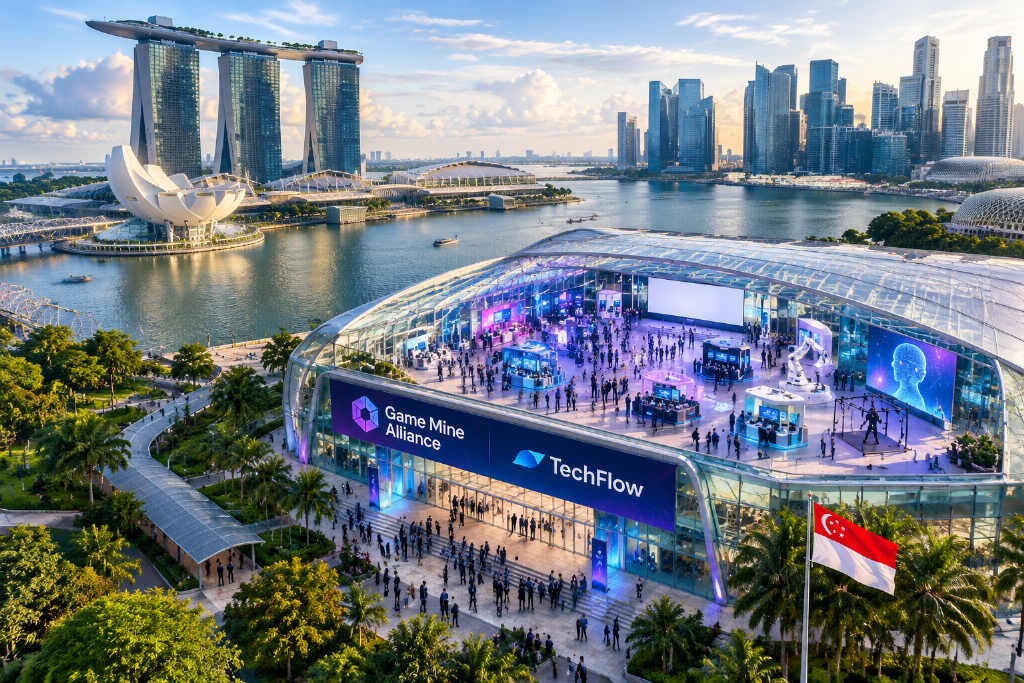
Game Mine Alliance (GMA) and TechFlow held AI & Gaming Nexus in Singapore on Oct. 6, bringing together people working across AI, gaming, Web3, investment, and startups to discuss how AI is changing game production, player experience, and business models. Organizers said the summit drew more than 600 online registrations and was supported by PumpSnake, the9bit, 0G, Waterdrip Capital, IOSG, AZverse, Miuro.AI, Cddjap, Bifire investment, as well as media partners including Foresight News, TechFlow, and PANews.

GMA describes itself as a DAO focused on Web3 gaming and AI. The group said it has continued to work in the gaming ecosystem and build cooperation with game teams and related upstream and downstream projects.
Panels focused on investment logic and project survival
The event featured discussions under two themes: game investment after the bubble fades, and how projects can survive in the AI era. Speakers covered investment logic, product experience, community building, and tokenomic or broader economic design. One view emerged repeatedly: AI is lowering the threshold for game development and content production, but lasting competition in games still comes back to playability, user retention, distribution efficiency, and long-term relationships.
After the hype, investors are looking back at fundamentals
Participants said several earlier market cycles pushed Web3 games higher on the back of strong narratives, token mechanisms, and elevated valuations, yet many projects did not turn those themes into working products or viable commercialization paths. During the discussion, multiple guests said enthusiasm for AI plus gaming cannot replace basic questions: what value a product creates for users, whether users are willing to keep using it, and whether a project can build a sustainable source of revenue.

They also pointed to cost compression as AI's clearest near-term effect. Work that once required teams of dozens may now be handled by much smaller teams using AI tools. That does not mean demand rises at the same pace as supply. Players still have limited time each day, and attention remains scarce.
That shift changes what matters. The key question is moving from whether a team can build a game at all to whether the game is worth playing over time. Gameplay, retention, community, publishing, and distribution capability are becoming more important measures.
AI may become part of the game itself, not just a production tool
In the panel on project survival in the AI era, the discussion moved beyond production efficiency and into player experience and economic relationships inside games.

One idea raised at the event was that future AI NPCs may no longer be limited to fixed scripts. Instead, they could become in-game participants able to interact, cooperate, and even grow alongside players over long periods. Players might train their own AI characters, give them abilities, and let them take part in tasks, competitions, or in-game economic activity. Speakers said that could open a new direction for gameplay.
If that happens, the player's role may also change. Through the combination of AI and Web3, players may take part not only as consumers but also in creation, production, community collaboration, and value distribution. In-game assets, time spent, and community ties could also form longer-term connections.
As content becomes easier to produce, relationships may be the scarce asset
By the end of the event, both panel discussions had converged on a broader question: if AI makes content production easier, what is actually scarce.

The answer put forward in the room was not necessarily more content, but more valuable relationships. For game projects, the moat is no longer just technical capability. It also depends on whether a team can keep players engaged, attract creators to co-create, build trust inside the community, and match its business model to real demand. AI can raise productivity, the speakers said, but it does not automatically create playability, community recognition, or long-term operating strength.
AI & Gaming Nexus said it hopes to keep connecting builders, creators, and investors across AI, gaming, and Web3. Even with technology moving quickly, the industry still has to answer a simple question: how to build products that people genuinely want to play, stay with, and help shape over time.
