

GMO asset allocation heads Ben Inker and John Pease said in their second-quarter 2026 letter that the first real break in the AI bubble may come from rising equity supply rather than disappointing AI fundamentals.

Their argument is blunt: the market is moving from a world in which equity supply shrank by about 1% a year to one in which supply could grow by nearly 5% a year, or more. In their view, that shift alone is large enough to weigh materially on U.S. equity returns over the next 12 to 18 months.
Why GMO thinks supply could puncture the AI trade before earnings do
In the summary of the note, Inker and Pease say AI infrastructure continues to attract enormous amounts of capital, but the trigger for a reversal may not be weak AI revenue. It may be a surge in the supply of financial assets that investors need to absorb.
They describe bubbles as structures that need a continuing flow of fresh capital. As long as prices rise and early investors appear successful, more money arrives. Once supply increases meaningfully, that self-reinforcing process can break.
The authors list three main sources of upcoming supply: the unlock of SpaceX shares, likely initial public offerings from Anthropic and OpenAI, and secondary issuance plus net dilution from hyperscale cloud companies.
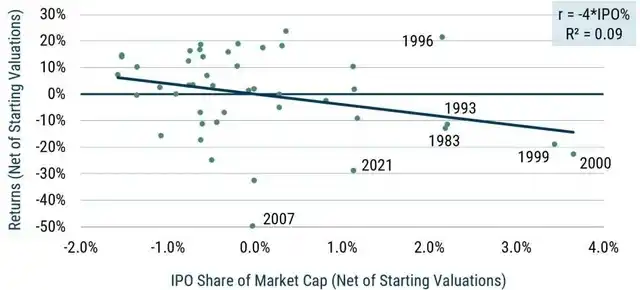
GMO’s historical estimate is central to the case. After controlling for valuation, every 1 percentage point increase in IPO issuance as a share of market capitalization has historically been associated with about a 4% drop in stock prices over the following year. On that basis, the firm argues that supply could push returns lower before any broad and obvious disappointment in AI demand shows up in earnings.
Bubbles often break on supply, and GMO says this one may do the same
Inker and Pease write that investment bubbles are dangerous by nature. They compare them to naturally occurring Ponzi-like structures that must attract ever larger sums of capital to stay alive. The stronger the apparent success, the easier it is to pull in more buyers. When that process reverses, losses can exceed the paper wealth created during the rise.
They also note that avoiding a bubble is risky for professional investors. Exiting too early is often harder to defend than staying too long. That leaves market participants looking not just for stretched valuations, but for a catalyst clear enough to act on.
The authors say they are usually better at identifying bubbles than at calling the exact top. In this AI cycle, though, they believe they can point to a more concrete trigger: supply.
The note splits bubble endings into two broad paths. Some collapse because the underlying physical capacity becomes excessive, as in the British railway boom. Others break because the supply of the financial assets investors are chasing rises sharply. GMO places the 2000 internet bubble in that second camp. Fiber capacity eventually outgrew traffic growth, they write, but the market cracked earlier, and the decline looked more like a response to a wave of internet-related issuance than to a clear deterioration in fundamentals.
That matters because, in GMO’s view, U.S. equities have become more sensitive to supply since 2000. If that is right, the market can come under pressure before AI investment returns are visibly undermined by weak end demand.
SpaceX unlock is presented as a major supply event
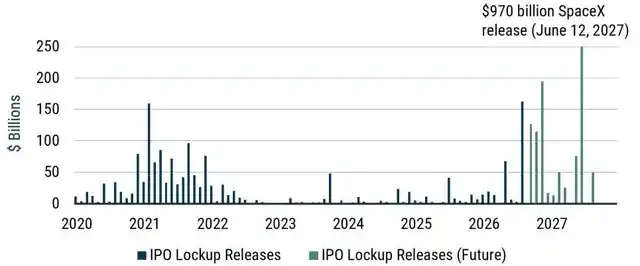
The note says that on June 12, 2027, roughly $2 trillion of SpaceX stock will come out of contractual lockup in the final wave of shares becoming tradable. That would allow individuals and institutions that bought or received shares while the company was still private to sell them to public-market buyers.
GMO says its best guess is that most non-Musk holders will sell. The note points to employees who may need cash to pay mortgages or interest on debt secured by SpaceX shares, foundations dealing with tighter cash conditions in a world of lower distributions, and endowments that also need liquidity and may not want to keep oversized single-stock exposure.
The question is not whether buyers exist. The question is where their money comes from. If investors need to buy SpaceX stock at market prices from existing private holders and do not have large cash balances available, they will likely fund those purchases by selling other liquid assets. Liquid public equities are the obvious candidates.
If former private holders recycle all of that cash back into other liquid stocks, the market effect is limited. In that case, it is largely a swap between SpaceX shares and other equities. But if some of the proceeds go to capital gains taxes, deleveraging, new AI venture investments, or consumption, then the trade is no longer stock-for-stock. Public equity supply rises more than demand, and GMO says the likely result is lower prices.
The firm’s historical framework: 1 point more IPO supply, 4% lower prices a year later
The paper includes a chart showing that, after controlling for valuation, every 1 percentage point rise in IPO issuance as a share of market capitalization has historically lined up with about a 4% decline in stock prices over the next year. The data run through June 30, 2026, and the cited sources are Jay Ritter, Compustat, Worldscope, Bloomberg, MSCI, and GMO.
The note says both IPO issuance and the next year’s S&P 500 return are residualized against the concurrent one-year forward earnings yield, so the slope reflects the IPO coefficient with valuation held constant.
In theory, equity supply should not matter nearly this much. Financial assets are not ordinary goods. A stock should be priced off expected future cash flows discounted for risk, not off whether 100 shares or 1,000 shares change hands in the secondary market. In a world dominated by unconstrained profit maximizers, any mispricing caused by supply and demand should be arbitraged away quickly.
GMO’s point is that the real market does not work like that. Most investors are not unconstrained return maximizers. They are constrained return maximizers.
Passive flows and benchmark limits make supply harder to absorb
The letter gives the example of a U.S. equity fund manager. She may think European stocks or Argentine bonds are cheaper, but the fund prospectus may not allow her to buy them. She may think U.S. equities are expensive overall, yet still be unable to cut exposure meaningfully. Even inside her own mandate, she may have to hold benchmark-heavy names she dislikes because of relative weight constraints, or she may be unable to add risk because of tracking-error limits.
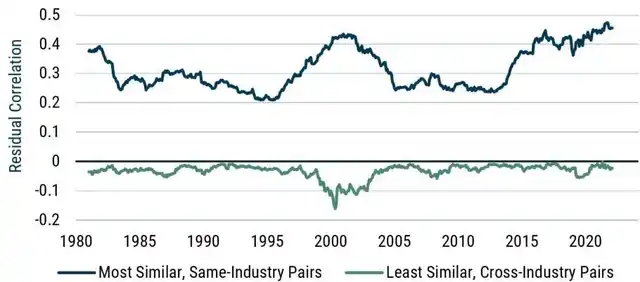
According to GMO, that structure has two consequences. First, markets become more segmented. As managers move away from comparing assets across categories and toward narrower style and sector boxes, fewer investors are willing to trade between securities that look less similar. If your job is growth technology, moving between Microsoft and Exxon becomes much less likely.
The firm says that process raises correlations among similar businesses while pushing correlations between very different industries and styles steadily toward zero. Its chart on average pairwise correlations uses a Russell 3000 proxy and compares the most similar with the least similar stocks based on GMO risk-model features and GICS sectors over the past 36 months of monthly residual returns.
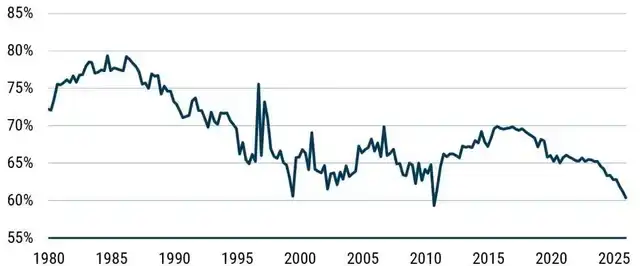
Second, benchmarks matter more than they should. GMO writes that in the 1980s, about $0.80 of every $1 allocated to U.S. active equity mutual funds sat in off-benchmark positions. By 2025, that figure had fallen to about $0.60. Once the rise of passive investing is added, the amount of capital actually searching for mispricing shrinks much more. The note says more than 50% of equity assets now sit in passive products, which by definition do not take off-benchmark positions.
The firm’s shorthand conclusion is that only about $0.30 of every $1 invested in the stock market is being used opportunistically to buy and sell securities. If that is right, new equity supply has a much smaller pool of active counterparties available to absorb it.
The letter also points to academic work on exogenous demand shocks such as index inclusion and forced mutual-fund selling. On average, those studies find that a 1% increase in demand for a stock tends to lift its price by about 1%. For GMO, that is already notable. Stocks should have many substitutes and should be evaluated on the same risk-return standard, so even a moderate medium-term price impact suggests the market is still far from the textbook world of unconstrained arbitrage.
The whole U.S. equity market is exposed because cross-asset flexibility is limited
GMO extends the same logic from single stocks to the broader market. As of May 2026, the note says, active and passive mutual funds plus ETFs held about $30 trillion in assets, and around 83% of that total sat in funds that only trade U.S. equities. Only about 3% of equity-holding funds, excluding target-date funds, are able to move meaningfully between stocks and other asset classes.
That means even if all asset allocators behaved like GMO and shifted exposures materially when opportunity sets changed, they still could not fully arbitrage away price distortions caused by flows.
The end owners of capital are not especially flexible either. The paper says only about 10% of 401(k) and IRA accounts, which make up the bulk of roughly $45 trillion in retirement assets, change their asset mix in a given year. Sovereign wealth funds move slowly as well. The world’s largest sovereign fund, GMO notes, has adjusted its target equity weight only twice in the past 20 years, most recently in 2017 when it lifted that target from 60% to 70%.
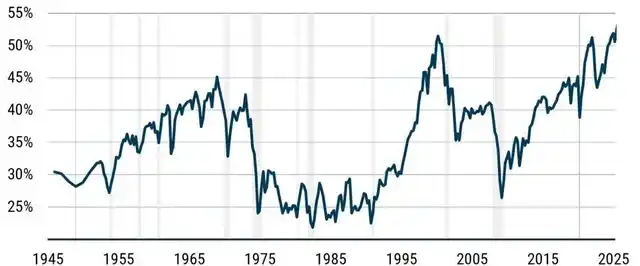
From that, the authors draw a market-level estimate similar to the stock-level one: every 1% increase in equity supply reduces total U.S. stock market capitalization by about 4% over the next 12 months.
They add that U.S. investors already have a record share of liquid assets tied up in public equities. That leaves the market with less room to absorb more supply.
From net shrinkage to net dilution
GMO’s supply-side math is direct. The note says potential selling by SpaceX shareholders other than Elon Musk alone exceeds 1% of total U.S. equity market capitalization.
On top of that, the firm says Anthropic and OpenAI are both likely to pursue IPOs over the next 12 months. Their combined valuation is described as roughly equal to 5% of the investable U.S. stock market.
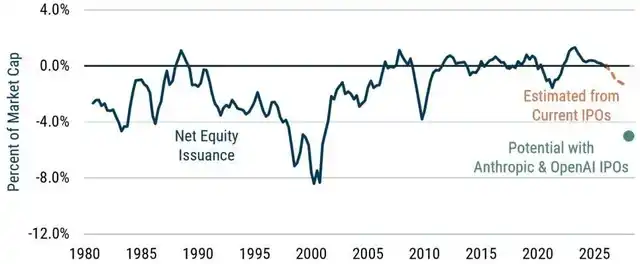
The report also says the U.S. market has entered net dilution for the first time in 20 years, excluding the brief period around the global financial crisis. Issuance is now exceeding buybacks because hyperscale cloud companies are still pushing capital expenditure aggressively.
Put together, GMO says the market is moving from a regime in which buybacks exceeded primary and secondary issuance, producing annual supply shrinkage of about 1%, to one in which supply is rising by close to 5% a year, or more.
Using what the authors call their 4x multiplier, that supply headwind by itself implies returns over the next 12 to 18 months could run about 20% below normal. The note describes normal real returns as roughly 6%.
The paper says that estimate does not yet include today’s very expensive valuations, elevated profit expectations, or macro and geopolitical problems that global markets have so far treated lightly.
Inker and Pease compare the setup with the internet bubble. In their telling, issuance appeared to trigger the first leg of the bear market then, and once prices started falling, high valuations and profit pressure from overinvestment turned a standard correction into something much deeper. Internet favorites did worse still. They say there is nothing to show that the current market cannot follow a similar script.
What GMO says the market should watch
In the conclusion, the authors say greater sensitivity to supply shocks matters well beyond the broad market. Leveraged single-stock ETFs and highly levered AI hedge funds can also create supply-demand dislocations, and the market has already shown how violent that sensitivity can become.
Still, they frame the issue at the market level not as an arbitrage opportunity but as a change in the risk-return tradeoff. In their view, the amount of equity supply already heading toward the market is enough to put meaningful pressure on future returns. If history remains a useful guide, returns over the next year and a half could end up about 20% below normal.
The note stops short of certainty. Demand could rise with supply, and the market could avoid stumbling over the next few quarters. But the authors add one more point: bubbles create positive feedback. If the market absorbs this round of supply calmly, it may only encourage more supply later, until demand can no longer keep up.
At the same time, the capital being raised will likely keep flowing into more AI capacity, eventually pressuring returns on those investments. Given enough time, weak returns may end the bubble anyway. GMO’s argument is that in a market this sensitive to equity supply, prices may turn before the market fully knows why.