
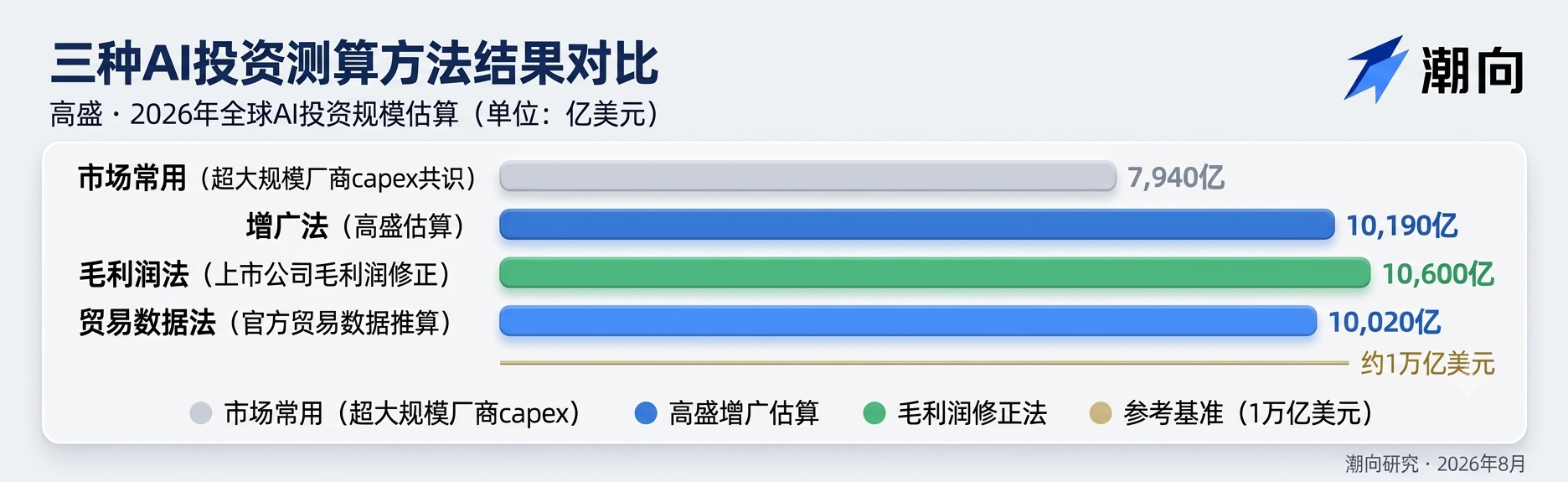
Goldman Sachs said in a global economics report dated Aug. 2 that the market’s most widely cited AI investment yardstick — roughly $800 billion in 2026 hyperscaler capital expenditure — does not capture the full size of spending worldwide. After revising that framework, the bank estimated total global AI investment at about $1.019 trillion in 2026, with roughly $581 billion of that in the United States.

According to the report, the commonly used $800 billion figure understates global AI investment by about $200 billion and overstates U.S. domestic AI investment by about $200 billion. Goldman added that three separate estimation methods pointed to a closely aligned result, with global AI investment approaching the $1 trillion mark.
The bank also projected AI investment as a share of U.S. GDP at 1.8% in 2026, rising to 2.5% in 2027 and 2.8% in 2028.
Why Goldman says the $800 billion benchmark is incomplete
Goldman identified four issues with the market’s standard hyperscaler capex figure. First, it leaves out a large amount of AI investment by privately held U.S. companies, which the bank said play an important role in the broader AI ecosystem. Second, it does not include AI spending by non-U.S. companies, especially in China and the wider Asian region. Third, hyperscalers were already investing more than $150 billion before the AI boom, meaning part of current capex is not directly tied to AI. Fourth, U.S. hyperscalers operate globally, so some of their investment is taking place outside the United States.
To address those issues, Goldman started with hyperscaler spending, then added AI capex from other listed U.S. companies, private U.S. firms and non-U.S. AI-related companies. It stripped out the level of investment already in place in 2022 and kept only the incremental portion. It then allocated the global total across countries and regions using data on the locations of publicly announced hyperscaler projects.
That produced an adjusted estimate of about $1.019 trillion in global AI investment for 2026, including around $581 billion in the U.S. Goldman said about 70% of U.S. hyperscaler capex goes to domestic projects, while 15% goes to Asia and 9% goes to Europe.
Two cross-checks came back with similar numbers
Goldman used two additional methods to test the result.
The first relied on revisions to expected gross profits for listed AI-related companies. The bank said AI investment should ultimately show up in stronger revenue and profit growth for upstream suppliers, which allows investment levels to be inferred by tracking the increase in gross profits relative to 2022. That method yielded an estimate of about $1.06 trillion in global AI investment for 2026.
The second method used official national accounts and trade data. For the U.S., Goldman applied a commodity-flow approach, adding domestic production, net imports and inventory changes to estimate annualized AI hardware investment at about $500 billion through May 2026. It then added about $100 billion in AI-related research, development and intellectual property investment, bringing the U.S. total to roughly $600 billion. At the global level, Goldman used AI-related net import data across countries and linked those flows to known country-level relationships, arriving at an estimate of about $1.002 trillion.

Goldman said the three methods converged on the same broad conclusion: global AI investment is running at about $1 trillion, and U.S. AI investment is close to $600 billion. It also estimated cumulative global AI investment since 2022 would reach about $1.8 trillion by the end of 2026.
AI investment is taking a larger share of GDP
Using consensus forecasts for listed-company capex, Goldman extended its AI investment path into 2027 and 2028. It projected AI investment as a share of U.S. GDP at 1.8% in 2026, 2.5% in 2027 and 2.8% in 2028. For the world economy, the bank forecast AI investment as a share of global GDP at 0.9% in 2026, 1.3% in 2027 and 1.4% in 2028.
Goldman said those levels are in line with the historical range seen during peak infrastructure buildouts tied to general-purpose technologies, which it put at 2% to 5%.
Leading indicators remain elevated, though June and July showed moderation
Goldman said the main macro uncertainty now is when AI investment growth begins to slow. To track that question, it built a set of leading indicators that includes semiconductor manufacturing equipment imports, PMI-related subcomponents, import prices, memory procurement and GPU rental prices. The report said all of those indicators remain near the upper end of their ranges since 2022, pointing to strong near-term growth.
At the same time, Goldman’s nowcast based on economies that publish trade data earlier, including Taiwan and South Korea, suggested AI-related investment eased in June and July, falling back moderately from very high levels. Official U.S. data, the bank said, also show that AI investment is increasingly being driven by cost inflation rather than growth in real investment volumes. In the first half of 2026, about 8% of nominal AI investment growth came from prices rather than an increase in real volumes.
If that pattern continues, Goldman said AI investment may provide less support to real GDP in 2026 than it did in 2025. The report added that the overall effect on U.S. GDP levels remains limited because semiconductor purchases are not counted as investment goods in U.S. national accounts, while the import-heavy content of AI hardware is excluded in GDP accounting.
Report framing and disclosure
In Goldman’s revised framework, global AI investment is larger than the market’s usual $800 billion reference point, while U.S. domestic AI investment is smaller than many investors assume. The report said the market’s framework for thinking about AI investment needs to be reset.
The original article said it was a整理 and interpretation of a third-party brokerage research report from Goldman Sachs dated Aug. 2, 2026, combined with public market information. It also stated that any ratings, target prices, earnings forecasts and related views cited in the text reflected the opinions of the brokerage analysts and their institution, not the view of the publisher, and did not constitute investment advice. The article added that market risks remain and that investment decisions should be made independently.