
Goldman Sachs is staying cautiously constructive on brokerage and crypto-linked stocks for the second half of the year, but the firm’s case does not rest on a confirmed rebound in crypto trading. Instead, it points to two areas with room to improve: a seasonal recovery in traditional brokerage activity and continued growth in prediction markets. A recent rise in crypto asset values adds upside, in Goldman’s view, but does not yet carry the thesis on its own.
According to Goldman’s data, the group of companies it covers has gained 3% on average since the first firm in the sector reported second-quarter results on July 21, outperforming the S&P 500 by about 1 percentage point. Sector earnings for the quarter came in 8% above consensus expectations, revenue was 2% ahead, and expenses were 5% higher.
Valuations also look less stretched than earlier in the cycle. Goldman said the sector is currently trading at roughly 24x forward adjusted P/E and about 14.5x EV/EBITDA, both around the 30th percentile of the past five years. If trading activity improves from September, the bank believes the group could still re-rate.
Summer trading slowed, but Goldman does not call the cycle over
U.S. retail equity trading volumes fell about 15% month over month in July and another 14% in August. With second-quarter equity trading volume and margin balances running about 40% and 100% above their 2021 peaks in absolute terms, investors have started to ask whether the retail trading cycle has already topped.
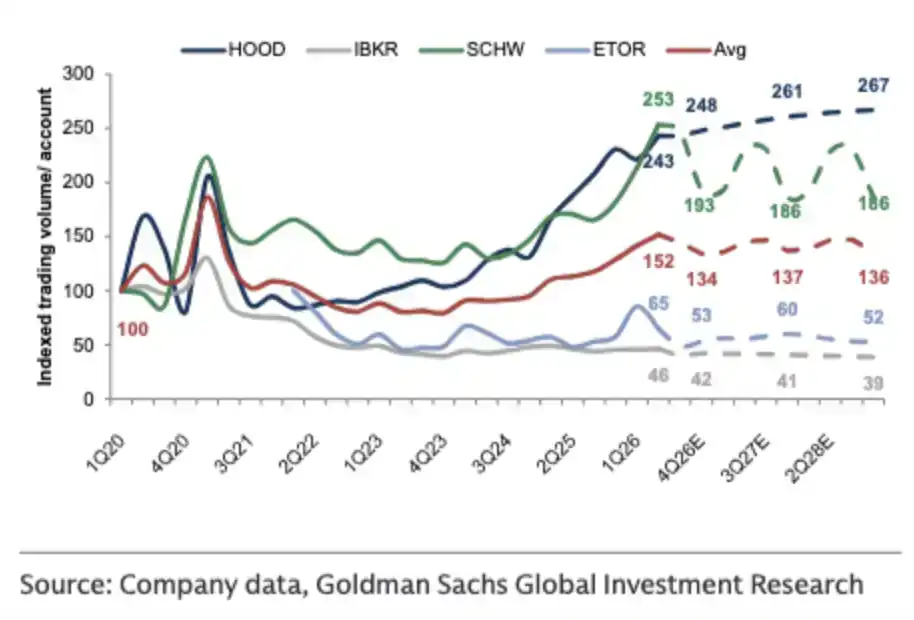
Goldman takes a more measured view. The bank said record headline trading volumes partly reflect the larger scale of brokerage platforms. From 2023 to 2025, major brokers grew account counts at an annual rate of about 13%, while client assets expanded at about 40% a year. After adjusting for account growth, second-quarter 2026 trading volume per account was still about 8% below the 2021 cycle high.
Margin balances show a similar pattern. Absolute balances are well above 2021 levels, but margin as a share of client assets remains below the prior peak. Because margin balances have historically shown a strong relationship with retail stock trading volumes, Goldman said the current cycle may still have room to expand, even if the pace slows.
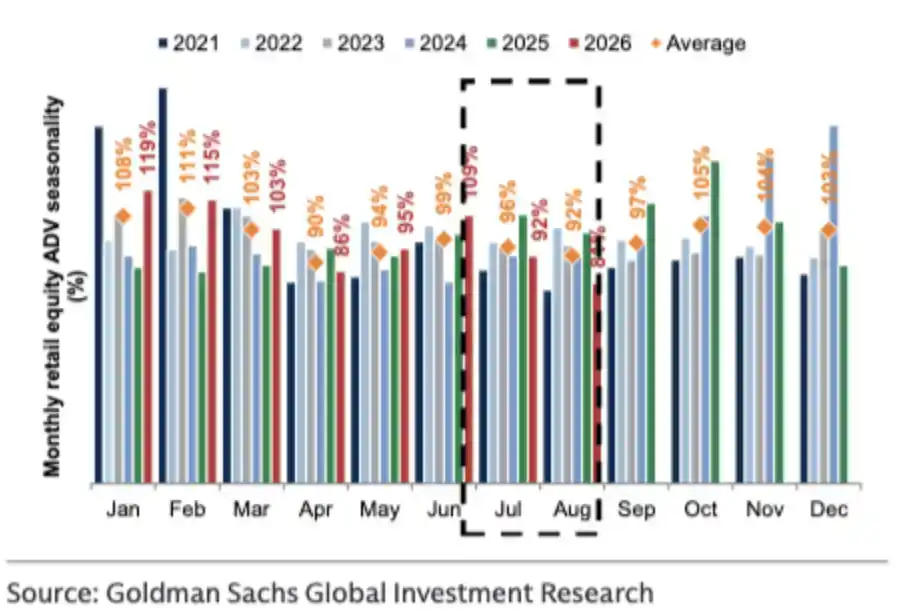
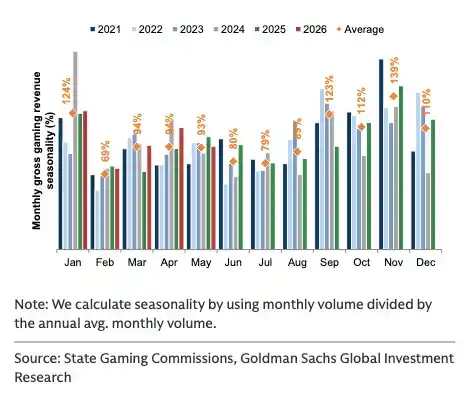
Seasonality matters here. July and August are usually softer months for retail trading, and this year’s drop has been steeper than the historical pattern, though Goldman said some activity may have been pulled forward into June. That month saw heavy equity capital markets activity, lifting retail participation and trading volumes to record levels.
Goldman expects U.S. equity issuance to reach a record $675 billion in 2026, with about $252 billion issued in the second quarter alone. Historically, equity issuance tends to support retail trading with a lag of about one quarter, while also helping securities lending, cash equity trading and IPO subscription activity.
Based on seasonal normalization and issuance activity, Goldman expects third-quarter traditional retail brokerage commissions to rise 28% year over year, while stock and options volumes increase by about 19% on average. That forecast still depends on a pickup in September trading.
Prediction markets are emerging as a larger revenue driver
Goldman said prediction markets offer both structural growth and cyclical recovery potential, with a fall rebound that could be sharper than in traditional brokerage.
From January 2024 to July 2026, annualized prediction-market trading volume rose by about 1,160%. Since August 2025, monthly unique users have increased month over month in every month except April 2026, suggesting the user base is still expanding.
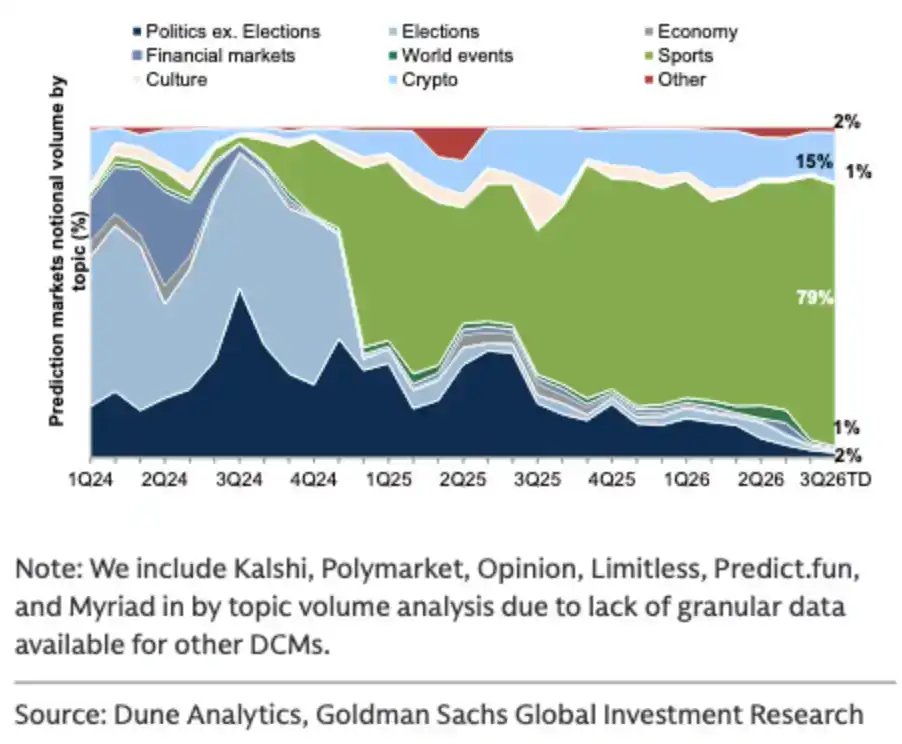
That rapid growth has partly obscured the category’s own seasonality. Goldman’s data show sports, crypto and political contracts account for the vast majority of trading volume. In July 2026, sports contracts made up about 79% of industry volume, crypto contracts about 15%, and political contracts about 2%.
Each of those categories follows a different cycle. Sports trading usually picks up after major U.S. professional leagues resume and tends to be more active from September through January. Political contracts typically gain traction as elections approach. Crypto event contracts depend more on token prices and the broader cycle in crypto market volumes.
Because summer has fewer major sports events and trading around the U.S. midterm election has not yet reached its peak, August prediction-market volume fell about 15% month over month. Goldman attributed that decline mainly to seasonality in the underlying events rather than the end of the category’s structural growth.
From September, the setup changes. U.S. sports schedules return, the midterm election draws closer, and if crypto activity also improves, the three main contract categories could all contribute at once. Goldman added one caution: prediction markets are still an asset class with less than three years of development history, so the stability of any seasonal pattern remains hard to prove.
Crypto market cap has bounced, but volumes have not followed
Goldman is more guarded on crypto trading than on traditional brokerage or prediction markets.
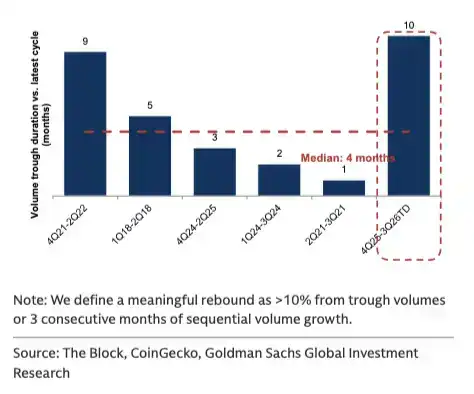
Industry crypto trading volume fell 30% in July and another 21% so far in August. The current downcycle has lasted about 10 months, longer than the roughly four-month median peak-to-trough period seen across the prior five crypto cycles.
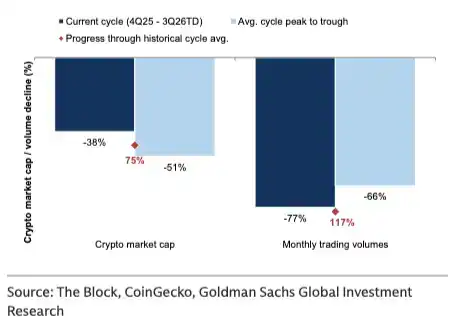
Across the past six crypto cycles, total market capitalization and trading volume declined by averages of about 51% and 66%, according to the report. In the current cycle, those figures stood at about 40% and 75%, respectively, as of the report date. That means the contraction in trading activity has already exceeded the historical average, but Goldman said neither the magnitude of the decline nor its duration is enough on its own to confirm a bottom.
The more constructive signal comes from prices. In the week before the report was published, total crypto market capitalization rose about 21%. Goldman said that if market cap can hold around current levels for an extended period, trading activity could recover as risk appetite improves.
The issue is durability. From April to May this year, total crypto market capitalization also briefly rose by about 5%, then gave back those gains, and trading volumes did not stage a sustained rebound. For that reason, Goldman treats the latest rise in market value as an improvement in the odds of recovery, not as proof that the trend has turned.
The effect also differs across names. Goldman said the median correlation between crypto-linked stock prices and total crypto market capitalization has been about 36% in 2026. More diversified platforms such as Robinhood and Figure have historically shown lower sensitivity to crypto prices, while Coinbase offers more direct operating leverage to a rebound in crypto activity.
Regulatory reform is moving, but legislation still matters most for institutions
Regulation is another variable in Goldman’s framework for whether crypto can move from a cyclical rebound to structural expansion.
The bank said the odds of Congress passing the CLARITY Act, a crypto market structure bill, during the current term are falling. The Senate did not hold a vote before the August recess, and the U.S. midterm election along with the following congressional break has narrowed the legislative window.
At the same time, regulators are still making changes. The U.S. Securities and Exchange Commission has recently proposed a digital-asset “innovation exemption” that would provide temporary relief from certain registration and qualification requirements for eligible digital-asset issuers and securities. The Office of the Comptroller of the Currency, or OCC, has continued approving trust bank charters for digital-asset firms, allowing them to conduct activities such as money transmission and custody.
Goldman said those steps could help expand tokenization, custody and decentralized finance, or DeFi, but also stressed that administrative regulation is less durable than congressional lawmaking. For institutions to adopt digital assets at scale, the market still needs a more stable and clearer legal framework.
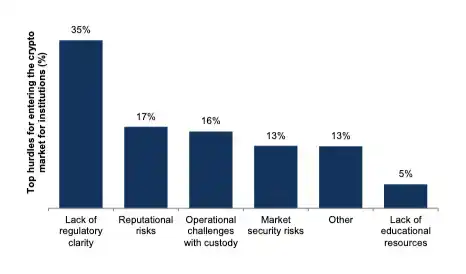
Goldman’s 2025 institutional survey found that 35% of managers cited a lack of regulatory clarity as the biggest barrier to entering crypto, while 32% named regulatory clarity as the top catalyst for institutional adoption. In Goldman’s reading, short-term regulatory adjustments can improve the operating environment, but progress in Congress remains the central indicator for whether institutional capital can enter the market in a systematic way.
Companies are looking beyond crypto trading for revenue
With crypto trading still weak, Goldman said related companies are relying on two main levers to stabilize earnings: cutting costs and building businesses with lower dependence on spot trading volumes.
Goldman estimates that five brokerage and crypto companies have implemented cost actions in 2026, reducing annual expenses by about 4% to 5% on average. That provides about 5.8 percentage points of support to adjusted operating margins. The savings have not fully offset lower revenue expectations, but they have eased part of the earnings pressure created by slower trading activity.
At the stock level, Goldman’s preferred names are FIGR, HOOD and IBKR. COIN is the bank’s higher-beta vehicle for a crypto recovery.
HOOD: diversification and prediction markets
Goldman expects Robinhood’s average revenue per user to grow at a compound annual rate of about 16% from 2025 to 2028, with client assets and revenue rising about 29% and 21%, respectively. The bank sees growth coming from traditional brokerage, prediction markets, digital banking, credit cards and wealth management.
Prediction markets alone are expected to contribute about 13% of HOOD’s 2026 revenue. Goldman said Robinhood’s newly launched Rothera prediction-market exchange captured about 3 percentage points of market share in less than two months after launch, implying annualized revenue of roughly $150 million by the report’s estimates. The category is growing fast, but the platform is new, so the durability of that share remains open.
FIGR: HELOC-led growth
For Figure, Goldman highlighted home equity line of credit, or HELOC, as the main growth engine. So far in the third quarter, trading volume in its consumer lending marketplace has continued to track toward more than 100% year-over-year growth. Goldman said lower blended fee rates reflect product and channel mix changes rather than simple price cuts: larger first-lien HELOCs carry lower rates, and FIGR Connect has lower fees as well, but also lighter capital use and higher margins.
IBKR: global scale reduces crypto sensitivity
Interactive Brokers stands out for its international footprint. In 2026 to date, more than 75% of its monthly active users and about 85% of app downloads have come from markets outside the U.S. Goldman expects IBKR account growth of 33%, 24% and 21% in 2026, 2027 and 2028, respectively, and projects 15% annual revenue growth from 2025 to 2028. Global account growth and pretax margins above 75% leave it relatively less exposed to swings in crypto prices.
COIN: more direct crypto upside
Coinbase offers more direct leverage to a recovery in crypto. Since the first quarter of 2024, the company has increased its share of the crypto derivatives market by about 8 percentage points. Subscription and services businesses such as stablecoins, custody, staking and Prime Brokerage contributed about 40% of 2025 revenue, according to Goldman, making the revenue base less tied to pure crypto trading volumes than before.
Coinbase is also building out products in prediction markets, equities trading, banking and wealth management. Goldman said those businesses are still small in revenue terms, so they are better viewed as upside optionality than as earnings streams that have already materially landed.
What Goldman says needs to be proven next
Goldman’s constructive stance on brokers and crypto-linked equities depends on several conditions that still need to be tested.
- A September rebound in retail stock and options trading would be needed to validate the seasonal recovery case for traditional brokerage.
- A rise in prediction-market volume driven by sports and the U.S. midterm election would help show whether the category is a durable new business line or only a temporary burst of high growth.
- Crypto needs both price support and volume follow-through. Holding total market cap at higher levels is only the first step; spot and derivatives volumes would also need to recover before trading revenue materially improves.
- On regulation, administrative easing may support near-term innovation, but a stable market-structure bill from Congress still sets the ceiling for institutional adoption.
Valuations in the group have already come down, but Goldman’s report draws a sharp distinction inside the sector. FIGR, HOOD and IBKR have business drivers in lending, prediction markets and global account growth that are more independent from a single trading cycle. COIN still offers the greater crypto-cycle sensitivity. In that sense, Goldman is not calling the start of a new crypto bull market. The bank is arguing that brokers and crypto platforms are building more revenue streams that do not depend on one trading cycle alone, and that the next question is whether those businesses can keep supporting growth once fall trading activity returns.