
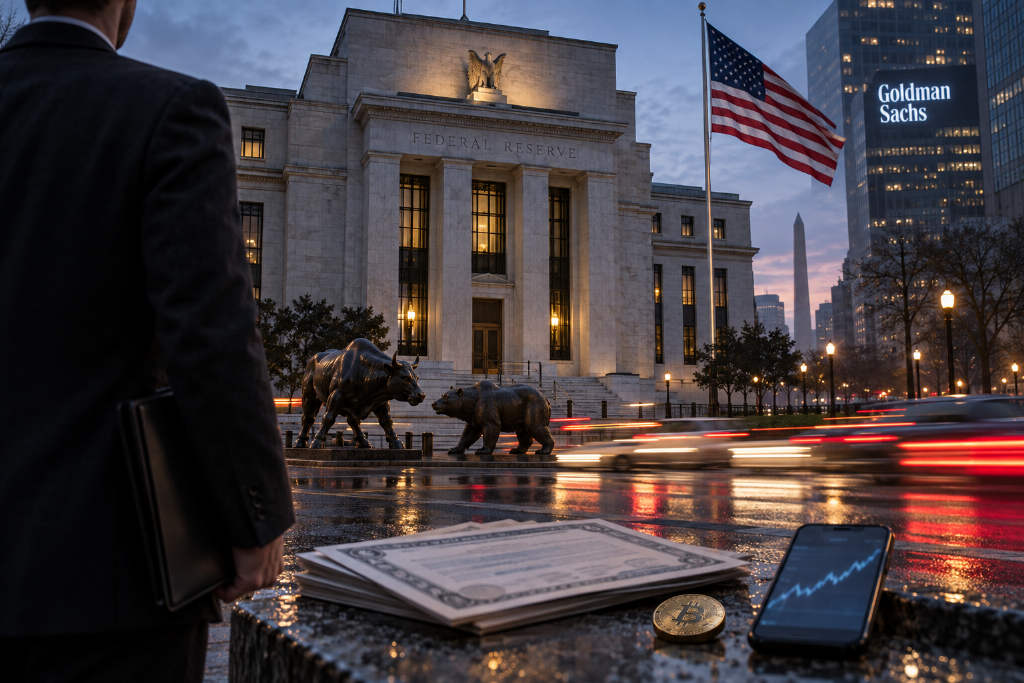
Goldman Sachs has withdrawn its previous forecast that the Federal Reserve would leave rates unchanged and is now expecting a 25-basis-point increase at Wednesday’s Federal Open Market Committee meeting. Market pricing has already moved in that direction, with the probability of a hike nearing 90%.
In its statement, Goldman said that even though the CPI report only nudged its August core PCE forecast to 0.26%, the FOMC may still want to avoid the market reaction that could follow if it stood pat while traders were pricing in a 90% chance of a hike.
From a 50-basis-point cut to a 25-basis-point hike call
The report contrasted the current setup with September 2024, when the Fed began a rate-cutting cycle even though core CPI was still above 3%, delivering a 50-basis-point cut in one move. At the time, the rationale was that the economy was slowing and needed a preventive cut.
By September 2026, core CPI had fallen to a five-year low of 2.4%, yet the market was treating a rate-hike cycle as the Fed’s only viable option. The article framed that reversal bluntly: two years ago, the Fed cut on a preventive basis; two years later, it is being pushed toward hiking because of market pricing.
James Thorne says the hike is about Wall Street, not inflation
James Thorne, chief market strategist at Wellington-Altus, described Goldman’s shift as part of Wall Street’s “kaleidoscope.” In his view, the inflation outlook has not materially changed, and a hike would amount to an effort to calm futures markets.
Thorne argued that rate increases cannot solve the underlying causes of inflation. More oil production, more refining capacity, and repaired supply chains are not interest-rate issues, he said. What hikes can do is reduce demand, investment, employment, and household purchasing power.
He added that wage growth has already slowed to 3.1% year over year, saying there is “no demonstrable wage-price spiral, no proven second-round inflation, and no evidence that energy shocks have become embedded in the economy.” Under that reading, if a Warsh-led Fed is hiking simply to validate a narrative already set by Wall Street futures markets, then Warsh’s earlier criticism of the “kaleidoscope” at Jackson Hole was little more than rhetoric.
Diane Swonk says inflation is hotter than CPI suggests
KPMG chief economist Diane Swonk pushed back. She said the increase in core CPI is concentrated in services, especially “super core services,” which strips out housing. That category rose 0.5% in a single month and is running at 3% on an annual basis, making it the hottest part of the inflation picture.
Using the CPI data, Swonk estimated that the Fed’s preferred inflation gauge, PCE, could rise 0.4% in August, with core PCE up 0.3%. On an annualized basis, she said core PCE could reach 3.4%, far above the Fed’s 2% target.
Swonk said: “We now expect three rate hikes before early 2027. The odds of a unanimous vote this time have increased. That would provide a much-needed boost to the Fed’s anti-inflation credibility, and that is exactly what the bond market is craving.”
What the report says for crypto markets
The article said higher rates usually point to tighter conditions for risk assets. Bitcoin has fallen about 3% over the past 24 hours and at one point came close to $75,000.
If Swonk’s forecast of three hikes before early 2027 proves correct, crypto markets would be dealing with a longer period of liquidity tightening. The report also noted that the 10-year U.S. Treasury yield has moved above 5%, increasing the appeal of dollar-denominated assets and potentially drawing more capital away from global risk assets.
It added that the “safe-haven” narrative around cryptocurrencies faces a tougher test during a hiking cycle, especially if the roots of inflation lie in supply-chain constraints rather than monetary policy.