
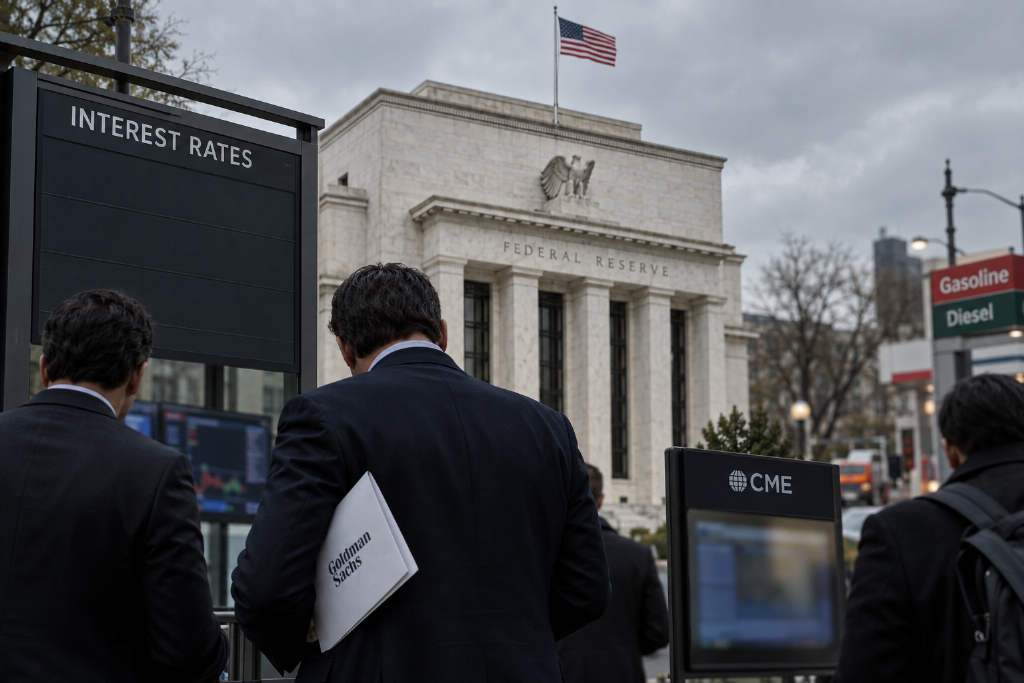
Wall Street’s view of the Federal Reserve’s September meeting is shifting fast. Goldman Sachs on Friday abandoned its earlier forecast for no change in rates and moved to a new call: a 25-basis-point hike this month.
The bank did not tie that shift to a major reassessment of the U.S. economic outlook. Its reasoning was more about market pricing. With investors already leaning heavily toward a hike, Goldman said policymakers may be reluctant to create a surprise by standing pat.
Market pricing drives the change
CME’s FedWatch tool shows markets now see an 87% chance of a 25-basis-point hike in September, up from about 70% before the latest round of U.S. data was released on Friday. Traders are also pricing in the possibility of another increase in December.
Goldman said the recent jump in oil prices could also affect policymakers’ thinking, pushing some officials toward tighter policy.
The shift comes as inflation worries have picked up again. Stronger-than-expected producer price data, together with Brent crude moving back above $100 a barrel, forced investors to take another look at inflation risk.
Over the past week, attacks by Houthi forces on Saudi infrastructure deepened concerns about energy supply. Brent crude then broke above $100 a barrel and climbed to its highest level since May.
On Friday, U.S. diesel prices rose above $6 a gallon for the first time. The continued rise in energy costs has also raised the risk that inflation could spread further into other parts of the economy.
August CPI did not show a clear cooling trend either. Data from the U.S. Bureau of Labor Statistics showed headline CPI inflation at 3.4% year over year in August, unchanged from July.
Warsh’s stance raises the stakes for September
Policy differences between Fed Chair Warsh and U.S. President Donald Trump have made the September meeting especially sensitive.
Speaking at last month’s Jackson Hole symposium, Warsh said price growth had become 「more concerning」 and warned that rate setters would have 「work to do」 if inflation failed to cool quickly.
Earlier official communication had also shown that Warsh said there would need to be meaningful improvement on inflation to justify avoiding a rate hike. The latest data, however, did not provide that kind of clear signal.
Former Federal Reserve Vice Chair Roger Ferguson said that raised the odds of action this week. He told CNBC: 「If Warsh and his colleagues are going to preserve credibility, everything points to September as the time to act.」
JPMorgan’s Michael Feroli made a similar point, saying Warsh had repeatedly sent a hard-line message that he would not tolerate inflation. If the Fed fails to act, Feroli said, it could face an institutional credibility problem.
Goldman’s David Mericle said policymakers also have to think about market reaction. In his view, the Fed may worry about the response if it fails to deliver a hike that recent Fed communication has already led markets to price in almost fully.
Mericle also said Warsh’s Jackson Hole remarks had helped create an expectation in markets that if inflation data were 「not perfect,」 the Fed would hike. 「While CPI is not alarming, it is not perfect,」 he said.
That is one of the main reasons Goldman changed its forecast. Markets already see a hike as a highly likely outcome, and a surprise pause from the Fed could produce a bigger shock.
Trump wants lower rates while markets lean the other way
Trump has long pushed for lower borrowing costs and repeated on Sunday that the U.S. should have 「the lowest interest rates in the world」.
The tension between Trump and Warsh is colliding with the timing of the midterm elections. If the Fed delivers its first rate hike in three years just weeks before the November midterms, it could further anger a president who wants cheaper financing.
Trump has also said Warsh wants to 「do the right thing」 on rates but may be blocked by a 「politicized」 and 「hostile」 Federal Open Market Committee. That suggests Trump may not direct his criticism solely at Warsh if the Fed does end up hiking.
Still, the election calendar makes the decision harder. Analysts have warned that a hike seven weeks before the midterms that will shape congressional control in the second half of Trump’s term could still frustrate the president.
Gregory Daco, chief economist at EY Parthenon, said the Fed should not delay policy action simply to avoid the election.
He said: 「Delaying a rate hike until after the midterms, just like tightening merely for policy credibility, is not and should not be part of the policymaker debate, even though it has become central to the market conversation.」
Daco expects the Fed to hike in the end because a majority of Federal Open Market Committee members already see the pace of disinflation as 「unsatisfactory」.
He also said Warsh may use the stance of the committee majority to reduce the pressure on himself, 「using the majority view as cover, leading from behind and voting in favor of a hike.」
For markets, a September hike is moving closer to consensus. The bigger question now is whether the Fed under Warsh can stick to its own judgment while facing pressure from Trump for lower rates, inflation that remains above target, and a renewed rise in energy prices.