
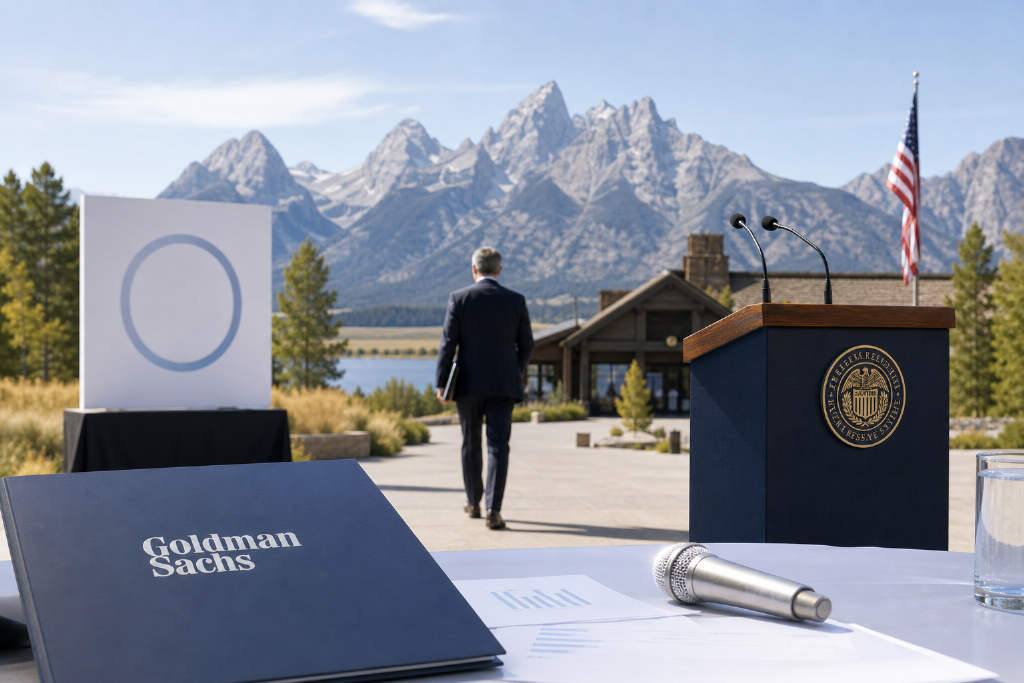
Goldman Sachs said in an Aug. 26 preview report that Federal Reserve Chair Warsh is unlikely to provide clear policy guidance for the September meeting in his Jackson Hole speech, but will probably address inflation, communication strategy and broader macro themes. The bank said Warsh’s relatively dovish lean, together with improving inflation data, points to the Federal Reserve holding rates steady in September and through the end of the year.
The Federal Reserve’s annual Jackson Hole Economic Symposium is scheduled for Aug. 27 to Aug. 29. The event most closely watched by markets is set for Friday at 10 a.m. New York time, when Warsh is due to deliver the keynote address.
Goldman Sachs expects three main themes in Warsh’s remarks
Goldman Sachs said Warsh is expected to cover three core areas in the speech.
The first is the inflation target. According to the report, Warsh will most likely restate the Federal Open Market Committee’s commitment to bringing inflation down to 2%, and may specify that the benchmark is PCE, or personal consumption expenditures, inflation.
The second is Fed communication. Goldman Sachs said Warsh had previously argued that if the Federal Reserve said less, financial markets would react more strongly to incoming economic data, giving policymakers more useful feedback. The bank expects him to elaborate on that idea at Jackson Hole.
The third is a set of macro issues. Goldman Sachs noted that Warsh said at a July press conference that he might discuss “what exactly has happened to productivity? What exactly has happened to demographics? What exactly has happened to the global economy under shock?” The bank expects him to repeat the view that AI could raise productivity growth and serve as a “significant disinflationary force.”
Goldman flags AI and productivity as a key point to watch
Goldman Sachs said Warsh’s view of AI as a disinflationary force deserves close attention. If AI keeps lifting productivity, the report said, it would restrain cost pressures over the medium to long term. In that case, the window for the Fed to leave rates unchanged could last longer than markets currently expect.
Improving inflation data supports a hold
Goldman Sachs said two consecutive months of better inflation data in June and July should strengthen confidence among most Federal Open Market Committee members that rates can stay unchanged. A minority of members who backed a rate increase at the July meeting may stick to that position, but the majority of voting members are likely to lean more clearly toward holding steady after the improved inflation readings.
Between Jackson Hole and the Sept. 16 policy meeting, another round of CPI and PPI data is due. Goldman Sachs expects August core CPI and core PCE inflation to rise about 0.2% month on month.
The report also said a methodology change scheduled for Sept. 30, described as an annual routine statistical adjustment, will lower year-on-year core PCE inflation by at least 0.2 percentage points. A further revision in December would push it down a bit more. Goldman Sachs said three straight months of better inflation data, combined with the coming downward revisions, suggest the biggest effects of tariffs, oil prices and AI demand on monthly inflation have already passed.
On that basis, Goldman Sachs expects the Federal Open Market Committee to leave rates unchanged at the September meeting and through year-end.
Financial innovation theme seen as having limited near-term policy impact
This year’s symposium theme is “Financial Innovation: Implications for Payments and Policy.” Goldman Sachs expects conference papers to touch on topics including stablecoins, but said that discussion is unlikely to have much near-term influence on monetary policy decisions.
Following past practice, some Federal Open Market Committee participants are expected to give television interviews during the conference. Goldman Sachs said the minority that supported a July rate increase may continue to hold that line, while most members are likely to be more confident in keeping rates unchanged after the latest inflation improvement.
Note attached to the original article
The original article said it was a整理与解读 of a third-party broker research report from Goldman Sachs dated Aug. 26, 2026, combined with publicly available market information. It also said any ratings, target prices, earnings forecasts and related judgments cited in the piece reflected the broker analyst’s views only, represented the stance of that institution, and did not constitute investment advice.
The original article also said market decisions should be made independently and that the piece should not be used as a basis for buying or selling any security.
