
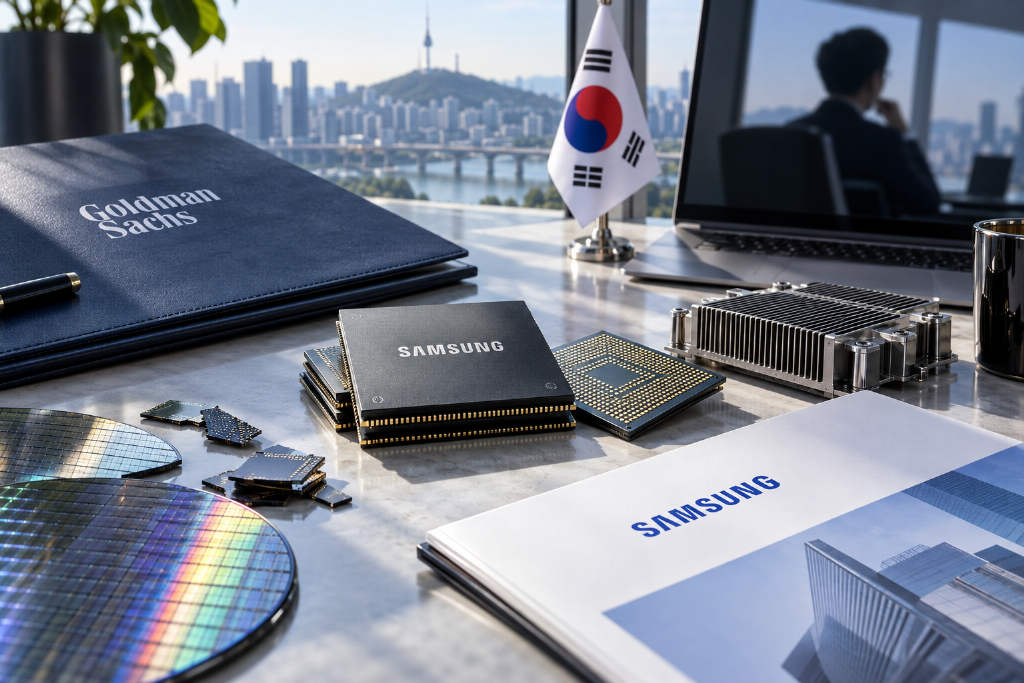
Goldman Sachs said in a Sept. 18, 2026 report that it reiterated its Buy rating on Samsung Electronics after an online meeting with the company’s management and added the stock to its Conviction Buy List. The bank set a KRW 490,000 target price for common shares, implying 94.1% upside from the current share price of KRW 252,500. It set a KRW 360,000 target for preferred shares, implying 86.2% upside.
The report addressed concerns that the memory cycle may be peaking. Samsung management’s view, as cited by Goldman, was that supply-demand conditions in 2027 would be tighter than in 2026. Goldman analyst Giu Lee wrote that management reaffirmed a tight memory backdrop, supported by solid demand momentum, low fulfillment rates, and demand deferrals carrying over from 2026 into 2027.
Samsung says 2027 could be tighter than 2026
Goldman said unmet demand in 2026 is expected to shift into 2027, leaving next year with even tighter supply-demand conditions. Long-term supply agreements also give the company visibility beyond 2027, and management expects favorable conditions to continue after that point.
On manufacturing plans, Samsung’s P4 fab is expected to focus mainly on 1c-nanometer DRAM for HBM4 and HBM4E. The P5 fab is also expected to start with a DRAM-heavy output mix when first wafers are produced in 2028. In NAND, the company plans to concentrate on process migration at its Xi’an plant because fab space in Korea is limited.
Goldman said both DRAM and NAND bit growth face difficulty. Conventional DRAM supply expansion is constrained because incremental capacity is being allocated primarily to HBM. The report said HBM trade ratios are rising with each generation and currently stand at 3-to-4-to-1, while larger die sizes are adding to the capacity squeeze.
Long-term supply agreements improve visibility
According to Goldman, current long-term supply agreements differ from those in earlier cycles in their duration, coverage, and enforceability. The bank said those contracts give Samsung greater financial stability and support more disciplined capital expenditure planning.
Customers are paying sizable prepayments and deposits, with prepayments linked to reserved purchase volumes. Goldman said that structure encourages customers to provide more accurate forecasts.
Samsung still has 30% to 40% of capacity outside long-term agreements. That portion is set aside for mobile, PC, and non-AI customers. Goldman said those segments may have upside tied to physical AI and edge AI. The bank added that wider use of long-term agreements is changing the memory industry’s business model from one driven more heavily by spot price swings to one built around more predictable contract revenue.
HBM is taking more of conventional DRAM capacity
Goldman said HBM’s pull on capacity is structural. HBM chips are larger, consume more wafers, and require higher trade ratios with each generation. As a result, even if Samsung adds DRAM capacity, most of that increase is likely to be absorbed by HBM, leaving only limited growth for conventional DRAM supply.
The report also said 4nm foundry capacity is very tight because of demand for HBM4 base dies, and Samsung is considering adding 4nm capacity in Korea. It is also evaluating a new 2nm production line for HBM5 base dies.
In the United States, Samsung confirmed that equipment installation has started at its Taylor plant. The site is dedicated to orders from U.S. automotive customers, and the company is also considering further U.S. expansion to meet possible future demand.
MX division is prioritizing market share
Samsung said its MX division will continue to prioritize market share in key regions despite short-term operating losses. The company expects financial conditions could worsen before they improve, partly because memory cost pressure is increasing.
On foldable phones, Samsung took a positive view of new entrants, saying they can raise consumer awareness and validate the foldable form factor.
Goldman said the MX strategy amounts to sacrificing near-term profit for longer-term market position. At the same time, Samsung may offset part of the handset margin pressure because it also benefits as a memory supplier when memory prices rise. The bank said that vertical integration becomes more visible as an advantage during an upcycle in memory.
Shareholder returns to be decided at year-end
Samsung said it is evaluating buybacks and dividends, with a final decision expected after year-end results are confirmed. Management also reiterated that cross-holdings by group affiliates would not be the main factor in determining shareholder return policy.
Goldman said clearer guidance on shareholder returns could become a catalyst for the stock.
Valuation framework and downside risks
Goldman said its target prices are based on a sum-of-the-parts EV/EBITDA valuation for 2026 to 2027. The KRW 490,000 target for common shares and KRW 360,000 target for preferred shares include a 27% preferred share discount.
The bank listed downside risks including a severe deterioration in memory supply-demand conditions, stronger HBM competition, and widening losses in the foundry business.
The original article said the piece was a整理 and interpretation by Chaoxiang Research of a third-party brokerage report published by Goldman Sachs on Sept. 18, 2026, combined with public market information. It also said the cited ratings, target prices, earnings forecasts, and related judgments were the views of that brokerage and represented only its institutional position, not the view of Chaoxiang Research, and did not constitute investment advice. The article added that markets carry risk and decisions should be made independently, and that the piece should not be used as a basis for buying or selling any security.