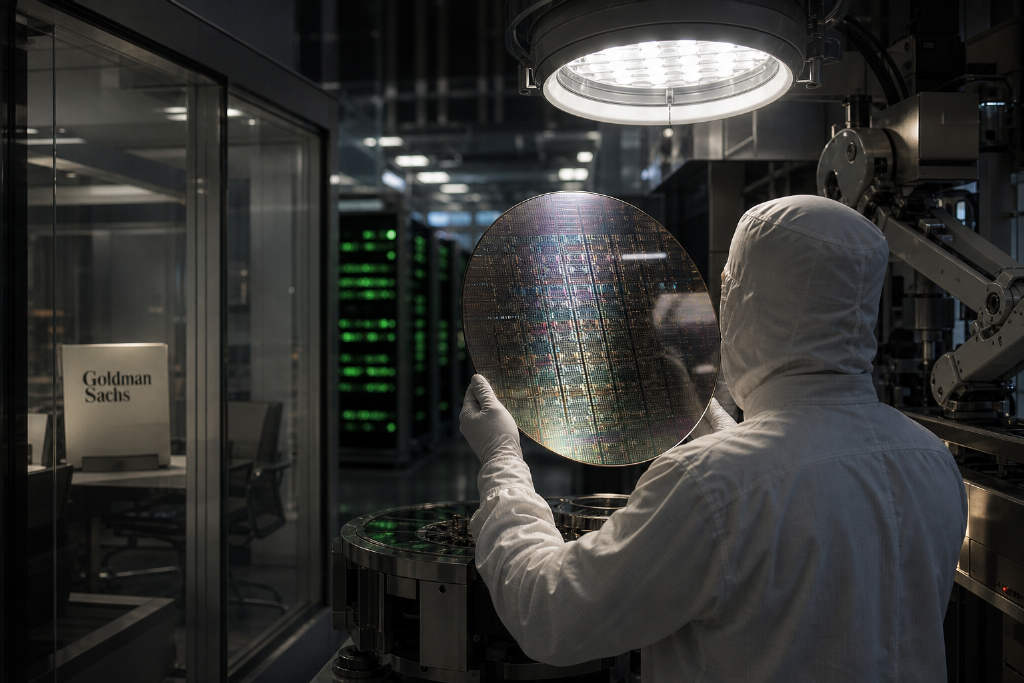
Goldman Sachs has raised its outlook for the semiconductor equipment cycle as Nvidia earnings approach and volatility across the AI supply chain picks up. The bank said AI demand is extending the current wafer fab equipment spending cycle, with global WFE spending expected to keep expanding from 2026 through 2028. Goldman projects global wafer fab equipment spending will reach $150 billion in 2026, rise to $218 billion in 2027, and increase again to $281 billion in 2028, representing year-over-year growth of 36%, 45%, and 29%, respectively. The bank said the main drivers are capacity expansion in DRAM, HBM, and advanced-node foundry production. Its report also said DRAM supply tightness could last through 2028, keeping capital expenditure by memory manufacturers at elevated levels.
Goldman Sachs raised its outlook for the semiconductor equipment cycle as Nvidia earnings near and volatility in the AI supply chain increases, according to a BlockBeats report published on Aug. 25.
The bank said AI demand is extending the current wafer fab equipment spending cycle, with global WFE spending set to continue expanding from 2026 to 2028.
Goldman projects global wafer fab equipment spending at $150 billion in 2026, rising to $218 billion in 2027 and then to $281 billion in 2028. That implies year-over-year growth of 36%, 45%, and 29%, respectively.
The report said the expansion will be driven mainly by capacity additions in DRAM, HBM, and advanced-process foundry production. Goldman also said tight DRAM supply could persist through 2028, keeping capital expenditure by memory makers at high levels.
This article was originally published by Bit.Fan. For more cryptocurrency news and market insights, visit www.bit.fan. Disclaimer:
The market information, project data, and third-party content displayed on this platform are for industry information sharing only and do not constitute any form of investment advice or return commitment.
Cryptocurrency trading carries high risks. Users should fully assess their risk tolerance and make independent decisions. All profits, losses, and legal responsibilities are borne by the users themselves.